
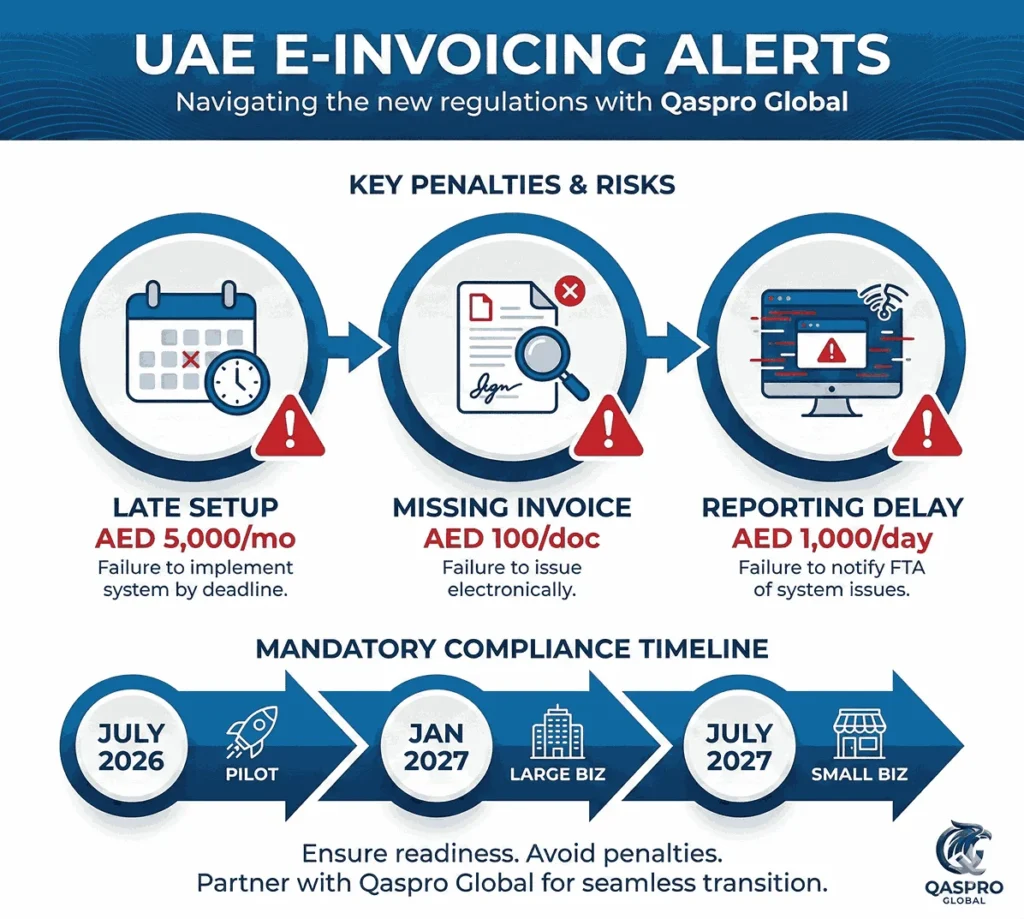
The UAE Ministry of Finance has taken a decisive step in its digital transformation journey by announcing strict new regulations and penalties regarding the upcoming Electronic Invoicing System. With the release of Cabinet Decision No. 106 of 2025, the government has outlined a clear framework for compliance, signaling that the time to prepare is now.
At Qaspro Global, we understand that regulatory changes can be daunting. To help you navigate this shift, we have broken down the critical updates and what they mean for your business.
The New E-Invoicing Penalty Structure
The new Cabinet Decision introduces specific administrative penalties for businesses that fail to comply with the e-invoicing mandate. These fines are designed to enforce timely adoption and ensure transparency across the board.
Key penalties include:
- Failure to Implement the System: If a business fails to implement the Electronic Invoicing System or does not appoint an Accredited Service Provider (ASP) by the deadline, they face a fine of AED 5,000 for every month of delay (or part thereof)
- Failure to Issue E-Invoices: Missing the deadline to issue or transmit an electronic invoice (or credit note) to a recipient will incur a penalty of AED 100 per document, capped at AED 5,000 per month
- Failure to Report System Issues: Both issuers and recipients must notify the Federal Tax Authority (FTA) of any system failures. A delay in reporting results in a fine of AED 1,000 per day
- Data Updates: Failing to notify your Accredited Service Provider of changes to your registered data will also attract a penalty of AED 1,000 per day of delay
These e-invoicing penalties sit alongside the broader UAE tax penalty regime for 2026, which covers corporate tax and VAT violations. Businesses should review both frameworks together to understand their full compliance exposure.
UAE E-Invoicing Implementation Timeline
While the penalties are strict, the government has provided a phased roadmap to help businesses prepare:
- Pilot Phase: Begins July 1, 2026
- Phase 1 (Revenue ≥ AED 50M): Mandatory compliance starts January 1, 2027 (ASP appointment deadline extended to 30 October 2026, from the original 31 July 2026 date)
- Phase 2 (Revenue < AED 50M): Mandatory compliance starts July 1, 2027 (ASP appointment required by March 31, 2027)
For a comprehensive overview of the technical requirements, Peppol framework, ASP selection, and preparation steps, see our full UAE e-invoicing guidelines guide.
Why You Should Act Now
Waiting until the deadline is a risky strategy. The transition to e-invoicing is not just a software update; it is a fundamental change to your financial reporting processes. It requires integrating your ERP systems, appointing an accredited provider, and training your staff to avoid the “per document” and “per day” fines that can accumulate quickly.
Published: 13 February 2026 | Last updated: 1 August 2026
If your current bookkeeping system is still Excel-based or relies on paper invoices, the transition will require more preparation time. Start with a readiness assessment now , the voluntary pilot phase is already live since 1 July 2026.
Frequently Asked Questions
When Does E-Invoicing Become Mandatory in UAE?
E-invoicing becomes mandatory in two phases: January 1, 2027 for businesses with annual revenue of AED 50 million or more, and July 1, 2027 for all remaining businesses. A pilot phase begins on July 1, 2026.
What Is an Accredited Service Provider (ASP)?
An ASP is a technology provider accredited by the FTA to handle the transmission, validation, and storage of electronic invoices. Businesses must appoint an ASP before their compliance deadline , by 30 October 2026 (Phase 1, extended from the original 31 July 2026 date) or March 31, 2027 (Phase 2).
What Is the Penalty for Not Implementing E-Invoicing?
The penalty is AED 5,000 per month (or part thereof) for each month a business fails to implement the e-invoicing system or appoint an ASP after its deadline.
Does E-Invoicing Apply to Free Zone Companies?
Yes. All VAT-registered businesses in the UAE, including free zone companies, must comply with the e-invoicing mandate. The requirement is based on VAT registration status, not business location.
Can I Use My Existing Accounting Software for E-Invoicing?
Your existing software may need updates or integration with an ASP’s platform to meet FTA e-invoicing standards. The system must support the Peppol framework and be capable of transmitting invoices in the required format.
What Is the Maximum Monthly Penalty for Missing E-Invoices?
The penalty for failing to issue or transmit individual electronic invoices is AED 100 per document, capped at AED 5,000 per month. This is separate from the AED 5,000/month penalty for not implementing the system at all.
How Qaspro Global Can Help
As your trusted consultancy partner, Qaspro Global is ready to guide you through every step of this transition. We offer:
- Readiness Assessments: Evaluating your current IT and tax infrastructure
- Vendor Selection: Assisting you in appointing the right Accredited Service Provider (ASP)
- Compliance Strategy: Ensuring your workflows align with the new FTA regulations to avoid penalties
Don’t let these new regulations catch you off guard. Contact Qaspro Global today to future-proof your business and ensure a seamless transition to the new e-invoicing era.
Related Reading
- UAE VAT Registration 2026: Step-by-Step Guide
- UAE VAT Return Filing 2026: Complete Guide
- UAE E-Invoicing Requirements 2026
- UAE Tax Penalty Regime 2026: Complete Guide
- UAE Corporate Tax Penalty Waiver 2026
- UAE Tax Deadlines 2026: Every Date Your Business Must Know
- Why Hire a Tax Consultant Before an FTA Audit
- How to Choose a Tax Consultant in Dubai 2026
- Corporate Tax Registration UAE 2026: Step-by-Step Guide
- Do I Need to Register for VAT in UAE?
- Monthly Bookkeeping Checklist for UAE Businesses
- Accounting Software for UAE Businesses 2026

Founder & CEO, Qaspro Global — UAE tax expert with 16+ years of experience in VAT, corporate tax and FTA audit support.