
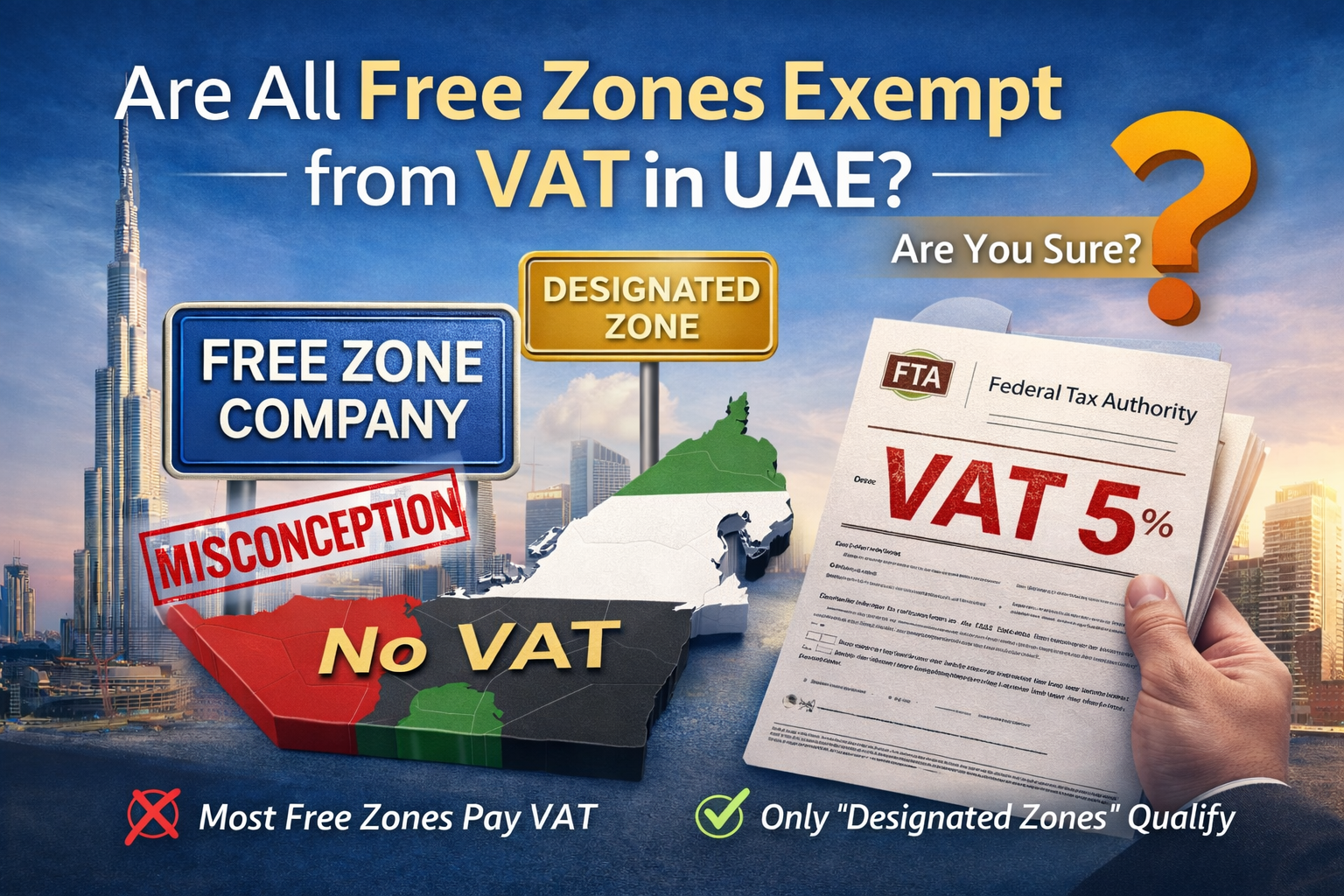
There’s a common myth among business owners in the UAE: “If my company is in a free zone, I don’t have to worry about VAT.”
That’s not accurate. Only certain free zones are treated differently for VAT purposes. Not all free zones are exempt from VAT. The distinction comes down to something called a Designated Zone as defined under the UAE VAT law and the Executive Regulations. For the full official list, see our complete guide to VAT Designated Zones in the UAE.
What the Law Says About Free Zones and VAT
In the UAE, VAT is generally a 5% tax applied to most supplies of goods and services within the UAE territorial scope. This applies to businesses operating anywhere in the UAE, including free zones.
However, the Federal Tax Authority (FTA) and Cabinet have identified specific areas as Designated Zones for VAT purposes. These zones meet strict criteria and are treated as being “outside the UAE” for certain VAT transactions involving goods.
If a free zone is not on the official designated list, it follows the normal UAE VAT rules, just like mainland UAE. That means VAT applies at 5% on most supplies of goods and services.
What Makes a Free Zone a Designated Zone?
A free zone must meet specific requirements under the VAT law and regulations before it can be treated as a Designated Zone under Cabinet Decision No. 59 of 2017. These include:
- Being a clearly defined geographic area
- Having security controls and customs oversight over the movement of people and goods
- Maintaining specific procedures for goods handling within the zone
This special status only applies for certain supplies of goods, and only where those conditions are met.
VAT Treatment for Designated Zones
Goods Transactions
When the conditions are fulfilled:
- Supplies of goods to or from a Designated Zone may be treated as outside the UAE (zero-rated), which means VAT might not be charged on those goods
- Transfers of goods between two Designated Zones can also be out of scope of UAE VAT
Services Transactions
Even if your company is located in a Designated Zone:
- Services are generally treated the same as in the rest of the UAE and are subject to the standard 5% VAT unless the transaction specifically qualifies for zero rating under a different rule
This is one of the key areas where business owners get confused.
Practical Implications for Free Zone Businesses
If your company is in a free zone that is NOT on the designated free zone list, VAT applies just like anywhere else. This includes:
- Charging VAT on taxable supplies at 5%
- Registering for VAT if your revenue exceeds AED 375,000 (mandatory) or AED 187,500 (voluntary)
- Filing periodic VAT returns with the FTA
Only free zones listed as Designated Zones can benefit from the special VAT treatment on certain goods transactions. See the complete list of all 23 Designated Zones to check if your zone qualifies. If you are still choosing between free zones based on cost, our cheapest business setup in Dubai 2026 guide compares license fees across IFZA, Meydan, RAKEZ, and more.
Examples of Designated Zones in UAE
The UAE Cabinet and FTA have officially identified several zones as Designated Zones for VAT purposes:
- Jebel Ali Free Zone (JAFZA) — Dubai
- Dubai Airport Free Zone (DAFZA)
- Khalifa Port Free Trade Zone — Abu Dhabi
- Hamriyah Free Zone — Sharjah
- Ajman Free Zone
- RAK Free Trade Zone
- Fujairah Free Zone
- Dubai Multi Commodities Centre (DMCC)
- Sharjah Airport Free Zone (SAIF)
These zones qualify because they meet the strict criteria and have been listed in official Cabinet decisions.
Why Many Free Zone Businesses Still Need VAT Registration
Even if you are in a Designated Zone:
- You still need to register for VAT if your taxable supplies exceed the mandatory registration threshold of AED 375,000 — see our complete VAT registration guide for the step-by-step process
- You still have ongoing VAT compliance obligations such as filing VAT returns
- Services you provide are still subject to standard 5% VAT
Being in a Designated Zone does not mean you are “VAT exempt” in all situations. It means certain supplies of goods under specific conditions may not attract VAT.
Frequently Asked Questions
Are Free Zone Companies Exempt from VAT in UAE?
No. Free zone companies are not automatically exempt from VAT. Only companies in officially listed Designated Zones receive special VAT treatment, and only for certain goods transactions. Services are still subject to 5% VAT regardless of location.
What Is the Difference Between a Free Zone and a Designated Zone?
A free zone is a special economic area offering business incentives. A Designated Zone is a free zone that additionally meets the FTA’s criteria for special VAT treatment (fenced area, customs controls, goods handling procedures). Not all free zones are Designated Zones.
Do I Need to Register for VAT If I’m in a Designated Zone?
Yes. If your taxable supplies exceed AED 375,000 over a 12-month period, VAT registration is mandatory regardless of whether you are in a Designated Zone. The special VAT treatment affects how certain transactions are taxed, not whether you need to register.
Is DMCC a Designated Zone for VAT?
Yes. Dubai Multi Commodities Centre (DMCC) is listed as a Designated Zone for VAT purposes. Goods transactions within DMCC or between DMCC and other Designated Zones may qualify for special VAT treatment.
Are Services in Designated Zones Subject to VAT?
Yes. Services are subject to the standard 5% VAT regardless of whether the business is in a Designated Zone. The special VAT treatment under Designated Zone rules applies only to goods, not services.
How Qaspro Global Can Help
At Qaspro Global, we help free zone and mainland businesses understand their VAT obligations and avoid costly mistakes. We provide:
- VAT classification review for free zone companies
- VAT registration support whether in designated or non-designated zones
- VAT compliance and return filing
- VAT advisory tailored to your business model
- FTA audit support and response
We don’t assume your company automatically enjoys special VAT status because it’s in a free zone. We review your setup and transactions, and then advise clearly on what applies.
Unsure about your VAT obligations? Contact Qaspro Global for clear, practical guidance on VAT rules that apply to your free zone business.