
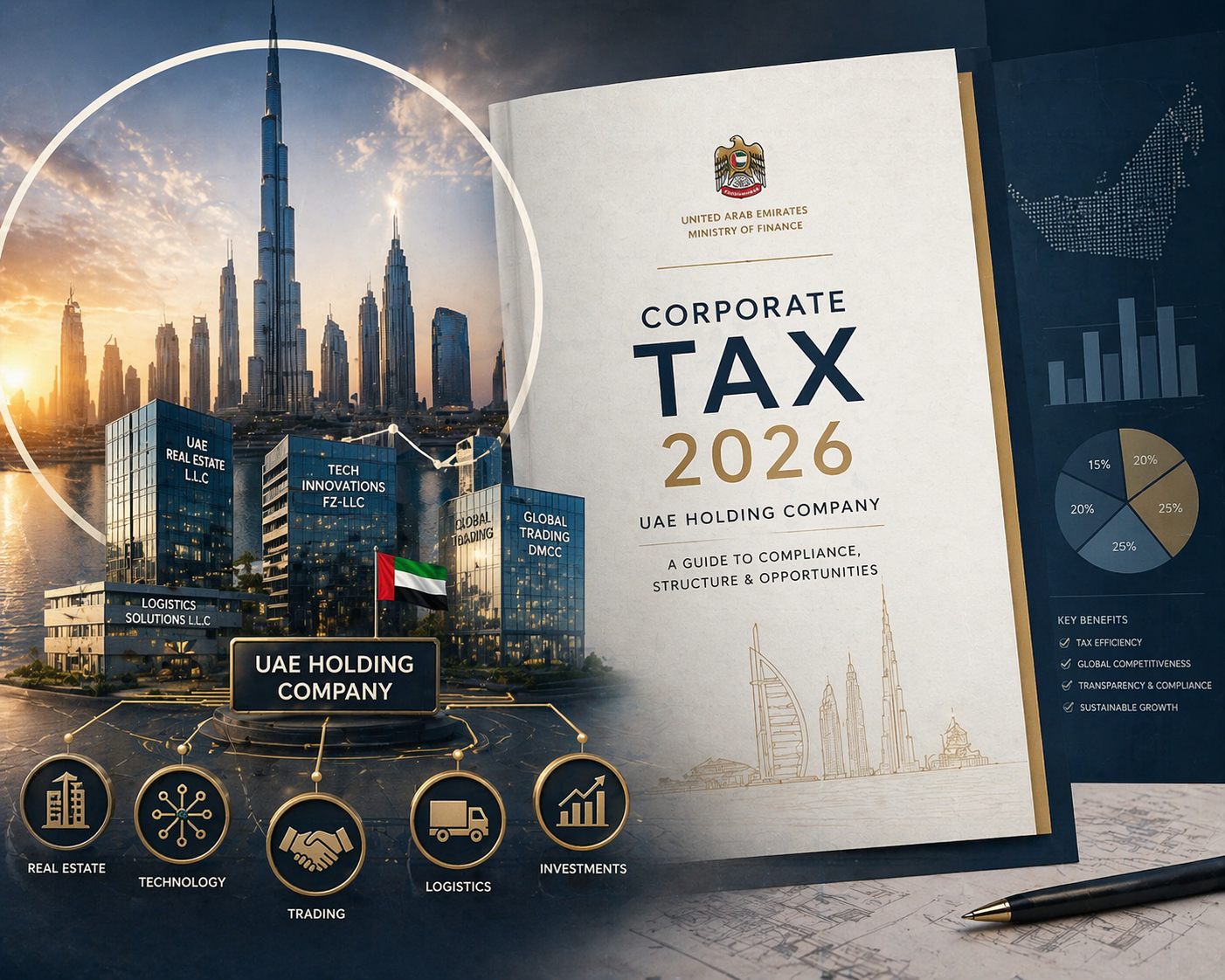
Does a UAE Holding Company Pay Corporate Tax in 2026?
Yes, a UAE holding company is subject to 9% corporate tax on taxable income above AED 375,000 under Federal Decree-Law No. 47 of 2022. However, two legal mechanisms dramatically reduce what a holding company actually pays: the participation exemption (which exempts dividends and capital gains received from subsidiaries) and tax group formation (which lets the parent file one consolidated return for the whole group and offset losses across entities). Most UAE business groups that skip these structures pay far more than they should.
Published: 22 April 2026 | Last updated: 16 August 2026
What Is a UAE Holding Company for Corporate Tax Purposes?
A holding company in the UAE is a juridical person that owns shares in one or more subsidiaries and derives income primarily from dividends, capital gains, management fees, or interest charged to group companies. The Federal Tax Authority does not have a separate “holding company” category under Federal Decree-Law No. 47 of 2022. A holding company is treated as any other UAE-resident taxable person and is subject to the standard 9% corporate tax rate unless it qualifies for specific exemptions or elections.
Common UAE holding company structures include:
- Mainland holding company: a UAE LLC or PJSC incorporated with DED, holding shares in mainland or free zone subsidiaries
- DIFC or ADGM holding company: incorporated in a financial free zone, commonly used for regional group structures and foreign investment
- Free zone holding company: incorporated in JAFZA, DMCC, or similar; may qualify for 0% as a QFZP if holding shares qualifies as a permitted activity
- Offshore holding company: incorporated in Ras Al Khaimah International Corporate Centre or Jebel Ali Offshore, with limited mainland access but simple setup
In this guide, Qaspro Global breaks down the three CT structures that every UAE holding company must evaluate before its first tax return.
How Is Holding Company Income Taxed Under UAE Corporate Tax 2026?
A UAE holding company earns several types of income, and each is treated differently under Federal Decree-Law No. 47 of 2022. Understanding the default tax treatment versus the treatment with available exemptions is the starting point for any CT planning exercise.
| Income Type | Default CT Treatment | With Exemption or Relief |
|---|---|---|
| Dividends from UAE subsidiaries | Exempt (automatic, no conditions) | 0% – Article 23(1) FDL 47/2022 |
| Capital gains on UAE shares | Exempt (automatic, no conditions) | 0% – Article 23(1) FDL 47/2022 |
| Dividends from foreign subsidiaries | 9% on amount above AED 375,000 | 0% with participation exemption (4 conditions) |
| Capital gains on foreign shares | 9% on amount above AED 375,000 | 0% with participation exemption (4 conditions) |
| Management fees from subsidiaries | 9% on amount above AED 375,000 | Eliminated within Tax Group consolidation |
| Interest charged to subsidiaries | 9%, subject to 30% EBITDA cap (Article 30) | Offset by group losses within Tax Group |
| Intra-group asset transfer gains | 9% in year of transfer | Deferred under Qualifying Group Transfer relief |
When foreign dividends are taxable (because the Participation Exemption conditions are not met), the holding company can still claim a Foreign Tax Credit under Article 47 to offset foreign withholding tax paid, capped at 9% of the foreign income.
A UAE holding company whose income is purely domestic (dividends and capital gains) pays virtually zero corporate tax under the automatic exemption in Article 23(1). The planning challenge arises when the group includes foreign subsidiaries, generates management fee income, or wants to restructure assets between entities.
Structure 1: Participation Exemption (Tax-Free Dividends and Capital Gains)
The participation exemption under Article 23 of Federal Decree-Law No. 47 of 2022, implemented by Ministerial Decision No. 116 of 2023, is the most powerful tool for UAE holding companies. It exempts qualifying dividends and capital gains from corporate tax entirely.
Domestic dividends and gains (automatic exemption): All dividends and capital gains received from a UAE-resident person are automatically exempt. No conditions, no election, no minimum ownership percentage. A UAE holding company that owns 1% of a UAE subsidiary receives dividends at 0% CT, automatically.
Foreign dividends and gains (participation exemption): For income from foreign subsidiaries, four conditions under Ministerial Decision No. 302 of 2024 must all be satisfied. MD 302 of 2024 replaced the earlier Ministerial Decision No. 116 of 2023 for tax periods commencing on or after 1 January 2026 (MD 116 of 2023 still governs tax periods that began before that date):
- Ownership threshold: The holding company must own at least 5% of the share capital of the foreign subsidiary. If ownership is below 5%, the acquisition cost of the interest must exceed AED 4 million to qualify as an alternative threshold.
- Holding period: The ownership interest must be held for at least 12 continuous months, or the holding company must have the intention to hold for 12 months at the time dividends are received or the disposal occurs.
- Subject to tax condition: The foreign subsidiary must be subject to corporate income tax or an equivalent tax in its country of residence at a rate of not less than 9%. Subsidiaries in jurisdictions with 0% tax rates do not meet this condition.
- Asset test: No more than 50% of the foreign subsidiary’s assets (directly or indirectly) may consist of ownership interests or entitlements that themselves would not qualify for the participation exemption if held directly by the UAE holding company. Under MD 302 of 2024, this test only has to be checked when the foreign subsidiary is a Related Party of the UAE holding company – if the subsidiary is not a Related Party, the asset test does not apply at all.
Worked example: A UAE mainland holding company owns 100% of a Dubai LLC and 40% of a UK limited company (UK corporation tax rate approximately 25%). In its tax period, it receives:
- AED 3 million dividends from Dubai LLC: AED 0 CT (automatic domestic exemption, Article 23(1))
- AED 1.5 million dividends from UK company (held for 2 years): AED 0 CT (participation exemption applies: 40% ownership exceeds 5%, held over 12 months, UK rate 25% exceeds 9%, asset test not triggered)
Total CT on AED 4.5 million in dividends: AED 0.
Note: The participation exemption specifically covers capital gains from selling shares. When a holding company disposes of a subsidiary, the gain is exempt if all conditions are met. For a complete breakdown of how UAE corporate tax treats capital gains from all asset types, see: UAE Capital Gains Tax 2026: How to Keep Your Rate at 0%.
Structure 2: Tax Group Formation (One Return, Offset Group Losses)
A Tax Group under Articles 40 to 42 of Federal Decree-Law No. 47 of 2022, further governed by Ministerial Decision No. 125 of 2023, treats a parent company and its qualifying subsidiaries as a single taxable person for CT purposes. The parent files one consolidated tax return, pays one tax amount, and losses from any subsidiary automatically reduce the total group profit for the year.
Formation conditions (all must be satisfied):
- The parent company must be a UAE-resident juridical person
- The parent must own, directly or indirectly, at least 95% of the share capital, 95% of voting rights, AND 95% of entitlement to profits and net assets of each subsidiary joining the group
- Neither the parent nor any subsidiary may be an exempt person under Article 4 of FDL 47/2022
- No member of the Tax Group may be a Qualifying Free Zone Person that benefits from the 0% rate (see below)
- All group members must use the same financial year end
- All group members must apply the same accounting standards (IFRS or IFRS for SMEs)
How to apply: The parent company submits a notification to the FTA via EmaraTax. The notification must be signed by the parent and all subsidiaries joining the group. FTA Decision No. 7 of 2025 sets out the audited financial statements requirement for Tax Group members. The Tax Group takes effect from the beginning of the tax period in which the application is approved.
Tax benefit illustrated:
| Scenario | Without Tax Group | With Tax Group |
|---|---|---|
| Holding company profit | AED 500,000 | Consolidated |
| Subsidiary A profit | AED 2,000,000 | Consolidated |
| Subsidiary B loss | AED (1,800,000) | Consolidated |
| Total taxable income | AED 2,500,000 (A+Holding only) | AED 700,000 (net group) |
| CT payable at 9% | AED 191,250 | AED 29,250 |
| Annual CT saving | – | AED 162,000 |
Without a Tax Group, Subsidiary B’s loss of AED 1.8 million is stranded in that entity and cannot offset the profits of other group members in the same year. With a Tax Group, that loss is used immediately, saving AED 162,000 in CT.
For the complete guide on UAE Tax Group formation, covering all 8 Article 40 conditions, the QFZP exclusion, the year-end application deadline, and an AED 20,250 worked example, see: UAE Tax Group Election 2026: File One CT Return for All Companies.
Can a Free Zone Holding Company Join a Tax Group?
A free zone company that qualifies as a Qualifying Free Zone Person (QFZP) and benefits from the 0% CT rate cannot be a member of a UAE Tax Group. This is an absolute restriction under Article 40(3) of FDL No. 47 of 2022. Including a QFZP in a Tax Group would immediately disqualify it from the 0% rate, making all its income taxable at the standard 9% rate. In almost all cases, this destroys rather than creates tax value.
For UAE groups with both mainland and free zone entities, the recommended structure is typically: (See also: e-commerce corporate tax rules for free zone sellers.)
- Keep QFZP-qualifying free zone subsidiaries outside the Tax Group, preserving their 0% rate on qualifying income
- Form the Tax Group among mainland subsidiaries under a mainland holding company
- Use the participation exemption for dividends flowing upward from QFZP subsidiaries to the mainland holding company
A free zone company that does NOT elect QFZP status (or does not meet QFZP conditions) can join the Tax Group and be taxed at the standard rate as part of the consolidated group, which may be beneficial if that entity is running losses.
Structure 3: Qualifying Group Asset Transfer Relief
When a UAE holding company moves assets or liabilities to a related group entity, a taxable gain or loss could arise under normal CT rules. Ministerial Decision No. 132 of 2023 provides relief: if the transfer is a “Qualifying Group Transfer,” any CT gain is deferred to when the asset subsequently leaves the group.
Conditions for Qualifying Group Transfer relief:
- The transferor and transferee must both be members of the same qualifying group: the common parent holds at least 75% (directly or indirectly) in both entities
- The transferred asset or liability must not leave the qualifying group for at least two years after the transfer
- If the asset is sold to a party outside the qualifying group within two years, the deferred gain becomes immediately taxable in the period of the subsequent sale
This relief covers intra-group asset transfers. For restructurings that involve transferring an entire business or merging companies, a separate mechanism applies: Article 27 Business Restructuring Relief, which allows full business transfers at net book value with no gain, even between companies outside the same qualifying group, subject to seven conditions and a 2-year clawback rule.
This relief is essential for holding companies that reorganise their group structure, move subsidiaries between holding entities, or consolidate operating businesses before a sale or investment round. Without it, every intra-group restructuring would trigger a CT charge on any embedded gain.
Common Mistakes UAE Holding Companies Make on Corporate Tax
Qaspro Global’s tax consultants see these errors repeatedly when reviewing holding company CT filings in 2026:
- Not registering with the FTA: Every UAE holding company, even one with entirely exempt income, must register for corporate tax. The penalty for late registration is AED 10,000 under Cabinet Decision No. 75 of 2023. No income does not mean no obligation.
- Treating all foreign dividends as exempt: The automatic exemption only covers UAE-sourced dividends. Foreign dividends require the four participation exemption conditions to be met. Dividends from zero-tax jurisdictions are taxable.
- Including a QFZP in the Tax Group: This disqualifies the QFZP from the 0% rate immediately. Review every entity’s QFZP status before applying for Tax Group formation.
- Missing the 95% threshold: If a minority shareholder holds even 6% of a subsidiary, that subsidiary cannot join the Tax Group. The 95% test applies separately to share capital, voting rights, and profit entitlement. All three must be at 95% or above.
- Unpriced management fees: Management fees charged by the holding company to subsidiaries are taxable income. Under Article 34 of FDL 47/2022 and Ministerial Decision No. 97 of 2023, these fees must be set at arm’s length. Both under-pricing and over-pricing create transfer pricing risk. Where the fee recipient is a director or owner of the holding company rather than a separate entity, the payment may also be subject to the separate AED 500,000 threshold under the Connected Persons rules in Article 36.
- Ignoring the two-year rule on group transfers: Moving an asset intra-group and then selling it outside the group within two years eliminates the deferral benefit and triggers CT on the original gain, plus interest on late payment.
Holding companies with long-term investment portfolios often benefit most from the realisation basis election on unrealised gains.
Holding companies that invest through UAE investment funds or REITs should also review the Cabinet Decision No. 34 of 2025 QIF and REIT rules, which create a separate exemption track for fund-held property income.
Frequently Asked Questions
Does a UAE holding company with zero operating income need to file a corporate tax return?
Yes. Every UAE juridical person that is a taxable person under FDL No. 47 of 2022 must file a corporate tax return, even with zero taxable income. If income consists entirely of exempt domestic dividends, taxable income is AED 0, but the return is still mandatory. Failure to file attracts an AED 10,000 penalty under Cabinet Decision No. 75 of 2023.
What is the minimum ownership to claim participation exemption on foreign dividends?
The minimum is 5% of the share capital, voting rights, or entitlement to profits of the foreign subsidiary. If ownership is below 5%, the acquisition cost of the interest must exceed AED 4 million – this AED 4 million route now also stands in for the 5% test across all three thresholds (ownership, liquidation proceeds, dividend entitlement). A 12-month continuous holding period also applies. These rules are set out in Ministerial Decision No. 302 of 2024, which replaced Ministerial Decision No. 116 of 2023 for tax periods starting on or after 1 January 2026.
Can a UAE holding company offset losses from one subsidiary against profits of another?
Only if a Tax Group has been formally constituted under Articles 40-42 of FDL No. 47 of 2022. Without a Tax Group, each legal entity files separately and losses stay within the entity that generated them. With a Tax Group, the parent consolidates all member income and losses into one return and one payment.
What ownership percentage does the parent need to form a UAE Tax Group?
The parent must hold at least 95% of the share capital, 95% of voting rights, and 95% of entitlement to profits and net assets in each subsidiary admitted to the Tax Group. This is an Article 40 requirement, further detailed in Ministerial Decision No. 125 of 2023.
Are management fees charged by a holding company to its subsidiaries subject to corporate tax?
Yes. Management fees are taxable income for the holding company at 9% above AED 375,000. They are deductible for the paying subsidiary. Within a Tax Group, the fee is eliminated in consolidation and creates no net CT. Outside a Tax Group, transfer pricing rules require fees to be set at arm’s length under Ministerial Decision No. 97 of 2023.
Can a DIFC or ADGM holding company form a UAE Tax Group with mainland subsidiaries?
Yes, provided the DIFC or ADGM entity is treated as a UAE-resident juridical person for CT purposes, meets the 95% ownership conditions, and does not benefit from the QFZP 0% rate. DIFC and ADGM entities are generally considered UAE-resident under FDL No. 47 of 2022 if incorporated in those jurisdictions.
What is the penalty for a holding company that fails to register for UAE corporate tax?
AED 10,000, imposed by the FTA under Cabinet Decision No. 75 of 2023. Registration is mandatory within 3 months of incorporation for most entities. Even a holding company with entirely exempt income must register. The penalty applies per entity, so a group of 5 unregistered companies faces AED 50,000 in total penalties.
Does the participation exemption apply to capital gains when a UAE holding company sells a subsidiary?
Yes. Capital gains on the disposal of shares in a UAE-resident subsidiary are automatically exempt under Article 23(1) of FDL No. 47 of 2022, with no conditions. For gains on disposal of shares in a foreign subsidiary, the four participation exemption conditions (5% ownership, 12-month holding, 9% subject-to-tax, 50% asset test) must all be satisfied under Ministerial Decision No. 116 of 2023. For the full picture of how UAE corporate tax treats capital gains across all asset classes, see: UAE Capital Gains Tax 2026: How to Keep Your Rate at 0%.
Need Expert Help?
Structuring a UAE holding company for maximum CT efficiency requires careful coordination between the participation exemption, Tax Group election, qualifying group transfer relief, QFZP planning, and transfer pricing compliance. Qaspro Global’s tax consultants can review your group structure, identify which subsidiaries should join the Tax Group, assess QFZP eligibility for free zone entities, and ensure your holding company’s CT return is filed correctly and on time. Contact us today for a free consultation.
Related Reading
- UAE Corporate Tax 2026: Don’t Pay 9% on Unrealised Gains
- UAE Offshore Company 2026: 0% Tax but You Still Must Register
- Corporate Tax Deregistration UAE 2026: The 3-Month Rule and AED 10,000 Penalty
- DMCC Company Setup Cost 2026: Real Costs, Hidden Fees and the Step Most Applicants Get Wrong
- UAE Capital Gains Tax 2026: How to Keep Your Rate at 0% (And the Mistake That Triggers 9%)
- Transfer Your UAE Business Tax-Free in 2026: The Article 27 Relief Most Companies Miss
- The Article 23 Rule That Makes UAE Dividends Tax-Free 2026
- UAE Corporate Tax Group Relief 2026: Stop Paying Double
- UAE Corporate Tax Loss Carry Forward 2026: Save Tax by Timing Your Losses Right
- UAE Transfer Pricing 2026: Documentation Rules and Penalties
- UAE Corporate Tax 2026: The AED 500K Connected Persons Trap
- Are Two UAE Government-Owned Companies Related Parties? FTA Says No
Founder & CEO, Qaspro Global — UAE tax expert with 16+ years of experience in VAT, corporate tax and FTA audit support.