

The UAE is taking a major step toward digital transformation of its tax ecosystem. The Ministry of Finance has officially released comprehensive Electronic Invoicing Guidelines, signalling the start of a national rollout that will reshape how every business in the UAE handles invoicing. With the pilot programme launching in July 2026 and mandatory compliance beginning from January 2027, businesses need to start preparing now.
At Qaspro Global, we are closely monitoring these developments and helping businesses across the UAE navigate this transition smoothly.
What Is UAE E-Invoicing and Why Does It Matter?
E-invoicing, or electronic invoicing, replaces traditional paper-based and PDF invoices with structured, machine-readable digital documents. Under the new UAE framework, all invoices must be transmitted in XML or JSON format through Accredited Service Providers (ASPs) — meaning simple PDF invoices will no longer be accepted as valid tax documents for B2B and B2G transactions.
The legal foundation was laid through Federal Decree-Law No. 16 of 2024, which amended the VAT Law to formally recognise electronic invoices as valid tax documents. The detailed implementation rules are set out in Ministerial Decisions No. 243 and 244 of 2025, along with updates to the VAT Executive Regulations.
UAE E-Invoicing Implementation Timeline
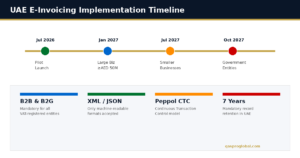
Phase 1 — Pilot Programme (July 2026)
The pilot programme launches on 1 July 2026, involving a selected Taxpayer Working Group under Ministry and FTA supervision. Any business can also voluntarily adopt the system from this date. Businesses participating voluntarily during the pilot stage are exempt from administrative penalties — making this an ideal window to test and refine your systems.
Phase 2 — Large Businesses (January 2027)
Businesses with annual revenue of AED 50 million or more must appoint an Accredited Service Provider by 31 July 2026 and go live on the e-invoicing system by 1 January 2027.
Phase 3 — Smaller Businesses (July 2027)
Businesses with revenue below AED 50 million must appoint their ASP by 31 March 2027 and go live by 1 July 2027.
Phase 4 — Government Entities (October 2027)
Government entities must appoint their ASP by 31 March 2027 and go live by 1 October 2027. B2C transactions are currently excluded from the mandate until further notice.
Who Needs to Comply with UAE E-Invoicing?
The e-invoicing mandate applies to all VAT-registered entities conducting B2B and B2G transactions in the UAE. The requirements extend beyond just taxable persons — all businesses operating in the UAE are expected to comply for in-scope transactions.
Current Exemptions
Certain transactions are currently exempt, including B2C transactions, government transactions conducted in a sovereign capacity, specific airline services, and exempt financial services. However, businesses should monitor FTA announcements as the scope may expand.
Technical Architecture: How the System Works
The UAE has adopted a Peppol-based Continuous Transaction Control (CTC) model. Under this architecture, Accredited Service Providers validate, transmit, and store e-invoices. The process works as follows:
- Supplier issues an invoice through their chosen ASP
- ASP validates it against the UAE e-invoicing schema (PINT AE)
- ASP transmits the validated invoice to the buyer’s ASP
- Tax data is reported to the FTA in real time
Key Technical Requirements
- Only machine-readable formats (XML/JSON) using UBL or PINT standards are valid
- Traditional PDF or paper invoices will not qualify
- The standard data model (PINT AE) defines mandatory and optional fields
- All electronic records must be stored within the UAE for minimum 7 years
- Offshore hosting is prohibited
- System failures must be reported to the FTA within two business days
E-Invoicing Penalties for Non-Compliance
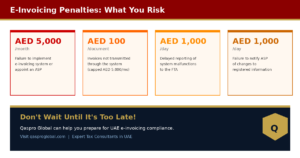
Under Cabinet Decision No. 106 of 2025, the UAE has defined specific financial penalties:
| Violation | Penalty | Frequency |
| Failure to implement e-invoicing or appoint ASP | AED 5,000 | Per month |
| Invoices not transmitted through system | AED 100/document (capped AED 5,000/mo) | Per document |
| Delayed system malfunction reporting | AED 1,000 | Per day |
| Failure to notify ASP of information changes | AED 1,000 | Per day |
How to Prepare Your Business for E-Invoicing
Step 1: Conduct an Impact Assessment
Audit your current invoicing processes, ERP systems, and accounting software. Identify gaps between your current setup and the new requirements. If your bookkeeping system is still Excel-based or paper-heavy, this is the time to upgrade — e-invoicing requires structured digital records that integrate with ASP platforms.
Step 2: Select an Accredited Service Provider
All businesses must work through an FTA-accredited ASP. Begin vendor evaluation early, considering integration capabilities, pricing, support quality, and compliance track record.
Step 3: Upgrade Systems and Clean Data
Ensure your invoicing software supports structured digital formats. Clean and organise your financial data to ensure smooth migration.
Step 4: Train Your Team
Provide training to finance, accounting, and operations teams on the new processes, compliance requirements, and system workflows.
Step 5: Engage Expert Tax Consultants
The complexity of e-invoicing compliance makes professional guidance invaluable. Qaspro Global provides end-to-end support from readiness assessment through to implementation.
Frequently Asked Questions
When Does E-Invoicing Start in UAE?
The pilot programme begins July 1, 2026. Mandatory compliance starts January 1, 2027 for large businesses (revenue ≥ AED 50M) and July 1, 2027 for smaller businesses.
What Format Must E-Invoices Be In?
E-invoices must be in XML or JSON format conforming to the PINT AE standard (based on the Peppol framework). Traditional PDF invoices will no longer be accepted as valid tax documents for B2B/B2G transactions.
Do Small Businesses Need to Comply with E-Invoicing?
Yes. All VAT-registered businesses must comply, regardless of size. Small businesses (revenue below AED 50M) have until July 1, 2027 to go live, but must appoint an ASP by March 31, 2027.
What Is an Accredited Service Provider (ASP)?
An ASP is a technology provider accredited by the FTA to validate, transmit, and store electronic invoices. Every business must appoint an ASP before their compliance deadline. The FTA will publish a list of accredited providers.
Are B2C Transactions Included?
No, not currently. B2C (business-to-consumer) transactions are excluded from the initial e-invoicing mandate. The requirement applies only to B2B and B2G transactions. The FTA may expand the scope in future phases.
Can I Use My Current Accounting Software?
Your existing software may need updates or integration with an ASP’s platform. The system must support the Peppol framework and transmit invoices in machine-readable XML/JSON format. Check with your software provider about e-invoicing readiness.
Why Choose Qaspro Global for E-Invoicing?
Qaspro Global is a leading tax consultancy in the UAE, specialising in VAT advisory, Corporate Tax compliance, and regulatory readiness. Our e-invoicing services include:
- Compliance Readiness Assessment — evaluating your current systems against new requirements
- ASP Selection Support — helping you choose the right provider
- Implementation Guidance — system integration and data migration support
- Ongoing Compliance Management — keeping you compliant as regulations evolve
- Staff Training — preparing your teams for the new workflows
Ready to prepare for UAE e-invoicing? Contact Qaspro Global today for a free consultation on your e-invoicing readiness.