
Published: 17 May 2026 | Last updated: 7 August 2026
What Is UAE Corporate Tax Loss Transfer Under Article 38?
Quick Answer: Article 38 of Federal Decree-Law No. 47 of 2022 allows a UAE company with a tax loss to transfer that loss to a related company that has taxable profit in the same period. Both companies must be linked by at least 75% common ownership, be UAE resident, share the same financial year end, and use the same accounting standards. The profitable company reduces its taxable income by the transferred amount, cutting its 9% corporate tax bill immediately. For businesses also calculating deductible amounts, the UAE corporate tax interest deduction cap (GILDR) may further affect total deductible expenditure.
Most business owners running multiple UAE companies file each company’s corporate tax return separately. If one company earns a profit and pays 9% corporate tax, and another makes a loss that gets carried forward, most assume that is the only option. Article 38 of Federal Decree-Law No. 47 of 2022 says otherwise.
In this guide, Qaspro Global breaks down how Article 38 works, the eight conditions you must meet, how the 75% ownership cap is calculated, and when Article 38 is better than forming a formal Tax Group under Articles 40 to 42.
How Does the Article 38 Tax Loss Transfer Actually Work?
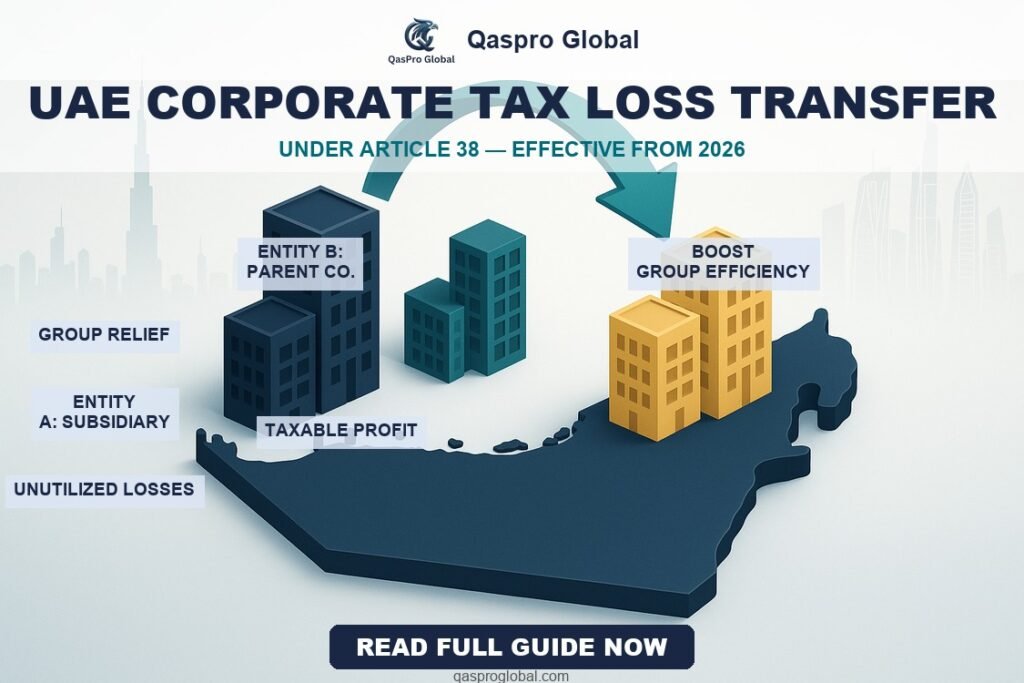
Under Article 38(1), a tax loss from one company can be offset against the taxable income of a different but related company within the same ownership structure. This is different from Article 37, which covers carrying losses forward within the same company into future tax periods.
Here is a straightforward example with AED figures:
- Parent Co earns AED 500,000 taxable profit in the 2025 tax period. Corporate tax at 9% = AED 45,000.
- Subsidiary Co makes a AED 200,000 tax loss in the same 2025 tax period.
- Parent Co applies for an Article 38 transfer and receives AED 200,000 of Subsidiary Co’s tax loss.
- Parent Co’s revised taxable income: AED 500,000 – AED 200,000 = AED 300,000.
- Parent Co’s CT bill: AED 300,000 x 9% = AED 27,000. Group saving: AED 18,000 in one year.
- Subsidiary Co permanently reduces its available tax losses by AED 200,000.
Both companies still file separate CT returns on EmaraTax. The transfer is reflected as a deduction in Parent Co’s return and a reduction in available losses in Subsidiary Co’s return. No formal Tax Group registration is required. For the full depreciation framework, see our UAE corporate tax depreciation guide.
When structuring group transfers under Article 38, keep in mind that payments between group companies and their owners or directors remain subject to the separate connected persons rules under Article 36. For a full explanation of how those limits interact with group planning, see: UAE Corporate Tax 2026: The AED 500K Connected Persons Trap.
What Are the 8 Conditions You Must Meet Under Article 38(1)?
All eight conditions must be satisfied simultaneously. Failing even one condition means the transfer cannot proceed for that tax period.
| # | Condition | What It Means in Practice |
|---|---|---|
| a | Both are juridical persons | Both companies must be incorporated legal entities: LLC, FZCO, PJSC, FZE, or similar. Sole establishments and natural persons cannot use Article 38. |
| b | Both are UAE Resident Persons | Both must be resident in the UAE for corporate tax purposes. Foreign entities without UAE residency status cannot participate. |
| c | 75% ownership link | One company owns at least 75% of the other (directly or indirectly), OR a third party owns at least 75% of both companies. |
| d | Ownership maintained throughout | The 75% link must exist continuously from the start of the tax period when the loss arose to the end of the period when the other company offsets it. |
| e | Neither is an Exempt Person | Government entities, qualifying public benefit entities, and CT-exempt investment funds cannot participate as either transferor or transferee. |
| f | Neither is a QFZP | Qualifying Free Zone Persons paying 0% on qualifying income are excluded from Article 38 on both sides of the transfer. |
| g | Same financial year end date | Both companies must use the same 12-month financial year end. A company with a 31 December year end and a company with a 30 June year end cannot transfer losses under Article 38. |
| h | Same accounting standards | Both must apply the same accounting basis: full IFRS, IFRS for SMEs, or Cash Basis under Ministerial Decision No. 114 of 2023. Mixed standards disqualify the transfer. |
What Is the Maximum Loss That Can Be Transferred?
Article 38(2)(b) cross-references the 75% cap in Article 37(2). The total loss offset at the receiving company cannot exceed 75% of that company’s taxable income for the period before any loss relief is applied.
Extending the earlier example:
- Parent Co taxable income (before loss relief): AED 500,000
- Maximum Article 38 offset: 75% x AED 500,000 = AED 375,000
- Subsidiary Co loss available to transfer: AED 200,000
- Since AED 200,000 is below the AED 375,000 cap, the full AED 200,000 can be transferred.
- Parent Co’s CT falls from AED 45,000 to AED 27,000. Saving: AED 18,000.
If Parent Co also held its own carry-forward losses from a prior period, those must be applied first under Article 37(4) before any Article 38 transfer can be counted. Article 38 is applied after carry-forward losses, not before them.
Article 38 vs Article 37 vs Tax Group: Which Route Should You Use?
There are three mechanisms for managing losses across a UAE corporate group. Each has different ownership thresholds, complexity levels, and outcomes.
| Feature | Article 37 (Carry Forward) | Article 38 (Loss Transfer) | Articles 40-42 (Tax Group) |
|---|---|---|---|
| What it does | Same company carries its own loss into future periods | Company A transfers its current-period loss to Company B | All group companies file one consolidated return |
| Ownership threshold | 50% continuity rule (same company, no transfer) | 75% direct or indirect link between the two companies | 95% between parent and each subsidiary |
| Timing of relief | Future tax periods only | Same tax period as the loss | Same tax period (consolidated) |
| Separate CT returns | Yes | Yes | No (single consolidated return) |
| QFZP companies | Available for QFZP’s own non-qualifying income | Not available (excluded by Article 38(1)(f)) | Not available (excluded by Article 40(1)(f)) |
| FTA registration required | No | No (reflected in returns) | Yes (Tax Group must be registered with FTA) |
| Complexity | Low | Medium | High (consolidated statements, FTA Decision 7/2025) |
| Best suited for | Single company with temporary losses | Groups with 75-94% ownership wanting immediate loss use without formal consolidation | Large groups with 95%+ ownership wanting full P&L consolidation |
The practical decision rule: If your group has 75% to 94% common ownership, Article 38 is often the most practical option. It provides immediate loss relief in the current period without the administrative overhead of Tax Group registration. If you already have 95% ownership, forming a Tax Group may give broader consolidation benefits, but Article 38 is available immediately without any FTA registration process.
Does QFZP Status Block Article 38 Loss Transfers?
Yes. Article 38(1)(f) explicitly excludes Qualifying Free Zone Persons from both sides of the transfer. A QFZP cannot transfer its tax loss to a related company, and it cannot receive a loss transfer from one either.
This exclusion applies to the QFZP as a whole entity. If the free zone company fails its QFZP conditions and becomes taxable at 9% on all income, it then becomes eligible for Article 38 in that tax period, since it would no longer hold QFZP status.
Regular free zone companies that do not hold QFZP status and pay 9% on their profits can use Article 38, provided all other conditions are met.
What Happens to the Loss-Making Company After the Transfer?
Under Article 38(2)(c), the company transferring its loss must permanently reduce its own available tax losses by the exact amount transferred. It cannot carry that same amount forward under Article 37 in future periods. The loss is consumed once, either via carry-forward in the same company or via transfer to a related company in the current period.
This makes the Article 38 decision a permanent one for that amount of loss. If the loss-making company is expected to become profitable quickly, it may prefer to keep its losses for Article 37 carry-forward. If the group has a consistently profitable parent, Article 38 may deliver faster overall tax savings. Qaspro Global recommends projecting both scenarios across at least two tax periods before deciding.
How Do You Record an Article 38 Transfer in the CT Return?
There is no separate FTA application for Article 38. The transfer is reflected directly in both companies’ EmaraTax CT returns:
- The loss-making company files its CT return showing the tax loss for the period and records the amount transferred out under Article 38.
- The profitable company’s CT return includes the Article 38 received loss as a deduction against its taxable income.
- Both companies must keep documentation: shareholder registers, trade licenses, MOA amendments, financial statements, and records confirming continuous 75% ownership throughout the tax period.
- If using the same accounting standards is a condition, both companies’ audited or reviewed financial statements should confirm the accounting basis applied.
- The filing deadline for calendar-year 2025 businesses is 30 September 2026 under Article 51 of Federal Decree-Law No. 47 of 2022.
The FTA can audit both companies’ CT returns and request the underlying documentation at any point within the assessment period. Clear documentation of the ownership structure throughout the relevant tax period is essential.
Frequently Asked Questions
Does Article 38 require both companies to be in the same emirate?
No. Article 38 of Federal Decree-Law No. 47 of 2022 has no emirate restriction. A Dubai mainland company and an Abu Dhabi company owned by the same 75% parent can transfer losses between them, provided all eight conditions in Article 38(1) are met.
Can a free zone company transfer a loss to a mainland company under Article 38?
Only if the free zone company does not hold QFZP status. If the free zone company is a Qualifying Free Zone Person on 0% qualifying income, it is excluded by Article 38(1)(f). If it is a regular free zone company paying 9% corporate tax on its profits, it can participate provided all other conditions are satisfied.
What if the 75% ownership runs through an indirect chain?
Indirect ownership counts under Article 38(1)(c), but the chain must produce at least 75% effective ownership. If Company A owns 80% of Company B, which owns 90% of Company C, the indirect ownership of A in C is 72% (80% x 90%). This is below 75%, so A and C cannot use Article 38. Direct or indirect ownership of at least 75% must be traceable at each level.
Can only part of the loss be transferred, or must it all go?
Article 38(1) states “a Tax Loss or a portion thereof may be offset.” The transferring company can choose to transfer only the portion that is useful to the receiving company, given the 75% taxable income cap. Any remaining portion stays with the transferring company to carry forward under Article 37 in future periods.
What if the 75% ownership falls below threshold after the transfer is agreed?
Article 38(1)(d) requires continuous 75% ownership from the start of the loss period to the end of the period in which the offset is applied. A break in ownership during that window means the transfer condition was not continuously met. The FTA could disallow the deduction on audit. Ownership continuity documentation is critical.
Can a profitable subsidiary receive a loss from its parent company?
Yes. Article 38(1)(c) says “either Taxable Person” can hold the 75% interest in the other. A parent can transfer its own loss to a profitable subsidiary, or a subsidiary can transfer its loss to the profitable parent. The transfer moves in whichever direction generates the actual tax saving.
Can Article 38 be used for the first CT return filed for financial year 2023?
Yes, provided the loss arose after the corporate tax commencement date for that company. For most UAE businesses incorporated before 1 June 2023, the first CT period started on 1 June 2023. Losses incurred before the CT start date cannot be used under either Article 37 or Article 38, per Article 37(3)(a).
Does a Small Business Relief election affect the Article 38 calculation?
Yes. A company that elects Small Business Relief treats its taxable income as zero for that period under Ministerial Decision No. 73 of 2023. With zero taxable income, there is nothing for an Article 38 transferred loss to offset, making the company an ineffective receiving party. Article 38 transfers to SBR-elected companies are pointless for that period.
Need Expert Help?
Qaspro Global’s corporate tax consultants help UAE business groups identify Article 38 opportunities, run the AED projections, and prepare the correct documentation for both companies’ CT returns. With the 30 September 2026 CT filing deadline approaching for calendar-year businesses, now is the time to review whether your group structure qualifies. Contact us today for a free consultation.
Related Reading
- UAE 15% Minimum Tax 2026: Who Pays the New DMTT
- Corporate Tax Deregistration UAE 2026: The 3-Month Rule and AED 10,000 Penalty
- UAE Corporate Tax Bad Debt 2026: The Write-Off Rule 90% of Businesses Get Wrong
- UAE Corporate Tax Loss Carry Forward 2026: Article 37 Explained
- UAE Tax Group 2026: File One CT Return and Offset Losses Across All Companies
- UAE Corporate Tax Group Relief 2026: Stop Paying Double
- UAE Corporate Tax 2026: The AED 500K Connected Persons Trap
- UAE QFZP 2026: Fail This One Test and Pay 9% for 5 Years
- How to File UAE Corporate Tax Return on EmaraTax 2026
- UAE Corporate Tax Penalties 2026: Every FTA Fine Explained
- Paying Tax Twice? Article 47 Foreign Tax Credit 2026
- UAE Corporate Tax Depreciation 2026: The 4% Rule Most Property Owners Miss

Founder & CEO, Qaspro Global — UAE tax expert with 16+ years of experience in VAT, corporate tax and FTA audit support.