Quick answer: For private-sector employees, the UAE Government states that unused annual leave on leaving employment is paid based on the employee’s basic salary. Carry-forward and cash compensation also depend on the Labour Law, its regulations and the employer’s applicable policy. Read the official UAE annual leave guidance before relying on any calculation.
Last updated: 23 August 2026
What Is Annual Leave Encashment in the UAE and When Does It Apply?
Annual leave encashment in the UAE is the cash payment an employee receives in lieu of unused annual leave days, either on termination or, in limited circumstances, during employment. Under Article 29 of Federal Decree-Law No. 33 of 2021 and Article 19 of Cabinet Resolution No. 1 of 2022, the encashment calculation is based on basic salary only, not the total salary package. This is the single most common mistake UAE employers make, and it is the leading cause of MOHRE labour disputes in final settlements.
In this guide, Qaspro Global, a UAE-based payroll and HR compliance consultancy, explains exactly when leave encashment applies, how to calculate it correctly with worked AED examples, and the five mistakes that expose employers to MOHRE complaints in 2026.
Quick Answer: UAE Annual Leave Encashment Formula 2026
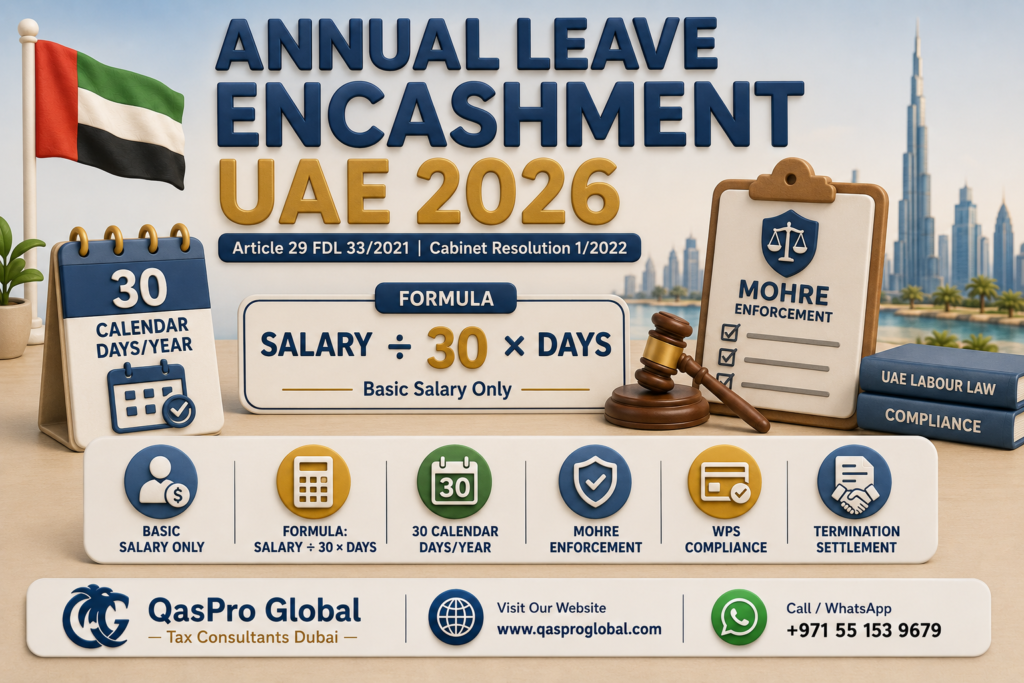
Encashment = (Basic monthly salary ÷ 30) × Number of unused leave days. Use basic salary only. Do not include housing allowance, transport allowance, or any other variable component. This formula applies to both termination settlements and any mid-employment cash payments agreed with the employer under Article 29 of Federal Decree-Law No. 33 of 2021.
Leave Encashment Calculator (UAE 2026)
Enter your basic monthly salary and unused leave days to get an instant estimate, using the same basic-salary-only formula required under Article 19 of Cabinet Resolution No. 1 of 2022. This is an estimate for guidance only; confirm the exact figure against your employment contract and final settlement documents.
What Is the Legal Basis for Annual Leave Encashment in UAE?
Annual leave rights in the UAE private sector are governed by Federal Decree-Law No. 33 of 2021 on the Regulation of Labour Relations, with implementing rules set in Cabinet Resolution No. 1 of 2022. The key provisions are:
- Article 29, FDL No. 33/2021: Sets annual leave entitlement at 30 calendar days per year after 12 months of continuous service, and 2 days per month for employees who have completed 6 months but not yet 1 year.
- Article 19, Cabinet Resolution No. 1/2022: Specifies that leave salary for encashment purposes is calculated at basic salary only, covering all accrued days including fractions of a day.
- Article 29(7), FDL No. 33/2021: An employer may, with the employee's written agreement, grant a cash equivalent for carried-forward leave days, but only for the portion that can legally be carried over (up to half the annual entitlement).
These rules apply to all private-sector employees working under mainland UAE companies and most free zones. The exceptions are the DIFC (Dubai International Financial Centre) and ADGM (Abu Dhabi Global Market), which have separate employment legislation.
When Can Annual Leave Be Encashed in UAE?
Scenario 1: Upon Termination (Mandatory)
When an employment relationship ends, whether by resignation, employer termination, or contract expiry, the employer must pay the employee for all accrued but unused annual leave days. This is a statutory right under Article 29 that cannot be waived. Courts have ruled that employees can still claim unpaid leave even after signing a general "full and final settlement" form, if the leave balance was not specifically stated and confirmed in writing.
Scenario 2: Mid-Employment by Agreement (Not a Right)
During active employment, an employee cannot unilaterally demand cash instead of taking leave. Article 29(7) allows the employer and employee to agree in writing that carried-forward leave days may be paid as a cash allowance rather than taken. This is limited to the carry-forward portion (a maximum of 15 days for full-year employees) and must be documented in writing. Many UAE companies include this as a "leave encashment option" in their HR policy, but it is not a right the employee can demand without the employer's agreement.
Scenario 3: Employer Cancels or Postpones Leave
If an employer cancels or postpones approved leave due to operational requirements and the employee cannot take it within the same year, Article 29(5) allows the employer to pay the cash equivalent for the cancelled days. This is an employer obligation, not an option, when the leave cannot be rescheduled within the year.
| Scenario | Can Employee Demand Encashment? | Calculation Basis |
|---|---|---|
| Resignation or employer-initiated termination | Yes, statutory right | Basic salary only |
| Contract expiry or non-renewal | Yes, statutory right | Basic salary only |
| Mid-employment (carry-forward portion) | Only by mutual written agreement | Basic salary only |
| Employer cancels or postpones leave | Yes, employer obligation | Basic salary only |
| Less than 6 months of service | No statutory entitlement | Not applicable |
The Basic Salary Rule: What Counts and What Is Excluded?
The most disputed issue in annual leave encashment settlements is what counts as "basic salary." UAE law is specific. Encashment is calculated on basic salary only. The following components are excluded from the encashment calculation:
- Housing allowance
- Transport or car allowance
- Mobile or phone allowance
- Annual bonus or performance bonus
- Commission payments
- Overtime pay
- Medical or health allowance
- Education allowance for dependants
- Utility or furniture allowances
Important exception: If the employment contract does not separately identify a basic salary and instead states a single total salary figure, MOHRE and courts typically treat the full contract amount as the basic salary for encashment purposes. Employers who want to base encashment on a lower figure must clearly split basic salary from allowances in the written employment contract from day one.
Also important: the basic-salary-only rule applies to encashment. When an employee takes approved leave and receives leave salary while off work, that payment follows the contract terms, which usually includes basic salary plus regular allowances. The two calculations are different and should not be confused.
Step-by-Step Calculation: Annual Leave Encashment UAE 2026
Step 1: Identify the Basic Monthly Salary
Check the employment contract. The basic salary is the fixed monthly component before any allowances. If the contract has no split, use the total contract salary as the basic salary for this calculation.
Step 2: Calculate Total Accrued Leave Days
Use the statutory accrual rates from Article 29 of FDL No. 33/2021:
- Months 7 to 12 (first year, partial): 2 days per completed month
- Full year (12 months or more): 2.5 days per month (30 days per year)
- Subtract all leave days already taken during the relevant period
- Always count in calendar days, not working days
Step 3: Apply the Formula
Encashment = (Basic monthly salary ÷ 30) × Unused leave days
The divisor is always 30, regardless of the actual days in the month. This is the legal standard confirmed by MOHRE and used consistently in labour courts. Fractions of a day must be included and not rounded down.
Worked AED Examples: Annual Leave Encashment UAE
Example 1: Employee Resigning After 2 Years
- Basic monthly salary: AED 10,000
- Housing allowance: AED 3,000 (excluded)
- Total service: 2 years (60 days entitlement)
- Leave taken: 22 days
- Unused leave: 38 days
- Encashment: (AED 10,000 ÷ 30) × 38 = AED 12,667
Common mistake: using AED 13,000 (basic + housing) gives AED 16,467. This overpays the employee and is not legally required. Worse, it sets a precedent for future calculations.
Example 2: Employee Terminated at 8 Months
- Basic monthly salary: AED 8,000
- Service: 8 months (2 days per month accrual applies)
- Accrued leave: 8 x 2 = 16 days
- Leave taken: 4 days
- Unused leave: 12 days
- Encashment: (AED 8,000 ÷ 30) × 12 = AED 3,200
Employees who have not yet completed 6 months have no statutory annual leave entitlement and cannot claim leave encashment under Article 29.
Example 3: Employee with Partial Year Accrual
- Basic monthly salary: AED 12,000
- Service: 1 year and 4 months
- Total entitlement: 30 days (Year 1) + (4 months x 2.5 days) = 40 days
- Leave taken: 30 days
- Unused leave: 10 days
- Encashment: (AED 12,000 ÷ 30) × 10 = AED 4,000
| Basic Salary (AED/month) | Unused Days | Daily Rate (AED) | Encashment (AED) |
|---|---|---|---|
| 5,000 | 10 | 166.67 | 1,667 |
| 8,000 | 15 | 266.67 | 4,000 |
| 10,000 | 20 | 333.33 | 6,667 |
| 15,000 | 25 | 500.00 | 12,500 |
| 20,000 | 30 | 666.67 | 20,000 |
| 25,000 | 30 | 833.33 | 25,000 |
Annual Leave Carry-Forward Rules UAE 2026
Under Article 29(6) of Federal Decree-Law No. 33 of 2021, employees may carry forward up to half their annual leave entitlement to the following year, provided the employer agrees. For a full-year employee entitled to 30 days, the maximum carry-forward is 15 days. The remaining unused days must either be taken or encashed by agreement within the same year.
Key carry-forward rules applicable in 2026:
- Maximum carry-forward: half the annual entitlement (15 days for full-year employees)
- Carry-forward requires employer agreement and is not automatic
- Carried-forward days can be encashed by written agreement under Article 29(7)
- If an employer prevents an employee from taking leave and refuses carry-forward, the employee can file a MOHRE complaint for the full unused balance
How Annual Leave Encashment Connects to WPS in 2026
From June 1, 2026, under Ministerial Resolution No. 340 of 2026, all UAE private-sector salary payments must flow through the Wages Protection System by the first of each month. Final settlement payments, including annual leave encashment, must also be processed through WPS to create a proper MOHRE compliance record.
Employers who pay final settlements in cash or outside WPS risk a WPS violation layered on top of any leave-related complaint. Qaspro Global advises processing the full final settlement through WPS, with the leave encashment itemised as a separate payment line, within 14 days of the termination date.
July 2026 Update: WPS Day-1 Rule Now Fully Enforced for Leave Encashment Payments
Updated June 30, 2026: From July 1, 2026, the first monthly WPS cycle under Ministerial Resolution No. 340 of 2026 falls due. Under the new rules, all salary payments, including final settlement components such as annual leave encashment, must be processed through the Wages Protection System by the first of each month. Employers paying out leave encashment as part of a final settlement in July 2026 must ensure the payment is routed through WPS and itemised as a separate line, not bundled into a lump-sum transfer. MOHRE enforcement for WPS violations now triggers a work permit freeze by Day 5 of the month, and there is no grace period for first-month violations under the new regime. If your business is processing multiple final settlements in July, run each through WPS individually with the leave encashment amount separately stated. A single bundled transfer without itemisation risks both a WPS violation notice and a labour complaint if the employee later disputes whether encashment was actually paid.
MOHRE Enforcement: Penalties for Non-Payment of Leave Encashment
Failing to pay annual leave encashment in full is a labour violation under FDL No. 33 of 2021. Employees can file a complaint via the MOHRE Tasheel portal or the MOHRE smart app at any time after leaving employment. Enforcement outcomes:
- MOHRE can issue an immediate work permit freeze, preventing the employer from processing any new visas or permit renewals
- Outstanding encashment must be paid with a 2% monthly late payment premium
- Repeated or serious violations escalate to the labour courts, where judges routinely award double the outstanding amount as compensation under Article 54 of FDL No. 33/2021
- The employer's MOHRE compliance rating is affected, impacting future hiring ability
Employers should retain a signed final settlement form that specifically lists: the leave days accrued, leave days taken, unused days remaining, the basic salary used for calculation, the encashment amount, and an employee acknowledgement of receipt.
DIFC and ADGM: Different Leave Encashment Rules
Companies licensed in the Dubai International Financial Centre (DIFC) or the Abu Dhabi Global Market (ADGM) are not subject to UAE Federal Labour Law. DIFC applies DIFC Law No. 2 of 2019 (Employment Law Amendment Law), and ADGM applies the ADGM Employment Regulations 2019. Both have different leave accrual, carry-forward, and encashment rules. Employers in these zones should confirm the applicable framework separately before processing any final settlements.
5 Annual Leave Encashment Mistakes UAE Employers Make in 2026
- Mistake 1: Using total salary instead of basic salary. Including housing and transport allowances in the encashment base overpays the employee and creates an incorrect precedent. Always identify and use basic salary only.
- Mistake 2: Ignoring partial year accrual. Employees who resigned after 7 or 8 months are entitled to 2 days per month from month 7. Not paying this is a common underpayment that leads to MOHRE complaints.
- Mistake 3: Using working days instead of calendar days. UAE annual leave is measured in calendar days. 30 days means 30 calendar days, which includes weekends. Using 22 working days instead of 30 calendar days is a violation.
- Mistake 4: Rounding down fractions. If the calculation produces 12.5 unused days, the encashment must cover 12.5 days. Rounding to 12 is a breach of Article 19 of Cabinet Resolution No. 1/2022.
- Mistake 5: General settlement forms without leave details. A "full and final settlement" form that does not specifically list the leave balance and amount paid does not legally bar the employee from later claiming unpaid leave. Always state the leave calculation explicitly.
Encashment is based on basic salary, so a payroll service that tracks accruals monthly keeps the exit figure accurate.
What Salary Is Used for Leave Encashment in 2026?
Annual leave encashment in the UAE is calculated on basic salary only, not your total package. Allowances for housing, transport, or other benefits are excluded under Federal Decree-Law No. 33 of 2021 on the regulation of labour relations. An employee on AED 12,000 total salary made up of AED 7,000 basic plus AED 5,000 allowances has each unused leave day valued on the AED 7,000 basic figure, divided by 30, which gives roughly AED 233 per day.
This is the single point most employers get wrong, because payroll systems often default to gross pay. Over several departing staff, the difference between basic-only and full-package encashment can run into tens of thousands of dirhams in either an overpayment or a dispute. Qaspro Global advises calculating encashment on basic salary, documenting the split clearly on each payslip, and reconciling leave balances every month rather than at exit. For the closely related end-of-service figure, see our guide to UAE gratuity calculation, and for the leave entitlement itself read UAE annual leave calculation.
Frequently Asked Questions
What is the leave salary rule in the UAE: full salary or basic salary only?
It depends on whether the employee is actively taking leave or has left the job. While an employee is on annual leave during active employment, Article 29 of Federal Decree-Law No. 33 of 2021 entitles them to their full salary for the leave period, meaning basic salary plus housing, transport, and other regular contractual allowances, paid in advance before the leave starts. This changes once employment ends: leave encashment paid as part of a final settlement is calculated on basic salary only, under Article 19 of Cabinet Resolution No. 1 of 2022, excluding allowances. Confusing these two situations, applying the basic-salary-only formula to active leave pay, or the full-salary rule to a termination payout, is one of the most common payroll errors UAE employers make and a frequent cause of MOHRE complaints.
Can an employee demand annual leave encashment instead of taking leave in UAE?
No. Employees cannot unilaterally demand cash in place of leave while still employed. Mid-employment encashment is only possible by mutual written agreement between employer and employee for the carried-forward portion under Article 29(7) of FDL No. 33/2021. Upon termination, encashment of all unused days is mandatory and the employee's statutory right.
Is annual leave encashment calculated on basic salary or total salary in UAE?
Annual leave encashment in UAE is calculated on basic salary only, under Article 19 of Cabinet Resolution No. 1 of 2022. Housing allowance, transport allowance, and other variable components are excluded. If the contract does not split basic salary from allowances, MOHRE treats the full contract salary as basic salary for encashment purposes.
What happens if an employer refuses to pay annual leave encashment in UAE?
The employee can file an immediate labour complaint with MOHRE via the Tasheel portal or MOHRE smart app. MOHRE can freeze the employer's ability to process new work permits and visas until the outstanding amount is paid. A 2% monthly late premium applies to the unpaid balance, and court referral can result in an order to pay double the outstanding amount under Article 54 of FDL No. 33/2021.
How many annual leave days can be carried forward in UAE?
Under Article 29(6) of FDL No. 33/2021, employees can carry forward up to half their annual entitlement to the next year, with the employer's agreement. For a full-year employee, that is a maximum of 15 days. The remainder must be taken or encashed in the same year.
Does annual leave encashment apply to free zone employees in UAE?
Yes, for most free zones. Federal Decree-Law No. 33 of 2021 applies to private-sector employees in mainland UAE and the majority of free zones. The exceptions are DIFC and ADGM, which have their own separate employment legislation with different rules on leave entitlement and encashment.
Does the WPS law change in June 2026 affect annual leave encashment?
Indirectly, yes. Ministerial Resolution No. 340 of 2026 requires all salary payments, including final settlements, to flow through the Wages Protection System. Leave encashment paid outside WPS may be treated as a WPS violation in addition to any leave dispute. Employers should process encashment through WPS with the amount clearly itemised.
What is the leave encashment formula for an employee who worked less than 1 year?
For employees with 6 to 11 completed months of service, the accrual is 2 days per completed month. The encashment is then (basic monthly salary ÷ 30) × accrued days not yet taken. Employees with fewer than 6 months of service have no statutory leave entitlement under Article 29 of FDL No. 33/2021 and cannot claim encashment.
Is annual leave encashment a tax-deductible expense for UAE businesses?
Yes. Leave encashment paid to employees is a staff cost and is fully deductible for UAE corporate tax purposes under Article 28 of Federal Decree-Law No. 47 of 2022, as long as the amount is at market rate and not a payment to a connected person subject to the Article 36 arm's length rules. There is no UAE personal income tax, so encashment is tax-free for the employee.
Need Help with Final Settlements and Payroll Compliance in UAE?
Qaspro Global's payroll and HR compliance team handles leave encashment calculations, final settlement preparation, WPS submissions, and MOHRE documentation for UAE businesses of all sizes. Contact us today for a free consultation on your payroll compliance.
Is annual leave encashment taxable in the UAE in 2026?
There is no personal income tax in the UAE, so employees receive leave encashment in full with no deduction. For the employer, leave encashment paid to staff is a deductible business expense for corporate tax purposes under the general deductibility rules of Federal Decree-Law 47 of 2022, provided it is incurred wholly and exclusively for the business.
Does the new WPS rule affect when encashment must be paid?
Under the updated Wages Protection System rules effective June 2026, salary elements must flow through WPS on time. Final settlements including leave encashment should be processed with the end of service payment, and delays expose the employer to WPS penalties. Qaspro Global advises calculating encashment on basic salary using the exact day count before the final WPS file is submitted.
Related Reading
- Payroll Services UAE 2026: Real Cost and the Day-5 WPS Freeze
- UAE Annual Leave 2026: The Calculation Most Employers Get Wrong
- UAE Gratuity Calculation 2026: End of Service Benefits
- UAE WPS 2026: Avoid AED 50,000 Penalty for Late Salary Payment
- New UAE WPS Law June 2026: All Salaries Must Be Paid by the 1st
- Annual Leave Encashment UAE 2026: Your Formula Is Probably Wrong
- Bookkeeping Services Dubai 2026: Monthly Prices Revealed
- Best Accounting Software for UAE Businesses 2026
- Monthly Bookkeeping Checklist UAE 2026: Stay FTA-Compliant
- UAE Bookkeeping Requirements 2026: What the FTA Expects
- UAE Bookkeeping Laws 2026: The 3 Federal Regulations
- Labour Card UAE 2026: Complete Guide

Founder & CEO, Qaspro Global — UAE tax expert with 16+ years of experience in VAT, corporate tax and FTA audit support.