
UAE Corporate Tax Loss Relief 2026: Quick Answer
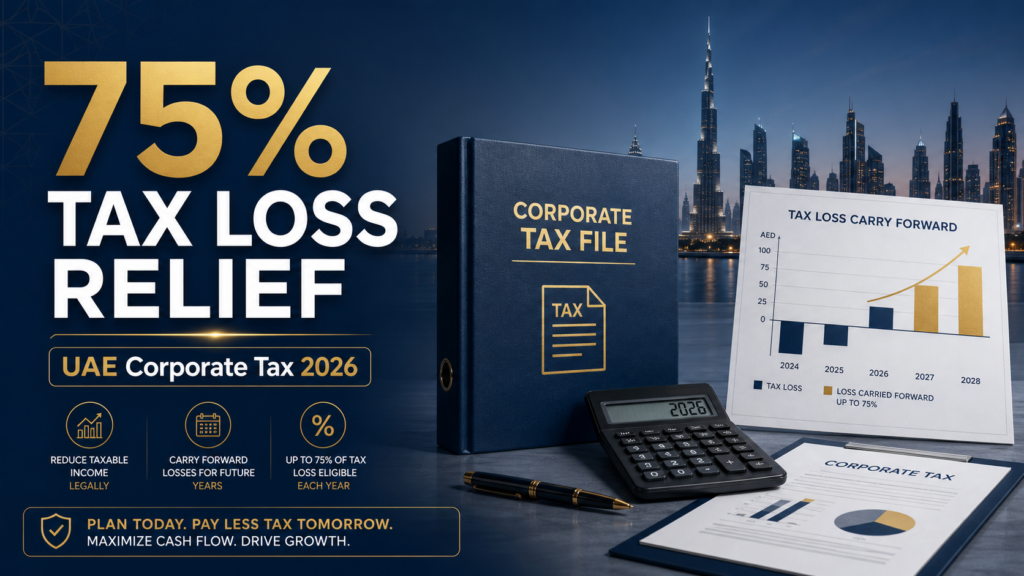
UAE Corporate Tax loss relief can reduce taxable income, but Article 37 generally caps the offset at 75% of taxable income for the relevant tax period. That means a company with enough carried-forward tax losses may still have taxable income left after applying loss relief.
This guide explains the 75% rule, AED examples, group transfer rules, ownership continuity checks and the filing documents UAE companies should prepare before claiming loss relief. Qaspro Global, a UAE-based tax and accounting consultancy, prepared this checklist for owners, finance teams and CFOs preparing 2026 Corporate Tax returns.
What Is a UAE Corporate Tax Loss?
A tax loss is not simply the accounting loss shown in the profit and loss statement. It is the negative taxable income calculated after Corporate Tax adjustments, disallowed expenses, exempt income treatment and other law-based adjustments. A business can have an accounting loss but a smaller tax loss, or even taxable income, after those adjustments.
This distinction matters because the Federal Tax Authority reviews the tax computation, not only the management accounts. Before claiming loss relief, the company should keep the tax computation, trial balance, financial statements and adjustment schedule that created the loss.
How Does Article 37 Loss Relief Work?
Article 37 allows a taxable person to offset tax losses against taxable income in later tax periods. The key limitation is that tax losses may not reduce taxable income by more than 75% for the period, unless a specific rule applies. Any unused balance can be carried forward to future periods if the conditions continue to be met.
The practical result is simple: loss relief improves cash flow, but it does not always erase the full taxable profit in one year. The company should calculate the 75% cap every year and maintain a running loss schedule.
AED Example: The 75% Tax Loss Carry Forward Rule
| Item | Amount | Explanation |
|---|---|---|
| Taxable income before loss relief | AED 1,000,000 | Current year taxable income after CT adjustments. |
| Available carried-forward tax loss | AED 900,000 | Tax loss from earlier tax periods. |
| Maximum loss offset | AED 750,000 | 75% of AED 1,000,000. |
| Taxable income after loss relief | AED 250,000 | Remaining 25% after maximum permitted offset. |
| Loss carried forward | AED 150,000 | AED 900,000 less AED 750,000 used. |
If the company had only AED 400,000 of carried-forward tax losses, it could use AED 400,000 because that is below the AED 750,000 cap. The 75% rule is a ceiling, not a compulsory amount.
Article 39: When Can Tax Losses Be Restricted?
Article 39 limits the use of carried-forward tax losses where ownership and business continuity conditions are not met. The key risk is a major ownership change combined with a change in the business activity. This prevents companies from buying loss-making entities only to use their losses against unrelated profitable businesses.
For 2026 planning, any shareholder sale, merger, asset transfer, activity change, licence amendment or group restructuring should be reviewed before claiming historic losses. The file should show who owned the company when the loss arose, who owns it now and whether the same or similar business is still being carried on.
Article 38: Can Group Companies Transfer Tax Losses?
Article 38 can allow tax losses to be transferred between taxable persons where the qualifying group conditions are met. This can be valuable when one group company has a current year loss and another group company has taxable income. The rules are technical and should be checked before the return is filed.
Do not assume that common shareholders are enough. The group relationship, residence position, exempt person status, qualifying free zone status, financial year alignment and ownership percentage should be reviewed before any transfer is claimed.
| Question | Why it matters | Evidence to keep |
|---|---|---|
| Was the loss calculated under CT rules? | Only tax losses matter for Article 37 relief. | Tax computation, financial statements, adjustment schedule. |
| Was there an ownership change? | Article 39 can restrict loss use. | Share register, licence, corporate structure chart. |
| Did the business activity change? | Business continuity affects loss eligibility. | Trade licence history, revenue analysis, contracts. |
| Is a group loss transfer planned? | Article 38 has strict conditions. | Group chart, ownership proof, board approvals. |
Filing Checklist for 2026 Corporate Tax Returns
- Prepare the current year taxable income calculation before loss relief.
- Prepare a tax loss schedule by tax period, not only by accounting year.
- Reconcile accounting losses to tax losses after CT adjustments.
- Calculate the 75% cap for the relevant tax period.
- Check Article 39 ownership and business continuity conditions.
- Review Article 38 if a group loss transfer is planned.
- Keep board approvals for group transfers or restructuring decisions.
- Retain financial statements, trial balance and tax working papers for FTA review.
- Update the carried-forward loss balance after filing.
- Review the position again before next year’s return.
Common Mistakes Businesses Make
- Using accounting losses without converting them into tax losses.
- Trying to offset 100% of taxable income when the 75% cap applies.
- Ignoring ownership changes before using losses.
- Forgetting to track unused losses after a partial offset.
- Assuming group loss transfer applies without checking Article 38 conditions.
- Keeping no proof of how the loss was calculated.
Official Sources Used
Official sources: UAE Corporate Tax Law, Federal Decree-Law No. 47 of 2022 and amendments, especially Article 37 on Tax Loss Relief, Article 38 on Transfer of Tax Losses and Article 39 on Limitation on Tax Losses Carried Forward. Ministry of Finance Corporate Tax information confirms the UAE CT regime and filing framework.
Source links: Ministry of Finance Corporate Tax page and Corporate Tax Law PDF.
For businesses closing operations, read our full guide to company liquidation in UAE 2026 with tax clearance and FTA deregistration steps before finalising tax records or licence cancellation.
Frequently Asked Questions
What is UAE Corporate Tax loss relief?
UAE Corporate Tax loss relief is the Article 37 mechanism that allows a taxable person to use tax losses from earlier periods against taxable income in later periods, subject to the 75% cap and continuity rules.
What is the 75% tax loss rule?
The 75% rule means tax losses generally cannot reduce taxable income for the period by more than 75%. If taxable income is AED 1,000,000, the maximum offset is generally AED 750,000.
Can tax losses be carried forward forever?
The law allows unused tax losses to be carried forward, but their future use depends on the Corporate Tax rules, including Article 39 ownership and business continuity restrictions.
Can pre-tax accounting losses be used?
Do not assume that accounting losses automatically qualify. The company must calculate tax losses under the Corporate Tax Law and keep supporting working papers.
What happens after a shareholder change?
A major ownership change can affect loss use, especially if the business activity also changes. Review Article 39 before claiming carried-forward losses.
Can one group company transfer losses to another?
Article 38 may allow loss transfers between qualifying group companies if strict conditions are met. The group should document ownership, tax status and board approvals.
Do free zone companies need loss relief schedules?
Yes. Free zone companies should track losses and taxable income carefully, especially where qualifying income and non-qualifying income are both relevant.
What records should be kept?
Keep financial statements, tax computations, loss schedules, ownership records, activity evidence, group charts and board approvals for FTA review.
Need Help With Tax Loss Relief?
Qaspro Global can prepare your 2026 Corporate Tax computation, tax loss schedule, Article 39 continuity review and group loss transfer working papers. Read also our Corporate Tax return documents guide, Corporate Tax calculation guide, Corporate Tax filing deadline guide and interest deduction guide. For family visit visa support for business owners and employees, see Yalah Dubai’s guide to UAE visit visa for relatives 2026.
How to Build a Tax Loss Schedule for FTA Review
A tax loss schedule should be a controlled working paper, not a number copied from last year’s accounts. Start with the taxable income or tax loss for each tax period, then show the amount used, the 75% limit applied, the balance carried forward and the reason the balance remains available. The schedule should reconcile to the Corporate Tax return and the financial statements.
For each loss year, keep the return filing confirmation, the final tax computation, the signed financial statements and any ownership records that prove Article 39 continuity. If the company has a restructuring, share transfer, licence activity change or merger, add a separate note explaining why the losses remain usable. This helps the finance team answer FTA questions quickly if the return is reviewed later.
When Should a UAE Business Use a Tax Adviser?
Loss relief becomes high risk when the company has related-party transactions, a new shareholder, a group structure, a free zone position, a business activity change or a planned sale. In these cases, the tax saving may be valuable, but the documentation burden is also higher. A tax adviser should review the calculation before filing, because a wrong loss claim can affect the current year return and future year balances.
Qaspro Global can review the calculation before submission, prepare the loss continuity memo and support the company if the FTA later asks for evidence. The goal is not only to reduce tax legally, but also to make the position easy to defend.

Founder & CEO, Qaspro Global — UAE tax expert with 16+ years of experience in VAT, corporate tax and FTA audit support.