
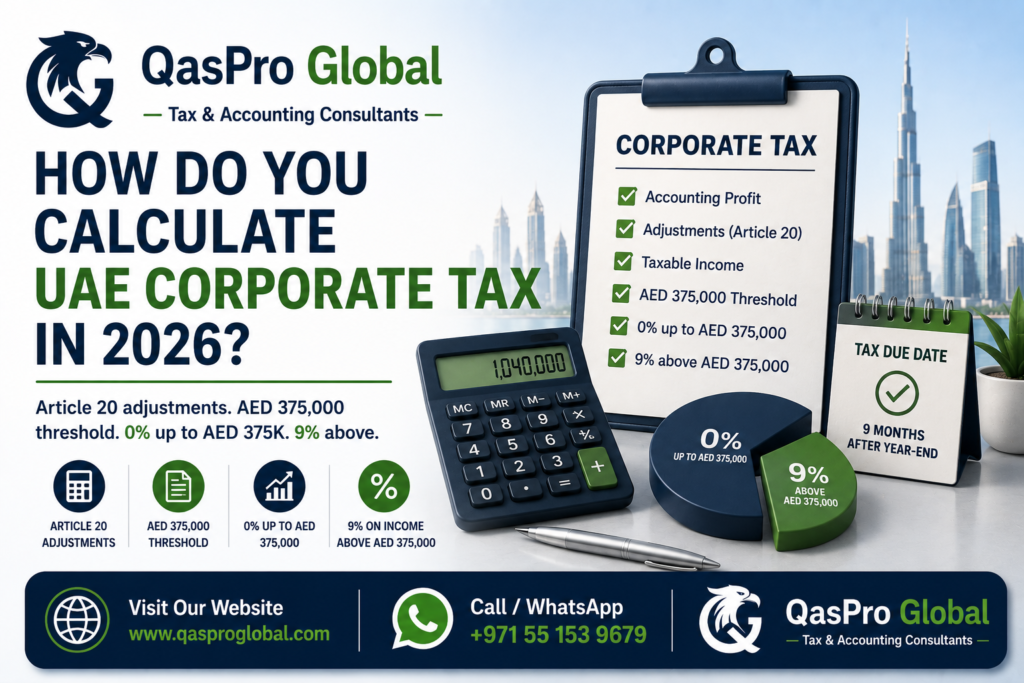
How Do You Calculate UAE Corporate Tax in 2026?
To calculate UAE corporate tax in 2026, you start with your accounting net profit, adjust it through the rules in Article 20 of Federal Decree-Law No. 47 of 2022, and then apply the rate: 0% on taxable income up to AED 375,000 and 9% on the portion above AED 375,000 (Article 3 and Cabinet Decision No. 116 of 2022). Your accounting profit is rarely your tax bill, because the law requires up to nine separate adjustments before the rate is applied.
Quick Answer: UAE corporate tax = (Accounting Income, adjusted under Article 20 for exempt income, non-deductible expenses, reliefs, related-party transactions and tax losses) taxed at 0% up to AED 375,000 and 9% above. A business with AED 1,200,000 net profit can owe anywhere from AED 0 to over AED 74,000 depending on its adjustments.
In this guide, Qaspro Global breaks down the exact method the Federal Tax Authority (FTA) expects, the nine adjustments listed in Article 20(2), and a full worked example with real AED figures so you can check your own return before the deadline.
What Is the Difference Between Accounting Profit and Taxable Income?
Accounting profit is the net profit shown in your financial statements, while taxable income is that profit after the corporate tax adjustments required by law. Under Article 20(1), taxable income must be determined separately for each taxable person on the basis of standalone financial statements prepared in line with accounting standards accepted in the UAE, which means IFRS or IFRS for SMEs under Ministerial Decision No. 114 of 2023.
The two numbers are different because tax law disallows certain costs, exempts certain income, and caps certain deductions. If your accounting profit and your taxable income are identical, you have almost certainly missed an adjustment. Article 20(7) confirms that where the Corporate Tax Law and the accounting standards conflict, the law prevails.
What Are the 9 Adjustments Article 20 Makes to Your Profit?
Article 20(2) lists nine categories of adjustment, lettered (a) to (i), that convert accounting income into taxable income. Every UAE business must work through each one that applies before calculating tax.
| # | Article 20(2) Adjustment | What It Means |
|---|---|---|
| a | Unrealised gains or losses | Fair-value and similar movements may be removed if you elect the realisation basis under Article 20(3) |
| b | Exempt income (Chapter 7) | Deduct dividends and participation income exempt under Articles 22 and 23 |
| c | Reliefs (Chapter 8) | Apply qualifying group, restructuring and other reliefs (Articles 26 and 27) |
| d | Deductions (Chapter 9) | Add back non-deductible expenses (Articles 28 to 33) |
| e | Related parties and connected persons (Chapter 10) | Adjust to arm’s length value (Articles 34 to 36) |
| f | Tax loss relief (Chapter 11) | Offset carried-forward losses, capped at 75% (Article 37) |
| g | Qualifying Business Activity incentives | Apply special reliefs set by Cabinet Decision |
| h | Income or expenditure not otherwise counted | Cabinet Decision adjustments |
| i | Other adjustments by the Minister | The detailed rules in Ministerial Decision No. 134 of 2023 |
Most small and medium businesses only trigger four of these in practice: exempt income (b), non-deductible expenses (d), related-party pricing (e) and tax losses (f). The rest matter for groups, banks, insurers and companies that hold investment assets.
Step 1: Start With Your Accounting Income
The starting point is the accounting net profit (or loss) in your audited or management financial statements for the tax period. Article 20(1) requires these statements to follow accepted UAE accounting standards, and Ministerial Decision No. 84 of 2025 makes audited financial statements mandatory for businesses with revenue above AED 50 million and for every Qualifying Free Zone Person.
Use the figure on the statement of income (the profit and loss account) before any tax. If you prepare consolidated accounts for a group, each taxable person still needs its own standalone profit figure, unless you have formed a tax group under Article 40. For more on which standard to use, see our guide on corporate tax accounting standards.
Step 2: Remove Exempt Income (Article 22)
Exempt income is deducted from accounting profit because Article 22 says it shall not be taken into account when determining taxable income. The main exempt categories are dividends from UAE companies, dividends and gains from a Participating Interest of 5% or more held for at least 12 months (Article 23), foreign permanent establishment income (Article 24), and qualifying international transport income (Article 25).
If your profit includes AED 100,000 of dividends from a UAE subsidiary, you subtract that AED 100,000 before applying the rate. Note that related expenditure incurred to earn exempt income is also disallowed, so the exemption is net. Our detailed breakdown of the Article 23 participation exemption explains the conditions in full.
Step 3: Add Back Non-Deductible Expenses (Articles 28 to 33)
Non-deductible expenses are added back to profit because they reduced your accounting income but the law does not allow them for tax. Under Article 28, only expenditure incurred wholly and exclusively for the business, and not capital in nature, is deductible, and Articles 32 and 33 then restrict or block specific costs.
The most common add-backs for UAE businesses are:
- Administrative fines and penalties (other than ordinary contractual damages) are fully non-deductible.
- Client entertainment is only 50% deductible under Article 32, so half is added back. See our guide on entertainment expenses.
- Donations to bodies that are not Qualifying Public Benefit Entities are non-deductible.
- General (non-specific) bad debt provisions are added back; only specific write-offs that meet the conditions are deductible. See our bad debt deduction guide.
- Expenditure that earns exempt income is disallowed (Article 28(2)(b)).
For the full list of what you can and cannot claim, read our deductible expenses guide.
Step 4: Apply the Interest Cap, Entertainment and Depreciation Rules
Some expenses are partly deductible, so you adjust only the disallowed portion rather than the whole cost. The largest of these is the general interest deduction limitation in Article 30, which caps net interest expenditure at 30% of tax EBITDA, with a de minimis threshold of AED 12 million under Ministerial Decision No. 126 of 2023.
If your net interest is below AED 12 million, the cap does not bite and you deduct the full amount. Above that, you add back any interest over the 30% limit and carry it forward for up to ten tax periods. Depreciation generally follows your accounts, but investment property held at fair value can elect a 4% annual deduction under Ministerial Decision No. 173 of 2025. Read more in our interest deduction guide and depreciation guide.
With the July 31 deadline approaching, see our detailed step-by-step guide on the UAE Corporate Tax Penalty Waiver 2026: Remove the AED 10,000 FTA Fine Before July 31 — including how to trigger the automatic waiver and what to do if you already paid the AED 10,000 penalty.
Step 5: Apply Reliefs, Related-Party Adjustments and Tax Losses
After income and expense adjustments, you apply reliefs, arm’s length pricing and tax losses. Transactions with related parties and connected persons must be priced at market value under Articles 34 to 36, so if you paid a connected director above market salary, the excess is added back. Tax losses from earlier periods can then be offset, but Article 37 caps the offset at 75% of the taxable income for the period.
This is also where Ministerial Decision No. 134 of 2023 applies its detailed “other adjustments” under Article 20(2)(i), covering equity-method investments, qualifying group transfers under Article 26, and business restructuring transfers under Article 27. For the loss rules, see our loss carry forward guide and for related-party pricing see connected persons.
Worked Example: Corporate Tax on AED 1,200,000 Accounting Profit
The clearest way to see the method is a full example. Assume a Dubai mainland company with AED 1,200,000 accounting net profit, some non-deductible costs, exempt dividend income, and a prior-year tax loss.
| Line | Item | AED |
|---|---|---|
| 1 | Accounting net profit | 1,200,000 |
| 2 | Add: administrative fines (non-deductible) | +15,000 |
| 3 | Add: 50% of client entertainment (AED 80,000) | +40,000 |
| 4 | Add: donation to non-approved entity | +25,000 |
| 5 | Add: general bad debt provision | +20,000 |
| 6 | Less: exempt dividend from UAE company | -60,000 |
| 7 | Adjusted income before losses | 1,240,000 |
| 8 | Less: tax loss brought forward (within 75% cap) | -200,000 |
| 9 | Taxable income | 1,040,000 |
| 10 | 0% on first AED 375,000 | 0 |
| 11 | 9% on AED 665,000 (1,040,000 – 375,000) | 59,850 |
| 12 | Corporate tax payable | 59,850 |
A business that wrongly applied 9% to its raw accounting profit above the threshold would have calculated AED 74,250, while the correct figure after adjustments and losses is AED 59,850. The adjustments are not optional, and getting them wrong in either direction creates penalty risk. Once you know your tax payable, our guide on how to pay UAE corporate tax covers the GIBAN payment steps.
What Is the Realisation Basis Election Under Article 20(3)?
The realisation basis election lets a company that prepares accounts on an accrual basis ignore unrealised gains and losses until the asset or liability is actually sold or settled. Under Article 20(3) and Article 8 of Ministerial Decision No. 134 of 2023, the election is made in your first tax period and is irrevocable except in exceptional circumstances approved by the FTA.
This matters for companies holding property or investments measured at fair value, because without the election an unrealised paper gain would be taxed even though no cash has changed hands. Banks and insurance providers have a specific version of this election under paragraph (b) of Article 20(3). Qaspro Global advises reviewing this election carefully in your first return, because you cannot easily change it later.
When Can You Skip the Calculation With Small Business Relief?
Small Business Relief lets a resident business elect to be treated as having no taxable income, which removes the need to compute the adjustments at all. Under Article 21 and Ministerial Decision No. 73 of 2023, the relief applies where revenue does not exceed AED 3,000,000 in the current and all previous tax periods, and it is available until 31 December 2026.
If you elect Small Business Relief, you cannot also claim exempt income, deductions, other reliefs or tax loss relief for that period (Article 21(2)). You still need to register and file, but you report nil taxable income. Because the relief ends after 2026, our guide on Small Business Relief ending explains how to plan the transition.
What Are the UAE Corporate Tax Rates in 2026?
The standard UAE corporate tax rates are 0% and 9%, split at the AED 375,000 threshold. A separate 15% Domestic Minimum Top-up Tax applies only to large multinational groups with consolidated revenue of EUR 750 million or more.
| Taxable Income / Entity | Rate | Legal Basis |
|---|---|---|
| Up to AED 375,000 | 0% | Article 3, Cabinet Decision 116 of 2022 |
| Above AED 375,000 | 9% | Article 3 of FDL 47 of 2022 |
| Qualifying Free Zone Person (qualifying income) | 0% | Article 18, MD 265 of 2023 |
| Large multinational groups (EUR 750M+) | 15% DMTT | Cabinet Decision 142 of 2024 |
For most UAE small and medium companies, only the 0% and 9% bands apply. Free zone businesses should confirm they meet the qualifying conditions, because failing the test means 9% on all profit. See our Qualifying Free Zone Person guide.
Common Mistakes UAE Businesses Make When Calculating Corporate Tax
The most frequent error is taxing raw accounting profit without making the Article 20 adjustments, which usually overstates or understates the bill. The second most common mistake is forgetting that the AED 375,000 0% band applies to taxable income, not revenue, so a company with AED 5 million revenue but AED 200,000 taxable income still pays zero.
- Treating revenue, not taxable income, as the figure taxed at 9%.
- Deducting client entertainment in full instead of 50%.
- Forgetting to add back fines, penalties and non-approved donations.
- Missing exempt dividend income that should be removed from profit.
- Applying losses without the 75% Article 37 cap.
- Ignoring the realisation basis election in the first tax period.
Each of these can trigger an FTA adjustment and penalties. Our guide on corporate tax penalties lists the exact fines, and the UAE tax deadlines guide confirms when your return is due.
First Things First: Register Before You Calculate
Before you calculate a dirham of corporate tax, your business must be registered with the FTA. Registration is mandatory under Article 51 of Federal Decree-Law No. 47 of 2022, even for companies below the AED 375,000 threshold that will owe zero tax. Missing the registration deadline set by FTA Decision No. 3 of 2024 triggers a fixed AED 10,000 penalty.
If you registered late, the FTA’s 2025 waiver can erase that AED 10,000 fine, provided you file your first return within 7 months of your first tax period end. Learn the full registration timeline, the EmaraTax steps, and how the waiver works in our guide to the UAE corporate tax late registration penalty.
If your adjustments bring taxable income to zero, you still file, see the nil corporate tax return rules.
Your calculation always covers one tax period, so start by confirming your first tax period dates.
One of those nine adjustments is the treatment of unrealised gains and losses; see how the realisation basis election can keep paper gains out of your tax bill.
Once you know how to calculate the tax, make sure you have the documents needed to file your corporate tax return ready before the 30 September 2026 deadline.
Frequently Asked Questions
How is UAE corporate tax calculated on net profit?
UAE corporate tax is calculated by adjusting accounting net profit under Article 20 of Federal Decree-Law 47 of 2022, then applying 0% to the first AED 375,000 of taxable income and 9% above. The adjustments add back non-deductible expenses, remove exempt income, and apply reliefs and tax losses.
Is corporate tax 9% of revenue or profit in the UAE?
Corporate tax is 9% of taxable income, not revenue. Taxable income is your adjusted accounting profit, and only the portion above AED 375,000 is taxed at 9% under Article 3. A business with high revenue but low profit can still pay little or no tax.
What is the AED 375,000 corporate tax threshold?
The AED 375,000 threshold is the amount of taxable income taxed at 0% under Cabinet Decision No. 116 of 2022. Any taxable income above AED 375,000 is taxed at 9%. The threshold applies per taxable person, per tax period.
What expenses are not deductible for UAE corporate tax?
Non-deductible expenses include administrative fines and penalties, 50% of client entertainment, donations to non-approved entities, expenditure earning exempt income, and capital expenditure. These are added back to accounting profit under Articles 28 to 33 of the Corporate Tax Law.
Do I subtract dividends when calculating corporate tax?
Yes. Dividends from UAE companies and qualifying participation income are exempt under Articles 22 and 23, so they are removed from accounting profit before applying the rate. Related expenditure incurred to earn that exempt income is also disallowed.
How much corporate tax on AED 1,000,000 profit in the UAE?
On AED 1,000,000 of taxable income, corporate tax is AED 56,250, calculated as 0% on the first AED 375,000 and 9% on the remaining AED 625,000. The figure changes once Article 20 adjustments for exempt income, non-deductible costs and losses are applied.
Can I offset previous losses against corporate tax?
Yes. Tax losses can be carried forward and offset against future taxable income, but Article 37 caps the offset at 75% of the taxable income for the period. Unused losses carry forward to later periods, subject to ownership continuity conditions.
What is the realisation basis election in UAE corporate tax?
The realisation basis election under Article 20(3) lets accrual-basis businesses ignore unrealised gains and losses until assets are sold or settled. It is made in the first tax period and is irrevocable except in exceptional circumstances approved by the FTA, under Ministerial Decision No. 134 of 2023.
Does Small Business Relief remove the need to calculate tax?
Yes. If your revenue stays at or below AED 3,000,000, you can elect Small Business Relief under Article 21 and report nil taxable income, so the full calculation is not needed. The relief is available until 31 December 2026 and you must still register and file.
If your Corporate Tax return contains an error, submitting a UAE corporate tax voluntary disclosure 2026 immediately is the most cost-effective way to avoid the 15% fixed FTA penalty.
Need Expert Help?
Qaspro Global, a UAE-based tax and accounting consultancy, can prepare your corporate tax computation, apply every Article 20 adjustment correctly, and file your return before the deadline so you avoid FTA penalties. Contact us today for a free consultation.
Related Reading
- UAE Qualifying Income 2026: The Full QFZP 0% List
- UAE Corporate Tax Return 2026: 9 Documents You Need to File
- UAE Corporate Tax 2026: Don’t Pay 9% on Unrealised Gains
- UAE Corporate Tax First Tax Period 2026: The 18-Month Rule
- Nil Corporate Tax Return UAE 2026: Zero Profit, AED 500 Fine
- UAE Corporate Tax Deductible Expenses 2026: Complete Guide (Article 28)
- UAE CT 2026: Are You Using the Wrong Accounting Standard?
- UAE Small Business Relief Expires December 31: The AED 38,250 Tax Bill Coming in 2027
- UAE Corporate Tax 2026: Erase the AED 10,000 Registration Fine
- UAE Corporate Tax Penalties 2026: Every FTA Fine That Can Hit You
- UAE Tax Deadlines 2026: Every Date Your Business Must Know
- How to Pay UAE Corporate Tax 2026: The GIBAN Steps
- UAE Corporate Tax Small Business Relief 2026: AED 3 Million Threshold, Eligibility and How to Elect on EmaraTax

Founder & CEO, Qaspro Global — UAE tax expert with 16+ years of experience in VAT, corporate tax and FTA audit support.