
Why UAE Corporate Tax Filing Now Needs a Proper Service File
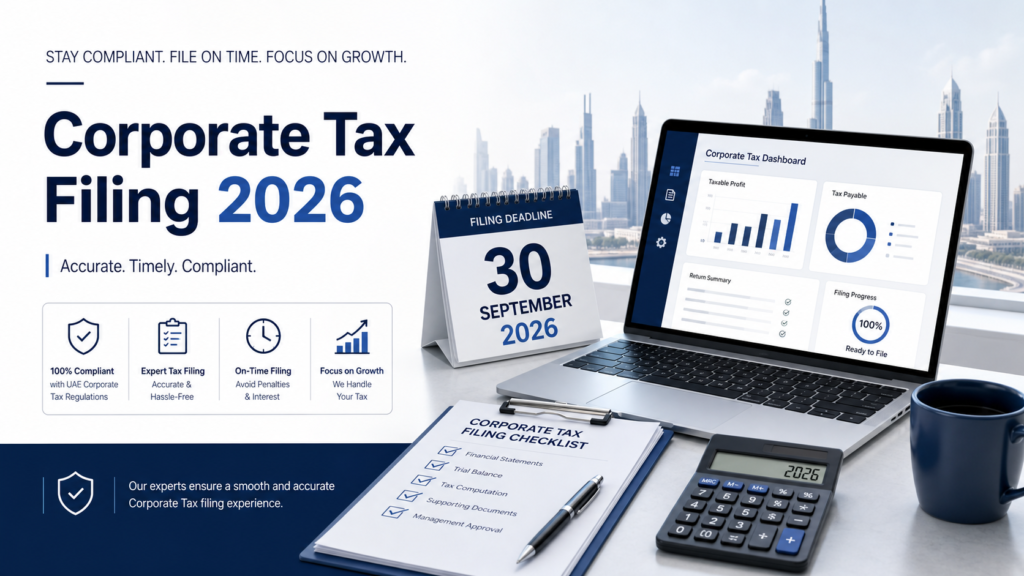
For many UAE companies, the first serious Corporate Tax deadline is no longer a future problem. If your financial year ends on 31 December 2025, the Corporate Tax return and any tax payment are generally due by 30 September 2026. The filing is not just a form in EmaraTax. It is a full tax position built from accounting records, adjustments, related-party checks, elections, penalties and management approval.
The Ministry of Finance explains that Taxable Persons must file a Corporate Tax return for each Tax Period within 9 months from the end of the relevant period, and the same deadline generally applies for payment. The Federal Tax Authority has also reminded businesses that late filing and late payment can lead to administrative penalties. That is why the filing service should start before the last month, not during the last week.
UAE Corporate Tax Filing Service 2026: What It Should Include
| Workstream | What the filing service checks | Why it matters |
|---|---|---|
| Accounting close | Trial balance, profit and loss, balance sheet, ledger, bank reconciliations, receivables and payables. | Corporate Tax starts from accounting income, so weak accounts create weak tax returns. |
| Tax adjustments | Exempt income, non-deductible expenses, interest limits, entertainment limits, related-party balances and accounting policy differences. | The return must translate accounting profit into taxable income correctly. |
| Registration and access | Corporate Tax TRN, EmaraTax access, user permissions and authorised signatory records. | Access issues near the deadline can delay submission and payment. |
| Reliefs and elections | Small Business Relief, Free Zone status, loss relief, group relief and other elections where relevant. | Missing a relief or applying it incorrectly can change the final tax position. |
| Payment readiness | Tax payable, GIBAN or online payment route, proof of payment and acknowledgement. | Filing and payment both need deadline control. |
| Evidence archive | Return, schedules, management sign-off, invoices, ledgers, contracts and calculations. | FTA record rules require strong support if a question or review arrives later. |
The Deadline Rule: 9 Months From the End of the Tax Period
For most businesses, the simple rule is this: count 9 months from the end of your financial year. If your tax period ends on 31 December 2025, the filing and payment deadline is generally 30 September 2026. If your tax period ends on a different date, your deadline changes. A company with a 31 May year-end has a different filing calendar from a company with a 31 December year-end.
Do not copy another company deadline. Confirm your legal entity, licence, accounting period and first tax period. If your accounting records are not closed, the tax return cannot be properly reviewed. If your EmaraTax access is not ready, the return can be technically correct but still not submitted in time.
Documents Needed Before Corporate Tax Filing
- Trade licence, legal documents and Corporate Tax TRN.
- Financial statements or management accounts for the tax period.
- Trial balance, general ledger and chart of accounts.
- Bank statements and bank reconciliation.
- VAT returns and FTA statements where the company is VAT registered.
- Sales invoices, purchase invoices, credit notes and key contracts.
- Payroll, gratuity, end-of-service, owner salary and connected person records.
- Loan agreements, interest schedules and related-party balances.
- Fixed asset register, depreciation schedule and disposal details.
- Free Zone documents, lease, qualifying income analysis or Small Business Relief support where relevant.
What Happens During the Filing Process?
Step 1: Confirm the tax period and filing responsibility
The service should first confirm which entity is filing, what tax period applies, whether the company is a Taxable Person, whether it is a Free Zone Person, whether it has a tax group relationship and who is authorised to approve submission. This avoids the most common mistake: preparing a return for the wrong entity or period.
Step 2: Close accounts before tax starts
Corporate Tax filing is not a replacement for bookkeeping. The accounts must be closed first. Revenue, expenses, accruals, prepayments, depreciation, inventory, receivables, payables and bank balances should be reconciled. A tax return built on unreconciled accounts can produce the wrong taxable income.
Step 3: Build the taxable income bridge
The reviewer then moves from accounting income to taxable income. This includes checking exempt income, non-deductible expenses, limitation rules, related-party pricing, owner or connected person payments, entertainment, penalties, provisions and other adjustments that may be required under the Corporate Tax framework.
Step 4: Review reliefs and elections
Some businesses may need to consider Small Business Relief, Free Zone qualifying status, tax loss treatment, group relief, transfer pricing documentation or elections. The filing service should not apply relief automatically. It should check eligibility, keep evidence and explain the impact to management before submission.
Step 5: File, pay and archive
After management approval, the return is submitted through EmaraTax. If tax is payable, the payment route must be completed before the deadline. The acknowledgement, tax schedules, calculations and supporting documents should be archived so the company can answer future FTA questions.
Penalties and Risk Areas to Avoid
The FTA has said late submission of a Corporate Tax return or delay in settling Corporate Tax payable can result in administrative penalties, including AED 500 per month or part of a month during the first 12 months, then AED 1,000 per month or part of a month from the thirteenth month onwards. Penalties are only one risk. The bigger commercial risk is filing an incorrect return that creates questions, corrections or future tax exposure.
For the full breakdown of every fine amount, see our complete guide to corporate tax penalties UAE.
Official Fees vs Professional Service Charges
Corporate Tax filing is a digital FTA process through EmaraTax. This article does not publish Qaspro Global service charges or package prices. Professional service charges vary by document volume, accounting condition, tax complexity, Free Zone analysis, related-party work and deadline urgency, and should be quoted only after reviewing the file.
Official tax amounts, penalties and statutory deadlines are separate from professional advice. A company may have no Corporate Tax payable if taxable income does not exceed the applicable threshold, but it may still need to file. Another company may have tax payable and must manage both return submission and payment on time.
How This Connects With Yalah Employment Visa Planning
If your business is hiring or renewing staff in Dubai, keep HR files and payroll support aligned with tax records. Employment costs, work permits, salaries and visa-related records should be documented clearly. Our sister team at Yalah Dubai has a practical guide to UAE employment visa cost 2026 so business owners can plan official MOHRE and visa steps alongside accounting records.
When Should a Business Start the Filing Service?
The best time is after the accounts for the tax period are substantially closed, but before the deadline pressure begins. For a 31 December year-end, a practical target is to start the tax file in the first half of the year, complete the document request list, resolve accounting gaps, then submit well before 30 September. This gives time to correct bookkeeping differences, request missing invoices, review management accounts and approve the final position calmly.
Last-minute filing is risky because the return depends on multiple teams: accounting, management, bank access, payroll, VAT records and EmaraTax users. If one person is travelling or one bank statement is missing, the whole process slows down. A clean filing service creates a tracker: documents received, open points, tax adjustments, management questions, final review, submission proof and payment proof.
What a Good Review Should Not Do
A proper review should not simply copy the profit from the accounting system into the tax return. It should not ignore owner drawings, related-party balances, Free Zone income, unreconciled VAT figures or old payable balances. It should not promise tax savings without first checking eligibility. It should also not file without management understanding the numbers. The return is a legal tax document, so the business owner should know what was submitted and keep the supporting file.
For businesses closing operations, read our full guide to company liquidation in UAE 2026 with tax clearance and FTA deregistration steps before finalising tax records or licence cancellation.
If your first return is being filed to remove an AED 10,000 late registration fine, review our Corporate Tax penalty waiver UAE advisory guide first.
If you are forming a new UAE company, build tax filing into the setup plan using our Business Setup Dubai 2026 guide.
Corporate Tax filing quotes should be compared by scope, not only price. See the Tax Consultant Cost Dubai 2026 guide.
Frequently Asked Questions
When is the UAE Corporate Tax return due?
Taxable Persons are generally required to file the Corporate Tax return within 9 months from the end of the relevant tax period. The same deadline generally applies for payment of Corporate Tax due for that period.
Is only one Corporate Tax return filed each year?
The FTA FAQ says only one UAE Corporate Tax return generally needs to be filed per Tax Period, with no provisional or advance Corporate Tax filings required.
Can I file Corporate Tax myself?
A Taxable Person may file directly through EmaraTax if the records are ready and the user understands the tax treatment. Many companies still use a reviewer because accounting adjustments, reliefs and documentation can be complex.
Does Qaspro Global publish fixed Corporate Tax filing fees?
No. We do not publish fixed service charges in this guide. Any professional service charge depends on the entity, records, tax period, urgency and technical scope after document review.
What happens if I miss the deadline?
Late filing or late payment can trigger administrative penalties. The FTA has referred to penalties of AED 500 per month or part thereof for the first 12 months, increasing to AED 1,000 per month or part thereof from the thirteenth month onwards.
Do Free Zone companies need to file?
Yes, Free Zone Persons are within the Corporate Tax framework and generally need to register and comply. A Free Zone company may need additional analysis on qualifying income and 0 percent treatment.
What records should be kept after filing?
Keep the return, acknowledgement, ledgers, invoices, contracts, bank records, calculations and management approval. The FTA has highlighted record retention obligations for Corporate Tax purposes.
Should VAT returns be reviewed before CT filing?
Yes. VAT returns can help reconcile sales, expenses and tax records. Differences between VAT filings and accounting ledgers should be explained before Corporate Tax submission.
Can a late accounting close delay tax filing?
Yes. Corporate Tax uses accounting income as the starting point, so the bookkeeping close should be completed before the tax return is reviewed and filed.
What is the first action for a company with a 30 September 2026 deadline?
Start with the accounting close, document request list, EmaraTax access check and tax period confirmation. Do not wait until September to begin.
Need a Corporate Tax Filing Review?
Qaspro Global can review your accounting file, Corporate Tax position, EmaraTax readiness and deadline risk before submission. WhatsApp +971 55 153 9679 to start with a document review. No fixed service fee is listed here because the correct scope depends on the file.
Official Sources and Related Reading
- UAE Ministry of Finance, Corporate Tax in the UAE
- Federal Tax Authority, CT returns and penalties reminder
- FTA EmaraTax, submit tax returns and pay
- UAE Corporate Tax Filing Deadline 2026
- UAE Corporate Tax Payment on EmaraTax 2026
- UAE Corporate Tax Return Documents 2026
- QFZP Qualifying Income UAE 2026
- UAE Transfer Pricing 2026
Fiscal year reminder: If your accounting year-end does not match your business cycle, review our change your UAE Corporate Tax fiscal year before finalising the next Corporate Tax return.
30 September filing push: Need the return prepared and submitted? See Qaspro’s 30 September 2026 corporate tax return filing service for document review, tax computation and EmaraTax filing support.

Founder & CEO, Qaspro Global — UAE tax expert with 16+ years of experience in VAT, corporate tax and FTA audit support.