
Are You Ready for UAE Transfer Pricing 2026 Compliance?
Published: 6 July 2026 | Last updated: 15 August 2026
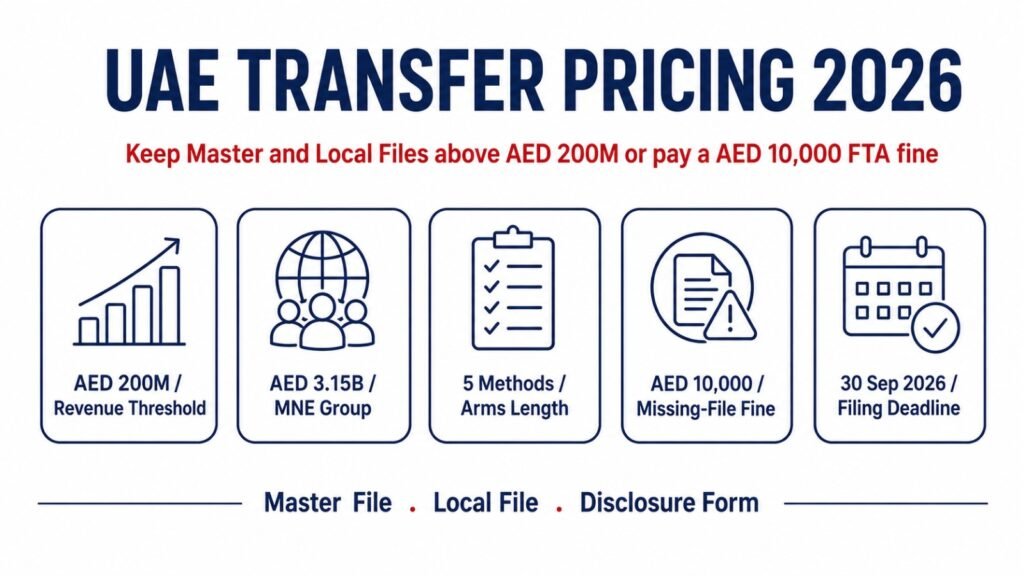
A staggering 100 percent of UAE businesses engaging with related parties face potential penalties of AED 10,000 or more if they fail to maintain compliant transfer pricing records. Navigating UAE transfer pricing 2026 requires strict adherence to Federal Decree-Law No. 47 of 2022. Multinational groups exceeding AED 3.15 billion in revenue must prepare comprehensive Master Files and Local Files, while all related-party transactions must reflect arm’s length principles to avoid severe tax penalties.
What is Transfer Pricing in the UAE Context?
Transfer pricing is not merely a regulatory hurdle, it is a fundamental pillar of the UAE corporate tax regime introduced by Federal Decree-Law No. 47 of 2022. As your tax advisor, I want to emphasize that these rules have applied since 1 June 2023, meaning your current financial operations are already subject to these requirements. The operational framework was further clarified by Ministerial Decision No. 97 of 2023, which provides the practical guidelines for compliance. At its core, transfer pricing dictates that transactions between related parties must be conducted as if they were taking place between independent enterprises operating in a competitive market. This is known as the arm’s length principle.
The UAE tax authorities are highly focused on ensuring that businesses do not artificially shift profits to related entities in lower-tax jurisdictions or unlawfully reduce their taxable income through inflated intercompany pricing. Looking ahead to the upcoming deadlines, the first returns are due 30 September 2026 for December 2025 year-ends, making 2026 a critical year for demonstrating absolute compliance. Businesses must understand that the Federal Tax Authority will scrutinize intercompany transactions heavily during routine audits. Whether you are providing management services to a sister company, lending money to a parent entity, or purchasing raw materials from an overseas subsidiary, every transaction must reflect fair market rates. Proper documentation is not just about filling out forms, it is about building a robust, defensible case that your pricing strategies are commercially rational and fully aligned with the arm’s length standard. This proactive approach will save you significant time, effort, and resources when the FTA initiates a review.
Who Must Comply: Related Parties vs Connected Persons?
The compliance net under the UAE corporate tax law is cast widely, capturing both Related Parties and Connected Persons. Under Article 34, the arm’s length principle strictly applies to all transactions and arrangements between these two categories. Related Parties typically include entities within the same multinational group, companies sharing common ownership or control, and businesses controlled by the same individuals. For these entities, every intercompany transaction, whether it involves the transfer of tangible goods, the licensing of intangible assets, or the provision of intra-group services, must adhere to arm’s length pricing. The FTA will look closely at the substance of these relationships to ensure that profit allocation aligns with value creation.
However, the law also places a significant and highly scrutinized emphasis on Connected Persons under Article 35. Connected Persons generally refer to business owners, board directors, and their relatives who have a financial relationship or influence over the taxable person. Article 35 specifically states that payments made to Connected Persons are deductible only if they are at arm’s length and incurred for the purpose of generating business income. This is a crucial detail for privately held businesses, family-owned enterprises, and entrepreneurial ventures in the UAE. If you are paying a salary, management fee, or performance bonus to a relative or a director, that compensation must align with what an independent, unrelated professional would receive for performing the exact same duties in a similar role. Failing to justify these payments can result in the FTA disallowing the deduction, thereby increasing your taxable income and your overall tax liability. As we navigate UAE transfer pricing 2026, it is absolutely essential to conduct a thorough review of all ownership structures, management compensation packages, and intercompany agreements to ensure total compliance with both Article 34 and Article 35.
Understanding the Documentation Tiers and Thresholds
The UAE employs a tiered approach to transfer pricing documentation, heavily influenced by OECD guidelines, to balance the administrative burden on smaller businesses while maintaining strict oversight of large multinational enterprises. Understanding where your business falls within these tiers is the first step in determining your compliance obligations. The key threshold is exact and must be memorized: a taxable person must maintain BOTH a Master File and a Local File if EITHER their revenue in the relevant tax period is AED 200 million or more, OR they are part of a Multinational Enterprise (MNE) Group with total consolidated group revenue of AED 3.15 billion or more. Businesses below both of these thresholds do not need a Master or Local File but must still keep basic records proving arm’s length pricing in all their related-party dealings.
The Master File provides a high-level overview of the entire MNE group’s global operations, its overall transfer pricing policies, and its global allocation of income and taxes. It is designed to give the tax authorities a macro-level understanding of how the group operates. The Local File, on the other hand, dives deep into the specific intercompany transactions of the local UAE entity. It provides detailed financial data, transactional breakdowns, and economic analyses to justify the pricing of the local entity’s related-party dealings. Furthermore, Country-by-Country Reporting is a separate, higher-tier requirement mandated only for MNE groups with consolidated revenue of AED 3.15 billion or more. This report provides the FTA with a global, jurisdiction-by-jurisdiction breakdown of the MNE group’s revenue, taxes paid, and economic activities. The table below summarizes these critical thresholds:
| Documentation Type | Revenue Threshold | Applicability |
|---|---|---|
| Master File and Local File | AED 200 million (Entity Revenue) OR AED 3.15 billion (MNE Group Revenue) | Required if the entity or its MNE group meets either threshold |
| Country-by-Country Reporting (CbCR) | AED 3.15 billion (MNE Group Consolidated Revenue) | Required only for qualifying large MNE groups |
| Basic Transfer Pricing Records | No threshold | All businesses with related-party transactions must maintain records proving arm’s length pricing |
The Five Arm’s Length Methods Under Article 36
Article 36 of Federal Decree-Law No. 47 of 2022 specifically lists five OECD-approved methods for determining the arm’s length price. Selecting the most appropriate method is a critical decision that depends on the nature of the transaction, the availability of reliable comparable data, and the specific operational facts of your business. You must choose the method that provides the most reliable measure of an arm’s length result.
- Comparable Uncontrolled Price (CUP) Method: This is the most direct and often preferred method. It compares the price charged in a controlled transaction between related parties to the price charged in a comparable uncontrolled transaction between independent parties. For example, if your UAE company sells goods to a foreign subsidiary, the CUP method would look at the price your company charges independent third-party customers for the exact same goods. It requires highly comparable data to be accurate.
- Resale Price Method: This method is typically used for distribution entities. It starts with the price at which a product purchased from a related party is resold to an independent party. An appropriate arm’s length gross margin is then subtracted from this resale price, leaving the arm’s length price for the original intercompany transaction. It is highly useful for companies that purchase goods from related parties and resell them without substantial value addition or complex manufacturing.
- Cost Plus Method: Under this method, the arm’s length price is determined by adding an appropriate gross profit markup to the direct and indirect costs incurred by the supplier of property or services in a controlled transaction. This is frequently applied to manufacturing entities and providers of routine, low-risk intra-group services, such as shared service centers or administrative support hubs.
- Transactional Net Margin Method (TNMM): The TNMM is one of the most commonly applied methods globally. It examines the net profit margin, relative to an appropriate base such as costs, sales, or assets, that a taxpayer realizes from a controlled transaction. It is particularly useful when reliable gross margin data is unavailable, as net profit margins are generally less affected by product-specific differences than gross margins. Our team at Qaspro Global frequently utilizes TNMM for clients with complex service agreements.
- Profit Split Method: This method is typically reserved for highly integrated transactions or when intangible assets are jointly developed by multiple group entities. It identifies the combined profit from the related-party transactions and splits it between the entities based on their relative contributions to the value creation. This requires a deep economic understanding of how each party contributes to the business, making it complex but highly accurate for unique transactions.
The Transfer Pricing Disclosure Form Explained
Beyond maintaining the Master File, Local File, and basic accounting records, taxable persons must also navigate the Transfer Pricing Disclosure Form. This form is a specific annex filed with the corporate tax return when related-party transaction thresholds set by the FTA are met. As your advisor, I urge you not to view this form as a mere administrative checkbox. The FTA uses the Transfer Pricing Disclosure Form to gather critical, structured data on the volume, nature, and pricing of your intercompany transactions.
The form requires a detailed breakdown of your related-party dealings, meticulously categorized by transaction type. You must report amounts for sales of goods, purchases of goods, services received, services provided, loans receivable, loans payable, and other financial transactions. Crucially, the form also requires you to disclose the specific arm’s length method you applied to these transactions. It is vital to understand that the corporate tax return and TP documentation are due within 9 months of the tax period end. For businesses with a December 2025 year-end, the first returns are due 30 September 2026. If you meet the FTA’s specific thresholds for related-party transactions, failing to accurately complete and submit the Transfer Pricing Disclosure Form alongside your return will trigger immediate compliance alerts and potential penalties. Therefore, your internal accounting systems must be configured to track and categorize related-party transactions accurately throughout the financial year, ensuring that the granular data required for the disclosure form is readily available long before the tax return deadline approaches.
Penalties for Non-Compliance with UAE Transfer Pricing
The UAE tax authorities have established a strict penalty regime to enforce transfer pricing compliance under Cabinet Decision No. 75 of 2023. Failure to maintain the required TP documentation, which includes the Master File, Local File, or the basic records proving arm’s length pricing, carries direct financial consequences. The penalty structure is designed to penalize negligence and encourage proactive compliance.
| Violation Type | First Instance Penalty | Repetition Within 24 Months |
|---|---|---|
| Failure to maintain required TP documentation | AED 10,000 | AED 20,000 |
While a penalty of AED 10,000 might seem manageable for a large enterprise, the true cost of non-compliance extends far beyond this initial fine. If the FTA discovers during an audit that your transfer pricing is not at arm’s length, they have the authority to make adjustments to your taxable income. These adjustments can result in significantly higher tax liabilities, plus additional penalties for underpayment of tax. Furthermore, the reputational damage and the immense cost of defending a protracted, complex tax audit can be financially crippling for any organization. The AED 20,000 penalty for repetition within a 24-month period clearly signals that the FTA will not tolerate persistent negligence. As a senior consultant, I always advise my clients that the investment in proactive compliance is a mere fraction of the cost associated with penalties, additional tax assessments, and prolonged audit defense fees.
How to Prepare Your UAE Transfer Pricing Documentation
Preparing for UAE transfer pricing compliance should be a structured, year-round operational process rather than a last-minute scramble before the 9-month filing deadline. Implementing a systematic approach ensures accuracy and significantly reduces audit risk.
- Identify all related-party and connected person transactions: Begin by comprehensively mapping out every transaction with related parties and connected persons. This includes intercompany loans, management service fees, royalties, intellectual property transfers, and the cost of goods sold between group entities. Do not overlook salaries paid to founding directors, as these fall under Article 35.
- Gather financial data and establish commercial rationale: Collect all contracts, intercompany agreements, invoices, and financial statements related to these transactions. Document the legitimate business rationale for each transaction to prove it was conducted for genuine commercial purposes, not solely for tax avoidance.
- Conduct a benchmarking study: Select the most appropriate arm’s length method under Article 36 and conduct a rigorous benchmarking analysis. This involves searching external commercial databases for comparable transactions between independent parties to establish a defensible arm’s length range.
- Draft the Local File and Master File: If you meet the AED 200 million or AED 3.15 billion thresholds, formally draft the Local File detailing your specific transactions and the Master File outlining the global group structure. Ensure these documents align perfectly with your financial statements.
- Prepare the Transfer Pricing Disclosure Form: Compile the necessary data to complete the annex for your corporate tax return, ensuring all transactional figures reconcile perfectly with your audited financials. Qaspro Global regularly assists businesses in building automated templates to streamline this exact process.
- Review and implement internal controls: Establish a robust governance framework to monitor intercompany pricing continuously throughout the year. Appoint a dedicated tax champion within your finance team to oversee compliance and act as the primary liaison with your external tax advisors.
Frequently Asked Questions
What is the revenue threshold for maintaining a Master File in the UAE?
A taxable person must maintain a Master File if their revenue in the relevant tax period is AED 200 million or more. Alternatively, they must maintain it if they are part of an MNE group with consolidated revenue of AED 3.15 billion or more.
When is the first corporate tax return with TP documentation due?
The corporate tax return and TP documentation are due within 9 months of the tax period end. For businesses with a December 2025 year-end, the first returns are due 30 September 2026. Businesses with a December 2024 year-end had their first return due 30 September 2025, which has already passed.
What is the penalty for failing to maintain TP documentation?
Under Cabinet Decision No. 75 of 2023, the penalty for failing to maintain required TP documentation is AED 10,000 for the first instance. This reflects the UAE’s commitment to enforcing strict compliance standards across all sectors.
What is the consolidated revenue threshold for Country-by-Country Reporting?
Country-by-Country Reporting is required only for MNE groups with consolidated revenue of AED 3.15 billion or more. This ensures that only the largest multinational groups operating in the UAE are subject to this specific reporting tier.
What is the penalty for repeating a TP documentation failure?
If a business fails to maintain required TP documentation and repeats the exact failure within 24 months, the financial penalty increases. The penalty for repetition is set at AED 20,000 under the established penalty regime.
Since when have the UAE transfer pricing rules been active?
The UAE transfer pricing rules have applied since 1 June 2023. Businesses must ensure their financial records for all periods starting from this date fully comply with the arm’s length principle and related documentation requirements.
How many arm’s length methods are accepted under Article 36?
Article 36 lists exactly five OECD methods for determining arm’s length pricing. These include the Comparable Uncontrolled Price, Resale Price, Cost Plus, Transactional Net Margin, and Profit Split methods.
What is the timeframe for filing the corporate tax return?
The corporate tax return and all associated TP documentation must be filed within 9 months of the tax period end. This means entities must have their transfer pricing analyses completed well before this 9-month deadline to avoid rushed errors.
If your Corporate Tax return contains an error, submitting a UAE corporate tax voluntary disclosure 2026 immediately is the most cost-effective way to avoid the 15% fixed FTA penalty.
Need Expert Help?
As a senior UAE tax consultant, I cannot stress enough the importance of treating transfer pricing not just as a tax issue, but as a core operational compliance matter that affects your entire business structure. The complexities of Articles 34, 35, and 36 require specialized knowledge and meticulous attention to detail to navigate successfully. At Qaspro Global, our team provides full FTA audit support and is dedicated to helping your business achieve seamless compliance while strategically optimizing your tax position. Do not wait until the 30 September 2026 deadline to begin your preparations, as rushing transfer pricing documentation often leads to critical errors and FTA challenges. Reach out to our specialized team of advisors today at qasproglobal.com/contact-us to schedule a consultation and secure your transfer pricing documentation with absolute confidence.
For businesses closing operations, read our full guide to company liquidation in UAE 2026 with tax clearance and FTA deregistration steps before finalising tax records or licence cancellation.
Related Reading
- Connected Persons and UAE Corporate Tax 2026
- Related Parties and Government Entities: UAE Corporate Tax 2026
- Corporate Tax Red Flags That Trigger an FTA Audit 2026
- Planning UAE residency? See the UAE Green Visa 2026 guide

Founder & CEO, Qaspro Global — UAE tax expert with 16+ years of experience in VAT, corporate tax and FTA audit support.