
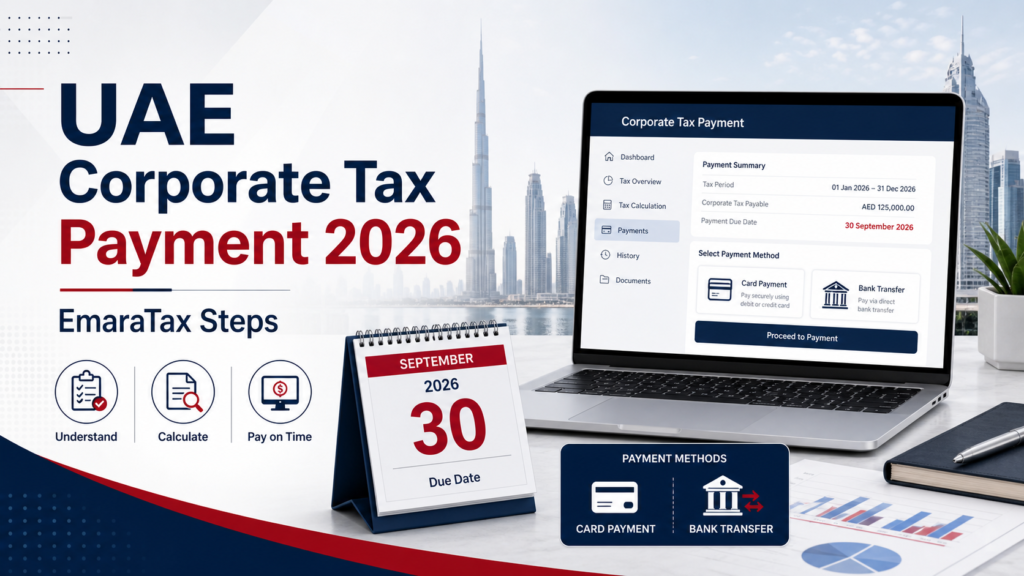
UAE Corporate Tax Payment 2026: Quick Answer
Most UAE companies with a financial year ending 31 December 2025 must file the Corporate Tax return and pay any Corporate Tax due by 30 September 2026. The Federal Tax Authority has stated that Corporate Tax returns and payable tax must be completed within nine months from the end of the tax period, unless a specific FTA decision gives a different deadline.
Published: 14 July 2026 | Last updated: 12 August 2026
This guide explains the EmaraTax payment sequence, GIBAN and card options, the 30 September 2026 calendar-year deadline, common payment mistakes and what documents to keep. Qaspro Global, a UAE-based tax and accounting consultancy, prepared it for business owners, accountants and finance teams who want the payment cleared before the deadline, not on deadline day.
Why 30 September 2026 Matters
For a UAE company whose tax period ended on 31 December 2025, the nine-month rule points to 30 September 2026. That date is important because Corporate Tax filing and payment are connected. Filing the return without settling the payable amount can still leave the company exposed to payment follow-up, late payment consequences and cash-flow stress.
The FTA has repeatedly urged taxable persons to file returns and settle Corporate Tax payable within the legally mandated timeframes. Waiting until the final day creates avoidable risk: UAE Pass login issues, bank beneficiary activation delays, card limits, wrong GIBAN references and internal approval delays can all stop payment from clearing on time.
Who Should Use This Guide?
This guide is for mainland companies, free zone companies, LLCs, sole establishments, branches and other taxable persons preparing their 2026 Corporate Tax payment process. It is especially useful if your accounting year ends on 31 December, your return produces tax payable, or you need management approval before money leaves the bank.
If your Corporate Tax return is nil, you still need to file where you are required to file. If the return shows payable Corporate Tax, payment planning should start before the return is submitted, because the approved return amount becomes the working figure for payment.
EmaraTax Payment Steps
- Log in to EmaraTax using the authorised user account or UAE Pass.
- Open the correct taxable person profile and Corporate Tax account.
- Review registration details, tax period and return status before filing.
- Complete the Corporate Tax return and upload or prepare all supporting schedules.
- Review taxable income, tax payable, available credits and any prepayments.
- Submit the return only after management approves the final numbers.
- Go to the payments area and select the outstanding Corporate Tax amount.
- Choose the available payment route shown in the system, such as GIBAN or card payment through MagnatiPay.
- Pay the exact amount with the correct reference details.
- Save the EmaraTax confirmation, bank proof, card receipt and internal approval trail.
GIBAN vs Card Payment: Which Is Safer?
| Payment route | Best for | Main risk | Practical action |
|---|---|---|---|
| GIBAN bank transfer | Larger payments, corporate approval chains and UAE bank payments. | Wrong reference, beneficiary delay or bank cut-off timing. | Add beneficiary early and copy the GIBAN details exactly from EmaraTax. |
| Card payment through MagnatiPay | Smaller payments where the card limit is enough and instant payment is preferred. | Card limit, bank security block or failed authentication. | Check card limit and bank approval before the final week. |
| Advance payment | Businesses that want to fund expected tax early. | Wrong allocation if the account is not reviewed carefully. | Match payment to the correct tax account and next return field. |
There is no single best method for every company. The safest method is the one your finance team can control, document and complete before the deadline. For larger companies, a GIBAN transfer often fits the approval workflow. For smaller balances, card payment may be faster if the limit and authentication work.
What Should You Check Before Paying?
- The tax period is correct.
- The taxable person profile is the right company, not another group entity.
- The Corporate Tax return has been reviewed and approved.
- The payable amount agrees to the final tax computation.
- Any tax credits, prepayments or adjustments are correctly reflected.
- The bank beneficiary, GIBAN or payment reference is copied exactly.
- The bank or card limit is sufficient.
- The payment proof is saved in the tax file.
Corporate Tax Payment Example
| Item | Amount | Explanation |
|---|---|---|
| Accounting profit | AED 1,200,000 | Profit before Corporate Tax adjustments. |
| Tax adjustments | AED 80,000 | Disallowed or adjusted items added back. |
| Taxable income | AED 1,280,000 | Accounting profit plus tax adjustments. |
| 0% band | AED 375,000 | Standard 0% threshold for taxable income. |
| Taxable income at 9% | AED 905,000 | AED 1,280,000 less AED 375,000. |
| Corporate Tax payable | AED 81,450 | 9% of AED 905,000, before any credits. |
In this example, the finance team should not pay from the management accounts alone. The amount should come from the completed Corporate Tax computation and the final return figures. If the company also has carried-forward losses, foreign tax credits or group relief, those schedules should be reviewed before payment.
Seven Payment Mistakes That Cause Problems
- Paying before the return is final and later discovering the amount changed.
- Using the wrong company profile in a group account.
- Copying an old payment reference from VAT or another tax account.
- Assuming the bank transfer clears instantly.
- Not checking card limits before choosing MagnatiPay.
- Saving no proof of payment in the Corporate Tax file.
- Waiting until the last day to ask the tax agent or accountant for the final number.
Documents to Keep After Payment
Keep a complete payment file. The file should include the filed Corporate Tax return, the tax computation, financial statements, management approval, EmaraTax payment screen, bank transfer confirmation or card receipt and any email confirmation. If a payment query arises later, this file helps prove when the company paid, how much it paid and which tax account it paid into.
For audit readiness, the payment file should sit with the tax return working papers, not in a separate bank folder. This makes it easier for management, auditors and tax advisers to connect the return to the payment.
Official Sources Used
Official sources: FTA information states that taxable persons must file Corporate Tax returns and settle payable tax within nine months from the end of the tax period. FTA EmaraTax pages describe online tax return submission and payment. FTA payment information says MagnatiPay accepts Visa and Mastercard prepaid, debit and credit cards, and FTA excellence information refers to paying through GIBAN or MagnatiPay.
Source links: FTA Corporate Tax deadline statement, FTA submit and pay tax return page, FTA EmaraTax page and FTA payment access information.
For businesses closing operations, read our full guide to company liquidation in UAE 2026 with tax clearance and FTA deregistration steps before finalising tax records or licence cancellation.
If an AED 10,000 late registration penalty has been paid, the waiver may result in EmaraTax credit where conditions are met. See the Corporate Tax penalty waiver UAE guide.
If payment and filing are being handled together, compare scope using the Tax Consultant Cost Dubai 2026 guide.
Frequently Asked Questions
What is the UAE Corporate Tax payment deadline for calendar-year companies?
For a company with a tax period ending 31 December 2025, the nine-month rule points to 30 September 2026 for filing and payment, unless a specific FTA decision changes that company’s deadline.
Can I pay Corporate Tax before filing the return?
You should review the live EmaraTax options in your account. The safest process is to complete the return, confirm the payable amount and then pay using the payment option shown by the FTA system.
Can Corporate Tax be paid by card?
FTA payment information says MagnatiPay accepts Visa and Mastercard prepaid, debit and credit cards. Your actual ability to pay depends on the payment option shown in your EmaraTax account and your bank or card limit.
What is GIBAN?
GIBAN means Generated International Bank Account Number. It is used for tax payments through bank transfer when shown by the FTA system. The number and reference must be copied exactly.
Do nil returns still need filing?
If the company is required to file a Corporate Tax return, a nil or zero-tax position does not remove the filing obligation. The return still needs to be submitted through the correct tax account.
What proof should I keep?
Keep the filed return, tax computation, payment confirmation, bank or card receipt, approval email and any EmaraTax confirmation screen.
Can a tax agent pay for me?
A tax agent can help prepare and review the return, but payment authorisation should be controlled by the business owner or authorised finance team. Keep clear approval records.
What if I paid the wrong amount?
Review the EmaraTax account, payment allocation and outstanding balance. If the issue is material, contact the FTA or ask a tax adviser to review the account before making another payment.
Need Help Before 30 September 2026?
Qaspro Global can prepare your Corporate Tax return, review the payable amount, reconcile the tax computation and guide your team through the EmaraTax payment file. Read also our Corporate Tax filing deadline guide, Corporate Tax return documents guide, Corporate Tax calculation guide and Corporate Tax loss relief guide. If your staff need UAE work-permit document support, see Yalah Dubai’s UAE labour card download guide.
Fiscal year reminder: If your accounting year-end does not match your business cycle, review our fiscal year deadline impact before finalising the next Corporate Tax return.

Founder & CEO, Qaspro Global — UAE tax expert with 16+ years of experience in VAT, corporate tax and FTA audit support.