
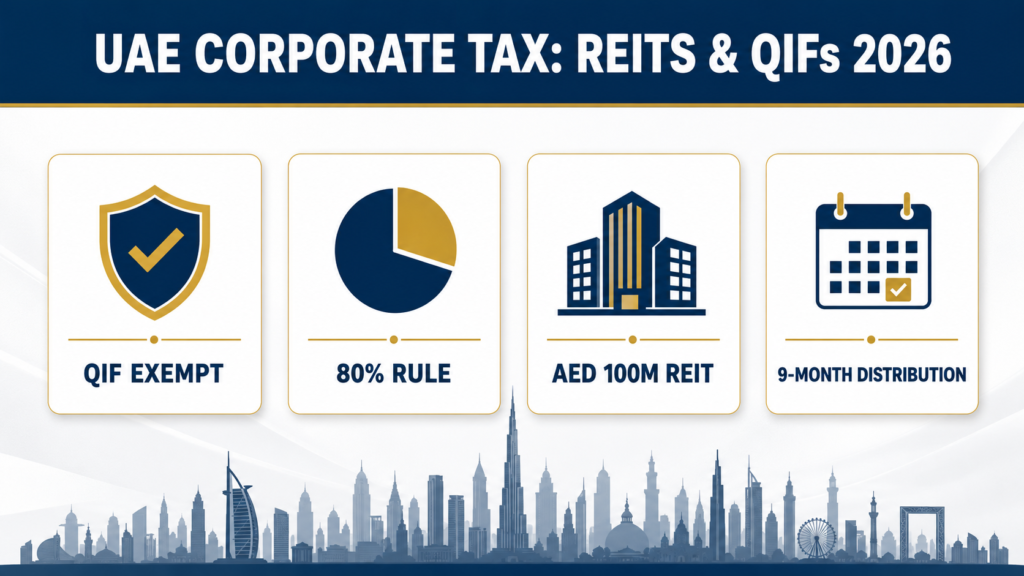
Only 20% of a REIT’s property income is taxable under UAE Corporate Tax in 2026 — but only if the fund distributes 80% or more within 9 months. Miss that window and the full amount lands on your investors’ returns.
Cabinet Decision No. 34 of 2025, published by the UAE Ministry of Finance on 5 April 2025, replaced Cabinet Decision No. 81 of 2023 and introduced a significantly revised framework for Qualifying Investment Funds (QIFs), Qualifying Limited Partnerships (QLPs), and Real Estate Investment Trusts (REITs) under Federal Decree-Law No. 47 of 2022. The new rules apply to tax periods beginning on or after 1 January 2025, meaning the first returns affected are due by 30 September 2026.
This guide explains what the decision means for fund managers, institutional investors, and foreign entities holding interests in UAE investment funds — including the critical 80% distribution threshold, diversity of ownership conditions, REIT asset tests, and the reduced registration relief that applies when the distribution condition is met.
What Changed Under Cabinet Decision No. 34 of 2025?
The biggest shift is how QIFs are treated for Corporate Tax purposes. Under the old Cabinet Decision No. 81 of 2023, QIFs were treated as tax-transparent entities, meaning income flowed through to investors who were taxed on their share. Under Cabinet Decision No. 34 of 2025, QIFs are instead exempt from UAE Corporate Tax at the fund level — provided the fund meets the qualifying conditions.
This is a meaningful upgrade for fund structures. Instead of pass-through taxation, the fund itself holds exempt status. The investor-level tax position only becomes relevant when the fund fails a condition or when specific income types such as UAE immovable property income are involved.
The decision also removed the investment manager condition that previously had to be met for a fund to qualify as a QIF. This simplifies the eligibility test for funds that appoint third-party managers.
What Conditions Must a QIF Meet to Stay Exempt?
A fund qualifies for the Corporate Tax exemption when it satisfies all of the following conditions:
| Condition | Requirement | Consequence if Failed |
|---|---|---|
| Principal business activities | Must be Investment Business only | Fund loses exempt status |
| Investor control | Investors must not control day-to-day operations | Fund loses exempt status |
| Information provision | All information needed to calculate adjusted Taxable Income must be provided to investors | Fund loses exempt status |
| Diversity of ownership | Concentration limits apply based on number of investors (see below) | Only the breaching investor is affected, not the whole fund |
| Real estate asset threshold | UAE immovable property must not exceed 10% of total assets | 80% of real estate income becomes taxable for investors |
How Does the Diversity of Ownership Condition Work?
The diversity of ownership test has two thresholds depending on how many investors the fund has:
- Fewer than 10 investors: a juridical investor and its Related Parties must not hold 30% or more of the fund’s ownership interests. If the threshold is breached, that investor must include its prorated share of the fund’s net profit in its own taxable income.
- 10 or more investors: the concentration limit rises to 50%. The same consequence applies to the breaching investor only.
Importantly, a breach by one investor does not disqualify the entire fund as a QIF. The exempt status remains intact for the other investors. This is a significant improvement over older transparency-based rules, where a concentration breach could have broader consequences for the fund structure.
What Is the 80% Rule for REIT Investors?
The 80% rule is the most commercially significant provision in Cabinet Decision No. 34 of 2025 for real estate fund investors.
Where a QIF breaches the 10% real estate asset threshold, or where investors hold interests in a REIT, the taxable income calculation works as follows: only 80% of the Immovable Property Income derived through the fund or REIT is included in the investor’s adjusted taxable income. This 80% treatment aligns with the regulatory distribution requirements that apply to REITs in the UAE.
However, there is a crucial exception:
This creates a straightforward planning decision for fund managers: distribute at least 80% of property income within 9 months and investors have no taxable inclusion. Fail to distribute and each investor includes 80% of their prorated share in their taxable income when they calculate their Corporate Tax return.
What Are the Conditions for a REIT to Qualify as an Exempt QIF?
A REIT must satisfy additional conditions beyond the general QIF test to qualify for exempt status:
| REIT Condition | Requirement |
|---|---|
| Minimum real estate asset value | UAE immovable property (excluding land) exceeding AED 100 million |
| Ownership structure | Wholly owned by 2 or more unrelated institutional investors |
| Asset composition | At least 70% of assets must be income-generating rental property (property held purely for capital appreciation is excluded from this test) |
| Stock exchange listing | First-time listings must float at least 10% of shares on a recognised exchange |
| Share subscription restriction | The REIT and its related parties or connected persons must not subscribe to shares floated on the recognised exchange |
| Institutional investors | Federal and Local Governments are no longer included in the institutional investor definition |
What Is the Reduced Registration Relief for Foreign Investors?
Foreign juridical investors in QIFs and REITs that distribute 80% or more of their income within 9 months of the financial year end benefit from reduced Corporate Tax registration obligations in the UAE. This is a significant practical relief for non-resident institutional investors who would otherwise face UAE registration, filing, and payment requirements purely because of their fund interest.
How Does the FTA’s July 2026 Clarification Affect QIF and REIT Investors?
The Federal Tax Authority updated its Corporate Tax guidance on 15 July 2026 with new private clarification material covering investment fund scenarios. Key points confirmed by the FTA include:
- The taxable income of an investor in a REIT that qualifies as an exempt QIF is limited to their share of net income available for distribution, excluding unrealised gains. Investors are not taxed on paper appreciation in the fund’s property values.
- Non-resident investors in Qualifying Limited Partnerships who earn only UAE state-sourced income are not automatically required to register for or file a UAE Corporate Tax return. Whether a registration obligation arises depends on the specific facts, including the nature of their income and any applicable treaty protections.
The FTA guidance update follows a broader summary of Corporate Tax private clarifications issued up to May 2026 that the authority published alongside. Qaspro Global reviews these clarifications as they are released to help clients assess their impact before the September filing deadline.
How Do QIF Rules Interact With the Participation Exemption?
Where an investor holds an interest in a QIF that does not hold UAE immovable property above the 10% threshold, the QIF is fully exempt and no income flows to the investor as taxable income. In that scenario, the UAE Participation Exemption may also be relevant for investors who hold a qualifying ownership interest in the QIF, depending on how the fund is structured and classified.
For holding structures that invest through a UAE holding company, the interaction between the QIF exemption, the Participation Exemption, and the new REIT rules requires careful analysis before the first tax return is filed.
What About Unincorporated Partnerships and Family Foundations?
Cabinet Decision No. 34 of 2025 also addressed Qualifying Limited Partnerships (QLPs), which are treated as tax-transparent for UAE Corporate Tax purposes in most circumstances. The QLPs rules run alongside the QIF framework but address different structures. For unincorporated partnerships and family foundations, separate provisions apply under the Corporate Tax Law.
How Does Rental Income From Funds Compare to Direct Rental Income?
Businesses that hold UAE real estate directly rather than through a fund should review how rental income is taxed under the Corporate Tax Law compared to the REIT and QIF rules. For direct property holders, rental income is generally part of taxable income. Through a qualifying REIT that meets the 80% distribution condition, the taxable income inclusion can be zero for the relevant period.
For individuals or foreign investors considering either structure, investors who are also planning to visit the UAE to evaluate fund opportunities should note that the UAE visit visa rules for 2026 now include new categories for business exploration and AI specialists under ICP decisions announced in 2025.
What Should Non-Resident Companies With UAE Fund Interests Do Before September 2026?
The Corporate Tax rules for non-resident and foreign companies apply when a non-resident has a nexus in the UAE. A UAE real estate interest through a REIT or QIF that fails the distribution condition may create such a nexus, triggering registration and filing obligations. Non-resident investors should confirm:
- Whether the fund they are invested in qualifies as an exempt QIF under Cabinet Decision No. 34 of 2025
- Whether the 80% distribution condition is expected to be met, and within the 9-month window
- Whether reduced registration relief applies or whether a full registration is required
- Whether any double tax treaty between the UAE and their country of residence provides further relief
These assessments should be completed well before the payment and filing deadline of 30 September 2026. If registration is required and has not been completed, the AED 10,000 late registration penalty applies.
How Does Loss Relief Interact With QIF Investments?
Where investors are required to include their prorated share of QIF income in their taxable income due to a concentration breach or real estate threshold breach, they may also be able to utilise Corporate Tax loss relief under Article 37 of the Corporate Tax Law to offset those inclusions, subject to the 75% taxable income cap and ownership continuity conditions.
Frequently Asked Questions
Is a REIT itself subject to UAE Corporate Tax?
A REIT that qualifies as an exempt Qualifying Investment Fund under Cabinet Decision No. 34 of 2025 is not subject to UAE Corporate Tax at the fund level. Taxation depends on whether investors meet the 80% distribution condition and whether individual investors breach diversity of ownership thresholds.
What is the 80% distribution rule in simple terms?
If a REIT pays out at least 80% of its UAE property rental income to investors within 9 months of the financial year end, those investors do not include any REIT property income in their taxable income for that year. If the REIT does not distribute enough, investors must include 80% of their prorated property income in their own Corporate Tax return.
What is the AED 100 million threshold for REITs?
A REIT must hold UAE immovable property (excluding bare land) with a value exceeding AED 100 million to qualify as an exempt QIF under Cabinet Decision No. 34 of 2025. REITs below this threshold do not meet the conditions for exempt status under this specific rule.
Does a foreign investor in a UAE REIT need to register for Corporate Tax?
Where the REIT distributes 80% or more of its Immovable Property Income within 9 months, foreign juridical investors benefit from reduced registration obligations. If the distribution condition is not met, registration may be required depending on the nexus created by the UAE income. Seek advice before assuming no registration is needed.
What was changed from Cabinet Decision No. 81 of 2023?
Cabinet Decision No. 34 of 2025 replaced Cabinet Decision No. 81 of 2023 and changed QIFs from tax-transparent entities to exempt entities, removed the investment manager condition, revised the diversity of ownership thresholds and consequences, and updated the REIT conditions including the exclusion of Federal and Local Governments from the institutional investor definition.
Can unrealised gains from a REIT increase my taxable income?
No. The FTA confirmed in its July 2026 private clarifications update that the taxable income of an investor in a REIT qualifying as an exempt QIF is limited to their share of net income available for distribution, specifically excluding unrealised gains. Paper appreciation in property values does not create a taxable event.
Is a Qualifying Limited Partnership the same as a Qualifying Investment Fund?
No. Qualifying Limited Partnerships (QLPs) are treated as tax-transparent for UAE Corporate Tax purposes and are governed under the same Cabinet Decision No. 34 of 2025 alongside QIFs. QLPs are pass-through structures, while QIFs that meet the conditions are fully exempt at the fund level.
What happens if a QIF fails the 10% real estate threshold?
If a QIF holds UAE immovable property exceeding 10% of its total assets, it loses the general QIF exemption for that property income. Instead, only 80% of the real estate income derived through the fund becomes taxable for investors. The remaining non-real-estate income of the fund retains the exempt treatment if other conditions are met.
When does Cabinet Decision No. 34 of 2025 first apply?
The decision applies to tax periods beginning on or after 1 January 2025. For a company with a calendar financial year, the first Corporate Tax return under these rules must be filed by 30 September 2026 via EmaraTax.
How Qaspro Global Helps
Understanding whether your fund interest triggers UAE Corporate Tax registration, how to document the 80% distribution test, and what to include in your first Corporate Tax return requires precise application of Cabinet Decision No. 34 of 2025 to your actual fund structure. Qaspro Global works with fund managers, institutional investors, and foreign entities to assess their position before the 30 September 2026 deadline.
Contact Qaspro Global on WhatsApp: +971 55 153 9679 for a direct conversation about your fund’s Corporate Tax position.
Related Reading
- UAE Corporate Tax Exemptions 2026: Complete List
- UAE Participation Exemption 2026
- UAE Corporate Tax for Holding Companies 2026
- Unincorporated Partnerships and Family Foundations: Corporate Tax 2026
- UAE Corporate Tax on Rental Income 2026
- Corporate Tax for Non-Resident and Foreign Companies UAE 2026
- UAE FTA Private Clarifications 2026
- UAE Corporate Tax Filing Deadline September 2026
- UAE Corporate Tax Payment via EmaraTax 2026
- UAE Corporate Tax Registration 2026
- UAE Corporate Tax Late Registration Penalty Waiver 2026
- UAE Corporate Tax Loss Relief 2026

Founder & CEO, Qaspro Global — UAE tax expert with 16+ years of experience in VAT, corporate tax and FTA audit support.