
Published: 3 November 2026
Manual review of a UAE company’s books usually checks a sample: a few dozen transactions picked from thousands. Automated controls can screen every single entry against a set of rules, and flag the ones that look wrong for a person to examine. For a finance manager or CFO, that changes the question from “did we happen to pick the bad transaction?” to “what did the screening flag, and what did a qualified accountant decide about it?” This is part of our wider guide to AI accounting automation in the UAE. If you also manage staff contracts, our sister site Yalah Dubai explains the UAE non-compete clause and what to check before signing.
This article is a practical deep-dive for finance managers. It explains why sampling leaves gaps, which control checks automation can run across all entries, which judgments must stay with a qualified accountant, what a late error really costs, and which controls to demand from any provider before you give them access to your books. We do not describe any provider’s internal method here, and nothing in this article is a tax position. It is about the quality and safety of your accounting records.
Why Manual Review Only Catches Part of the Picture
Manual review is built on samples because people cannot read every line. A reviewer in a month-end close looks at the largest items, the unusual-looking items and a handful of random ones. Everything else is trusted. That is a sensible use of limited hours, but it means an error or a fraudulent entry that is small, well disguised or simply unlucky in the draw can sit in the ledger for months.
Three structural limits make this worse in busy teams:
- Time pressure at close. Review is squeezed into the last days before reporting, so reviewers prioritise by size, not by pattern.
- Familiarity blindness. A reviewer who sees the same supplier names every month stops noticing a changed bank detail or a near-duplicate invoice number.
- Pattern invisibility. Some problems are only visible across many entries: the same amount paid twice in different weeks, a series of payments each just under an approval limit, or one person raising and approving the same item. No sample reveals a pattern that is spread across the whole year.
Automated screening does not get tired and does not skip the small items. It applies the same rules to every entry, every time. That is its real value: coverage and consistency, not judgment.
What Automated Controls Can Screen Across Every Entry
Automation is best at rule-based and pattern-based checks that are tedious for people but easy to express as a rule. The list below is the set most finance managers find useful. Each is a flag for review, not a verdict.
| Control check | What the screening looks for | Why it matters |
|---|---|---|
| Unusual amounts | Entries far outside the normal range for that account or supplier | Catches keying errors (an extra zero) and out-of-pattern payments |
| Round-sum payments | Payments in exact round figures where invoices are normally uneven | Round sums can signal estimates, advances or invented items |
| Just-below-limit payments | Amounts sitting just under an approval threshold, or a series of them | A classic way to avoid a second approval |
| New or changed supplier bank details | A supplier’s bank account changed shortly before a payment | A common route for payment-redirection fraud |
| Out-of-hours or weekend postings | Entries posted at unusual times or on non-working days | Worth a second look when it is not a normal pattern for that user |
| Same person creates and approves | One user both raising and approving an entry | A direct segregation-of-duties conflict |
| Vendor and employee overlaps | A supplier whose bank account, phone or address matches an employee’s | A known sign of a conflict of interest or a fictitious supplier |
| Unmatched receipts and documents | Payments or expenses with no matching invoice, receipt or purchase order | Missing support is the most common audit finding |
| Duplicate entries | Same supplier, amount and date range posted more than once | Overpayment and double-booking |
For the specific money leaks that come from duplicate supplier payments, late fees and missed supplier credits, see our separate article on manual accounting leaks in UAE businesses. We do not repeat that material here. This article is about the controls that find the problem early, whatever its source.
One-line example from a trading company: a screening rule that compares each supplier payment against that supplier’s saved bank details would flag a payment sent to a different account than the one used for the last twelve payments. A person then calls the supplier on a known number to confirm before the payment is released. The rule finds it; the human settles it.
What Must Stay With a Qualified Accountant
A flag is a question, not an answer. Most flags have an innocent explanation: a genuine one-off purchase, a supplier that really did change banks, a month-end posting done late at night. Deciding which is which is judgment, and it needs context that a rule does not have.
These responsibilities must remain with a qualified accountant, whatever the automation does:
- Deciding whether a flag is a real problem. Is the unusual amount a mistake, a legitimate exception or a sign of something worse?
- Using business context. A large payment may be normal during a project launch. Only someone who knows the business can tell.
- Escalation. Deciding who must be told, how quickly, and whether the matter goes to management, the board or an external adviser.
- Sign-off. Taking professional responsibility for the books. Software cannot sign.
- Designing segregation of duties. Who may raise, approve, pay and reconcile is a design decision for the organisation. Automation can enforce a design and report breaches of it, but it cannot decide what the right design is for your size and risk.
- Deciding the rules and thresholds themselves. Too tight and the team drowns in false alerts. Too loose and real problems pass. Tuning needs judgment and regular review.
The position we hold is simple: AI does the routine screening, and qualified accountants review the flags and sign off. Nobody should claim that AI alone replaces an accountant, and any provider who implies it is a risk in itself.
Before and After: Hours, Error Risk and Cost
The table below compares a manual-sampling approach with automated screening plus human review. The AED figures are a hypothetical illustration on stated assumptions, not a measurement of any real business and not a promise of results. Replace the assumptions with your own numbers.
Assumptions for the illustration: a company posts 4,000 entries a month; a reviewer can check about 40 entries an hour; manual review samples 10 percent of entries; the reviewer’s loaded cost is AED 80 an hour; one undetected error is assumed to cost AED 5,000 to unwind when found late.
| Item | Manual sampling | Automated screening plus human review |
|---|---|---|
| Entries checked each month | 400 (10 percent sample) | 4,000 screened; only flagged items reviewed by a person |
| Reviewer hours on checking | 10 hours (400 entries at 40 an hour) | Illustration: 200 flags at 20 an hour = 10 hours, plus rule upkeep |
| Review cost at AED 80 an hour | AED 800 | AED 800 (similar hours, much wider coverage) |
| Share of entries any control looks at | 10 percent | 100 percent screened |
| Chance a pattern across months is seen | Low | High, because the rules run on every entry |
| Illustration: undetected errors found late (assume 6 a year) | 6 x AED 5,000 = AED 30,000 | Assume 2 slip through: 2 x AED 5,000 = AED 10,000 |
| Illustration: yearly difference | AED 20,000 less late-detection cost, on these assumptions only (illustration) | |
Notice what this illustration shows and what it does not. The saving does not come from fewer reviewer hours. The hours are similar. The gain is that the same hours are spent on the entries that most need a person, instead of on a random tenth of the ledger. The figures for how many errors slip through are assumptions, and your real numbers could be better or worse. Treat the table as a template for your own calculation.
The Hidden Cost of Late Detection
An error found three months late costs more than the error itself. The amount on the entry is the smallest part of the bill. A finance manager should count the following:
- Misstated books. Management reports, covenants and decisions built on figures that were wrong. Every report since the error may need correcting.
- Wrong figures reaching authorities. Where an incorrect figure fed a filing, the correction and any resulting penalty are a direct cost. Check the exact consequences with the relevant authority or your adviser for your own situation.
- Lost cash. A payment sent to the wrong account or paid twice is often hard to recover, and the chance of recovery falls with every week of delay.
- Audit findings. Late-found errors and missing support become audit findings, which cost team time and erode the auditor’s trust in your controls.
- Time spent unwinding. Reversing entries, re-running reports, contacting suppliers and re-reconciling accounts can take far longer than the original task.
- Pressure on the close. A month that is delayed by clean-up pushes the next month late too. Our article on a two-day month-end close with AI explains how early detection supports a faster close.
Early detection compresses all of this. A flag raised on the day of posting is a ten-minute check. The same issue found at quarter end is a project.
Risks and Controls to Demand From Any Provider
Giving a provider access to your ledger, bank feeds and supplier details is itself a risk. Whether you work with a firm that uses AI tools or buy software directly, ask for these controls, and expect clear answers in writing.
1. Human review of every flag. Who looks at each flag, what is their qualification, and how fast must they respond? A tool that produces alerts nobody reads is worse than no tool, because it creates a false sense of safety.
2. An immutable audit trail. Every entry, change, approval and flag decision should be logged with who, what and when, and the log must be impossible to edit or delete after the fact. Ask: can an administrator change history? If the answer is yes, the trail is not reliable evidence.
3. Role-based access. Each person should see and do only what their role needs. Ask how access is granted, reviewed and removed when someone leaves.
4. Data security and UAE personal data law. Ask where your data is stored, who can access it, how it is encrypted, and how the provider meets the requirements of the UAE Personal Data Protection Law (Federal Decree-Law No. 45 of 2021) where personal data of employees, customers or suppliers is involved. Ask for the answer in the contract, not only in a brochure.
5. A handling process for false positives. Every screening system raises false alarms. Ask how they are recorded, how rules are tuned so the same false alarm does not repeat endlessly, and who approves a rule change.
6. Clear alert routing. Who is told when something serious is flagged: the accountant only, the finance manager, the owner? Serious flags, such as a changed bank detail on a large payment, should reach a named senior person, not sit in a shared inbox.
7. Segregation of duties preserved. The provider’s own team should not both prepare and approve payments for you. Ask how the provider separates those roles internally.
8. Exit and data return. Ask how you get your data and the full audit trail back if you leave.
A Finance Manager’s Readiness Checklist
Use these questions to judge your own readiness, or to test any provider. A clear “yes” is a good sign; a vague answer is a reason to ask again.
- Can we state which share of our entries any control checks today, in numbers?
- Do we have written approval limits, and do we know whether any payments cluster just below them?
- Is a change to a supplier’s bank details verified by a call to a known number before the next payment?
- Can the same user raise and approve an entry in our system? If so, is it reported?
- Do we compare supplier bank details, phone numbers and addresses with our employee records?
- Is every payment matched to an invoice and a receipt or order before release?
- Is there an audit trail that no administrator can edit?
- Who reviews each flag, how quickly, and how is the decision recorded?
- How are false positives tracked and the rules tuned?
- Who is alerted for serious flags, and is that person named in writing?
- Where is our data stored, and does the contract address the UAE Personal Data Protection Law?
- Have we measured how long an error stays undetected today, from posting to discovery?
If you cannot answer questions 1, 7 or 12, start there. Those three show how much of your ledger is truly controlled, whether your evidence can be trusted and how costly late detection is for you.
How This Connects to Your Other Finance Routines
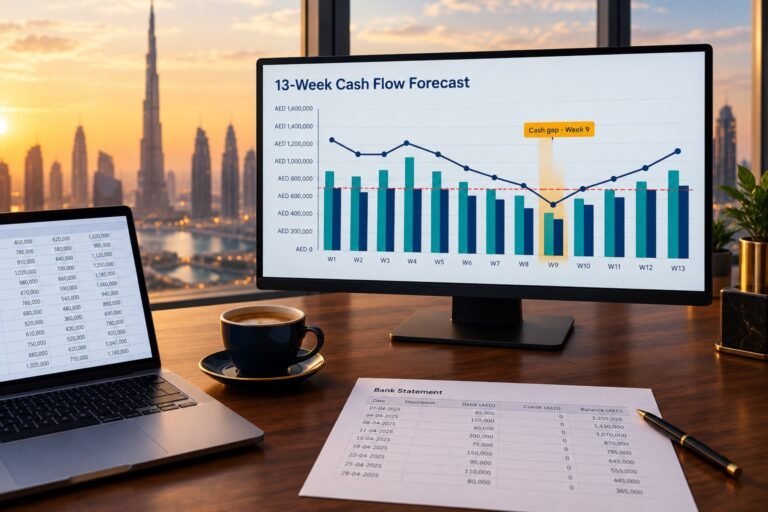
Controls work best when they feed routines you already run. Automated screening of bank movements pairs naturally with bank reconciliation automation, because an unmatched receipt or payment is both a reconciliation item and a control flag. A short list of the five numbers an owner needs each week, covered in our owner dashboard article, becomes more trustworthy when the underlying entries have been screened. And a forward look at cash, as described in our 13-week cash flow forecast guide, is only as good as the payables and receivables behind it.
Frequently Asked Questions
Can automated controls really screen every transaction?
Yes, for rule-based and pattern-based checks. A rule such as “flag any payment to a supplier whose bank details changed in the last 30 days” can run on every payment. What automation cannot do alone is decide whether a flag is a real problem. That step needs a qualified accountant.
Does automation replace the accountant or the auditor?
No. Automation does the routine screening. A qualified accountant reviews the flags and signs off the books, and an external auditor, where required, gives an independent opinion. AI alone does not replace either role.
What kinds of fraud signals can automation flag?
Common examples are payments just under an approval limit, round-sum payments, changed supplier bank details, entries raised and approved by the same person, suppliers whose details match an employee’s, and postings at unusual times. These are signals for review. None proves wrongdoing by itself.
What is a false positive, and why do they matter?
A false positive is a flag on something that turns out to be perfectly normal. Too many of them wear out the team and cause real alerts to be ignored. A good process records each one and tunes the rules, with a named person approving each change.
What is an immutable audit trail?
It is a record of every entry, change, approval and flag decision, with who and when, that nobody can alter or delete afterwards, including administrators. It is the evidence that shows what really happened in your books.
How does this relate to segregation of duties?
Segregation of duties means different people raise, approve, pay and reconcile. Automation can enforce your design and report any breach, such as one user creating and approving the same entry. Deciding the right design for your size and risk remains a management and accountant decision.
Is my data safe if a provider uses AI tools?
It depends on the provider’s controls. Ask where data is stored, who can access it, how it is encrypted, how access is removed, and how the provider complies with the UAE Personal Data Protection Law (Federal Decree-Law No. 45 of 2021). Get the answers in writing.
How quickly should a serious flag be reviewed?
Set the expectation in writing before you start. For a high-risk flag, such as a changed bank detail on a large payment, same-day review before release is a reasonable standard to ask for. The right timing for your business is a decision for you and your accountant.
Do small businesses need automated controls, or is this only for large companies?
Smaller companies often have fewer people and therefore weaker natural separation of duties, so screening can help them more. The checklist above scales: start with the questions you cannot answer today.
What should we measure to know whether controls are working?
Track the share of entries screened, the number of flags raised, how many were real, how long each took to resolve, and how long real errors stayed undetected before and after. If you do not measure these, you cannot show improvement.
Next Step
If you want a second opinion on how well your accounting records are controlled today, or want to test what a provider is promising against the checklist above, speak to our team. A qualified accountant will go through your current routines with you.
WhatsApp us on +971 55 153 9679 to start the conversation. For the full picture of what can and cannot be automated, read our AI accounting automation guide for the UAE.
Related Reading
- Manual accounting leaks: duplicate payments, late fees and supplier credits
- Bank reconciliation automation in the UAE
- Month-end close in 2 days instead of 10
- The 5 numbers on an owner dashboard
- 13-week cash flow forecast for a UAE business

Founder & CEO, Qaspro Global — UAE tax expert with 16+ years of experience in VAT, corporate tax and FTA audit support.