
Published: 2 August 2026
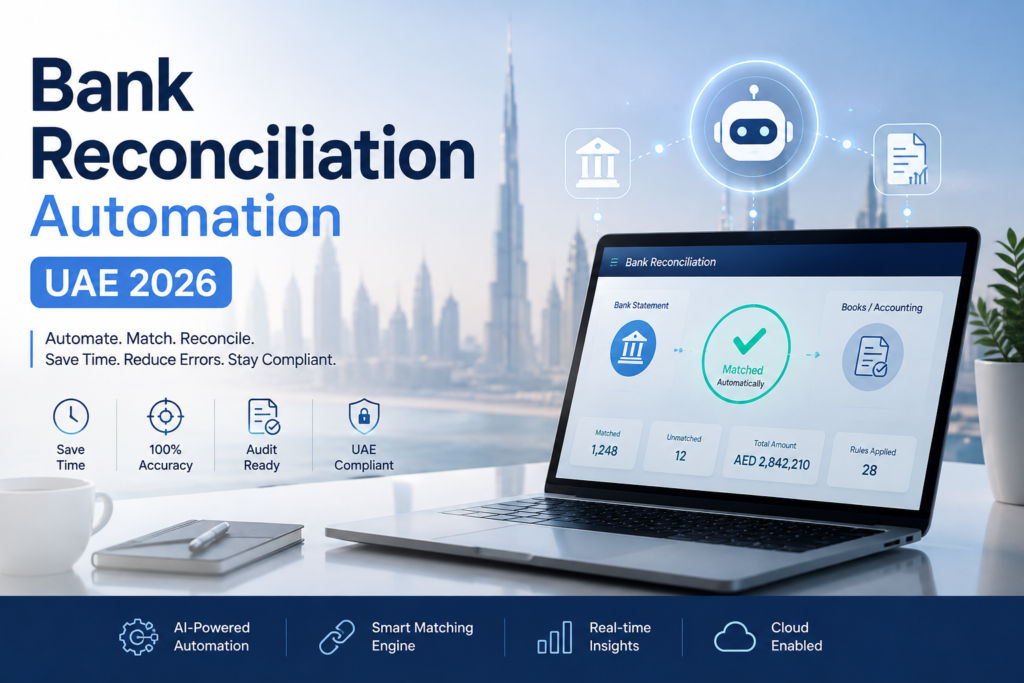
Bank reconciliation automation UAE 2026 is no longer a future idea for accounting departments. For UAE businesses, it is now a practical way to stop using staff hours on repetitive statement matching, formula checking, PDF conversion, and month-end catching up.
Bank reconciliation is simple in principle: every bank movement must agree with the accounting records, invoices, receipts, payments, card settlements, transfers, and adjustments behind it. In practice, it becomes slow when a company has several bank accounts, multiple payment channels, repeated supplier payments, salary batches, card collections, loan repayments, intercompany transfers, and month-end adjustments all landing in the same statement.
That work used to need a person sitting with Excel, the bank statement, the ledger, and the supporting documents. The person would check line after line, highlight matches, investigate missing entries, and then prepare a summary for the owner or finance manager. That is exactly the type of work AI and automation should now handle.
At Qaspro Global, this is a real product we run for clients, not a concept: Bank Reconciliation Automation, built to reconcile real UAE bank accounts every single day. The practical advantage is not that automation sounds modern. The advantage is that the same control process runs daily, checks every line, produces a clear exception report, and sends the result without waiting for someone to start the work manually.
Why This Matters for Employers
This matters because employers are making a direct cost decision: should the company hire more accounting staff, or should the repetitive reconciliation work be handled by a machine-supported process?
For many UAE businesses, the old answer was hiring. As transaction volume increased, the finance team needed another accountant, another assistant accountant, or another part-time bookkeeper. The reason was not always technical complexity. It was volume. Someone had to open statements, convert files, sort data, compare entries, follow formulas, prepare reports, and chase missing items.
Automation changes that calculation. Thirty transactions and three thousand transactions can move through the same designed control process. The system does not get tired after the first hundred lines. It does not skip small entries because the statement is long. It does not lose patience because the bank layout changed from the previous month. It checks the full file, follows the same logic, and surfaces what needs attention.
This is why the employer angle is important. Bank reconciliation is not only an accounting task. It is a staffing, cost, control, and management information issue. If the work can be done daily by automation, the business owner does not need to wait until month-end to find out whether cash records are clean.
The Old Way vs The AI Era
The old way was familiar to almost every accountant. Download a PDF bank statement from the bank portal. Run it through a free online PDF-to-Excel converter. Clean the rows because the converter moved dates, descriptions, balances, or debit and credit columns into strange places. Then match entries manually, or use VLOOKUP formulas that break when the bank changes its statement layout.
That method worked only because accountants were patient, not because the method was good. A free converter could split one transaction across two rows. A narration could shift into the wrong column. A running balance could be read as a debit amount. A VLOOKUP could match the wrong amount when the same supplier payment appeared more than once. A formula could look correct and still miss a timing difference.
That is the old method, and it is over, this is the AI era now.
In the AI era, the goal is not to make a slightly better spreadsheet. The goal is to remove the repetitive matching burden from the employee. The system reads the available banking and accounting evidence, compares the movements, separates clean matches from real exceptions, and prepares the reconciliation output in a form the business can use.
The finance team should not spend its best hours repairing converted bank statements. Staff should not be paid to fight broken columns. Employers should not add headcount because Excel formulas cannot keep up with bank formats. A modern reconciliation workflow treats statement matching as machine work and treats judgment, policy, approval, and business decisions as management work.
What Automated Bank Reconciliation Actually Does
Automated bank reconciliation takes the daily bank activity and compares it with the company’s accounting records and source documents. It identifies entries that match, entries that are missing, entries that appear in the bank but not in the books, entries that appear in the books but not in the bank, duplicated records, unclear narration, timing differences, bank charges, card settlement gaps, and unusual movements.
The important point is consistency. The same checks run every day. The same reporting structure is produced. The same exception categories are used. The same discipline applies whether the company has one bank account or many.
| Area | Manual reconciliation | Automated reconciliation |
|---|---|---|
| Statement handling | Staff downloads, converts, cleans, and formats files | Statement is read and processed through the designed workflow |
| Matching | Manual checking, filters, formulas, and repeated review | Every line is compared against the available records |
| Volume | More transactions mean more staff time | Same effort at 30 transactions or 30,000 |
| Reporting | Prepared after the person finishes checking | Generated automatically after the reconciliation run |
| Email summary | Someone writes and sends it | Sent automatically to the agreed recipients |
| Control | Depends heavily on individual discipline | Runs the same checks on every cycle |
This does not mean accounting judgment disappears. It means the repetitive checking is removed from the person. The system does the heavy comparison work and presents the result clearly. That is where automation gives employers the strongest return: less routine labour, faster visibility, and fewer missed entries hiding inside long statements.
How Bank Reconciliation Actually Gets Done Now
This is our approach, the one we run for real UAE clients every day, not the old manual method.
- The day’s statement gets read the moment it arrives. No one has to open it, convert it, or start the process manually.
- Every single line gets checked against the accounting records, not sampled. Nothing gets skipped because the statement is long or the month was busy.
- Clean matches post themselves. A transaction that agrees with the records, amount, date, reference, moves straight to the ledger. No one has to touch it.
- Real gaps get separated from noise. A line only gets flagged if it is a genuine mismatch, not a normal timing difference that would clear on its own.
- Staff confirm only the exceptions that actually need a decision. That is the one place a person is still involved, and it is by design, not because the system could not go further.
- Confirmed entries post automatically once approved. There is no separate manual posting step afterward.
- The reconciliation closes itself the same day. Balances agree without anyone recalculating by hand.
- A report goes out immediately, in Excel. It shows what matched, what was flagged, what got confirmed, and what was posted.
How We Handle a Large Bank Statement
This is the same approach, run at real volume, not a different manual technique for bigger statements.
- The process does not change with size. Thirty lines and ten thousand lines go through the identical check, there is no batching by date range or account required from anyone.
- Every line gets the same treatment. A recurring supplier payment and an unfamiliar transaction both get checked, nothing is skipped because the statement is long.
- Volume does not create a backlog. A big statement does not sit waiting for someone to find time for it, it gets processed the same day as a small one.
- Exceptions still get confirmed by staff, no matter the size. A large statement means more matched lines, not less review of the real exceptions.
This is the actual difference between our approach and the old way of batching, prioritising, and chasing a long statement by hand. Volume that used to mean more staff hours now means the same process, run once, on more lines.
A 24/7 Employee That Never Needs Hiring
A properly designed reconciliation automation works like a 24/7 employee that never needs hiring, training, sick leave, annual leave, replacement, or supervision to begin the task.
The system can run daily automatic bank reconciliation. It can generate reports automatically. It can send email summaries automatically. It can run at set times without anyone pressing a start button. It can keep checking the same way every day, including weekends and public holidays, depending on how the business wants its reporting cycle designed.
There is exactly one manual step in the whole process: a staff member drops the day’s bank statement into a folder once a day.
That manual step is kept manual on purpose for security. It is a deliberate choice, not a technical limitation. Bank data is sensitive. Many UAE businesses do not want full unattended access to bank portals, credentials, approvals, or banking environments. Keeping the statement drop as a controlled human action gives the business a clear security checkpoint while still removing the actual reconciliation workload from staff.
After that one daily document drop, the workflow runs. It reads the statement. It compares the entries. It checks the accounting records and support available to it. It prepares the reconciliation result. It generates the report. It sends the summary email. Nobody needs to open a converter, repair columns, refresh formulas, or prepare the same reconciliation summary again from scratch.
The Real Advantage Is Scale
The strongest reason to automate bank reconciliation is scale. A business with thirty bank transactions a month can reconcile manually. It may still waste time, but it is manageable. A business with one thousand, three thousand, or ten thousand transactions a month has a different problem. Volume changes the risk.
When a human checks a long bank statement, fatigue matters. Repeated amounts become confusing. Similar supplier names blur together. Card settlements need splitting. Bank charges are easy to miss. Transfers between accounts can be entered twice or not entered at all. A small duplicated receipt may not be noticed until the month-end report looks wrong.
Automation does not treat the first hundred lines differently from the last hundred lines. Thousands of transactions a month get handled the same way as thirty. Every line is checked. Every exception is placed into a report. The system does not slow down because the business grew.
This is where UAE employers should look carefully at the cost of manual accounting work. Hiring another employee may solve today’s backlog, but it does not redesign the process. Automation redesigns the process. It gives the business a structure that can handle growth without turning every increase in transaction volume into another hiring decision.
Using AI in Excel to Clean Client Files? How to Make It Repeatable and Auditable
Short answer: stop letting the AI edit the data directly. Use AI to help design the cleaning rules, then run those fixed rules the same way on every file, keep the original untouched, and log what each run changed. A cleaning step is repeatable only if someone else can run it on the same input and get the same output, and auditable only if the change record shows what was altered and why.
When an AI tool changes cells inside a workbook, there is usually no saved record of the steps, the prompt may be reworded next month, and the result can differ between runs. That is the gap an auditor or reviewer will find. A workable control set looks like this:
- Keep the raw file read-only. Save the original statement or client export unchanged, and do all cleaning on a copy.
- Write the rules down once. Encode the cleaning as saved steps, such as a Power Query query in Excel or a version-controlled script, instead of one-off prompts. Power Query records each applied step, so the same query can be refreshed on next month’s file.
- Separate raw, cleaned and output areas. Do not overwrite imported data with cleaned values.
- Produce a change report on every run. Row counts before and after, rows removed or merged, values altered and anything flagged for a person to review.
- Record who approved the result. Date, preparer, reviewer and the version of the rules used.
- Re-test when the source format changes. A new bank layout or export format can silently break a saved rule, so compare totals against the source after the first run on any new format.
For bank statements this is the same logic as the daily process described above: the rules are fixed, every line is checked, exceptions are separated for a person to decide, and a report is produced each run. That is what turns a one-off AI cleanup into a control a reviewer or external auditor can follow. For what auditors expect to see, read our guide to external audit requirements in the UAE.
Daily Reconciliation Is Better Than Month-End Reconciliation
Month-end reconciliation is already late. By the time the accountant finds a missing receipt, an unposted supplier payment, a card settlement difference, or a bank charge that was never recorded, the business owner may have already relied on incomplete cash information.
Daily reconciliation changes the control rhythm. Instead of discovering problems after the month closes, the company sees exceptions while they are still fresh. The report can show what matched, what did not match, and what needs a decision. The owner, finance manager, or accounting firm gets a clean view before the problem becomes part of the month-end backlog.
This supports better bookkeeping, VAT preparation, cash control, audit readiness, and management reporting. A business that reconciles daily has cleaner accounting records than a business that waits until month-end and then rushes through hundreds or thousands of lines.
For a wider monthly finance process, reconciliation should connect with a proper bookkeeping routine. We have explained that wider routine in our monthly bookkeeping checklist for UAE businesses. Bank reconciliation is one of the controls that makes the rest of the month-end process reliable.
What This Means for UAE Business Owners
For UAE business owners, the benefit is not only speed. The benefit is cleaner decision-making. Bank reconciliation affects cash flow, VAT records, supplier balances, customer collections, audit support, and management accounts.
If the bank is not reconciled properly, the owner may think a customer paid when the receipt belongs to another invoice. A supplier balance may look unpaid when the bank payment was posted to the wrong account. A VAT input claim may depend on records that have not been matched correctly. A cash flow report may look stronger or weaker than the real bank position.
Automation improves the discipline around these records. It does not replace the legal responsibility of maintaining proper books. It helps the company maintain those books with less repetitive manual work.
UAE companies also need to think about bookkeeping compliance and record quality. If you want the legal background, read our guide to UAE bookkeeping laws and federal recordkeeping regulations. Reconciliation is one of the practical controls behind proper accounting records.
Automation Should Not Add Risk
Bank data is sensitive. Accounting records are sensitive. A reconciliation system should reduce operational risk, not create new risk by exposing credentials, giving unnecessary access, or sending confidential information to places where it does not belong.
That is why the one daily manual statement drop matters. It keeps control with the business. The staff member provides the day’s statement in the agreed secure location, and the automation handles the reconciliation work after that. The process is designed around business control, not blind access.
We do not publish the exact tools, product names, or setup steps behind the system, on purpose. A serious automation system is not a public recipe. It is designed around each client’s accounting records, bank statement formats, internal controls, approval flow, and security preference. What matters to the business owner is the outcome, daily reconciliation, clear reports, automatic email summaries, exception visibility, and less dependence on manual matching.
Where Bank Reconciliation Fits in the Wider Accounting System
Choosing the right accounting software also matters because a poor accounting structure makes reconciliation harder. We have covered this decision in our guide to the best accounting software for UAE businesses in 2026.
VAT is another connected area. If bank receipts and payments are not reconciled properly, VAT return preparation becomes slower and more risky. For businesses preparing regular VAT submissions, our VAT return filing service in Dubai explains how accurate accounting records support filing work.
External audit is also affected. Auditors look for support, bank confirmations, reconciliations, and clean schedules. A company that reconciles daily is in a stronger position than a company that tries to rebuild the bank position at year-end. For audit preparation, see our guide to external audit requirements in the UAE.
How AI Employees Reduce Accounting Costs
Bank reconciliation is one example of a bigger shift: AI-supported employees are starting to take over routine back-office work. This does not mean every accounting role disappears. It means the business should stop assigning people to repetitive tasks that machines can now handle consistently.
A good automation setup combines three practical capabilities: AI handles the judgment-style reading and comparison a simple formula cannot manage, scheduled automation handles the routine daily cycle, and alerts and reports make sure the right people see the result when attention is needed.
We explain the wider cost angle in our article on how AI employees cut company costs for accounting firms.
Common Mistakes When Businesses Automate Reconciliation
- Automating a messy accounting file. Automation cannot fix poor chart of accounts design, unclear customer references, weak document discipline, or inconsistent payment narration by itself.
- Building around one bank format only. If the bank changes the statement layout, the old spreadsheet method breaks. A stronger process is designed to handle statement variation without turning every format change into a staff emergency.
- Exposing too much access. Bank reconciliation needs data, but it does not always need full bank portal access. A secure daily statement drop is a better design choice for many UAE businesses.
- Measuring only the time saved. Time matters, but the bigger value is consistency at scale. A thousand transactions and ten thousand transactions should not need a different method each time the business grows.
Frequently Asked Questions
How do I reconcile a bank statement step by step?
The day’s statement gets read the moment it arrives, every line is checked against the accounting records, clean matches post themselves, real gaps get separated from normal timing differences, staff confirm only the exceptions that need a decision, confirmed entries post automatically, and a report goes out the same day.
How do I reconcile a large number of bank transactions?
The same process handles thirty lines or ten thousand, with no batching required. Every line gets checked the same way, volume does not create a backlog, and staff only confirm the real exceptions, however large the statement is.
We use AI in Excel to clean client files but cannot repeat or audit it. What gives us a repeatable workflow?
Keep the original file unchanged, turn the cleaning into fixed saved rules (Power Query steps or a version-controlled script) rather than ad hoc AI edits, and produce a change report on every run showing what was altered. Add a named reviewer and the rules version, and re-test whenever the source format changes.
What is bank reconciliation automation?
It means using an automated workflow to compare bank statement activity with accounting records, identify matched items, report exceptions, and send reconciliation summaries with minimal staff involvement.
Can AI reconcile bank statements without an employee doing the matching?
Yes. AI-supported reconciliation does the repetitive matching work that employees traditionally handled in Excel. The employee should not need to manually compare every statement line when the system is designed properly.
What is the only manual step in this reconciliation process?
A staff member drops the day’s bank statement into a folder once a day. This is kept manual on purpose for security and data control, not because the process cannot be automated further.
Why not connect directly to the bank portal?
Some businesses may choose direct connections, but many UAE companies prefer to avoid unnecessary bank access exposure. A controlled statement drop gives the business a clear security checkpoint while automation still handles the reconciliation work.
Does this work for thousands of monthly transactions?
Yes, and it is one of the main advantages. A business running ten thousand transactions a month gets the same consistent, same-day checking as one running thirty, because the process checks every line the same way.
Will automation replace the accountant completely?
No. It replaces repetitive matching work, not professional responsibility. Accountants still manage accounting policies, compliance, review, reporting, VAT, audit support, and business advice.
Is automated reconciliation useful for small UAE businesses?
Yes. Small businesses benefit because the process keeps records clean from the beginning, and it helps the owner avoid building the company around manual habits that become expensive as volume grows.
Can automated bank reconciliation help with VAT return preparation?
Yes. Clean bank records support VAT return preparation because receipts, payments, expenses, and adjustments are easier to verify when bank activity is reconciled regularly.
Can this be implemented inside a client’s own business?
Yes. A one-time implementation can be built around the client’s own accounting process and handed over to the client’s team, depending on their internal controls and preferred operating model.
Can Qaspro run the reconciliation every month for the client?
Yes. Qaspro can handle it as a done-for-you monthly service, where the client provides the required records and Qaspro runs the reconciliation on an ongoing basis.
Related Reading
- Monthly Bookkeeping Checklist UAE 2026
- UAE Bookkeeping Laws: 3 Federal Regulations for 2026
- How AI Employees Cut Company Costs for Accounting Firms
- Best Accounting Software for UAE Businesses 2026
- VAT Return Filing Service Dubai 2026
- External Audit UAE 2026
Qaspro Bank Reconciliation Automation: Get It for Your UAE Business
If your team is still downloading PDF bank statements, converting them to Excel, fixing broken columns, and matching transactions manually, that work should be redesigned. Bank reconciliation is now a machine-supported daily control process, not a reason to hire another employee for repetitive matching.
Bank Reconciliation Automation is available two ways. We can run it for your business every month, as a done-for-you service, so you never have to think about it. Or we can build it directly on your own systems as a one-time implementation and hand it over to your team to run going forward. Either way, your VAT and corporate tax filings stay backed by clean, current, audit-ready records. Message us on WhatsApp to get Bank Reconciliation Automation set up for your business.

Founder & CEO, Qaspro Global — UAE tax expert with 16+ years of experience in VAT, corporate tax and FTA audit support.