
Last updated: 3 August 2026.
What Is the VAT Return Filing Deadline in Dubai and What Happens If You Miss It?
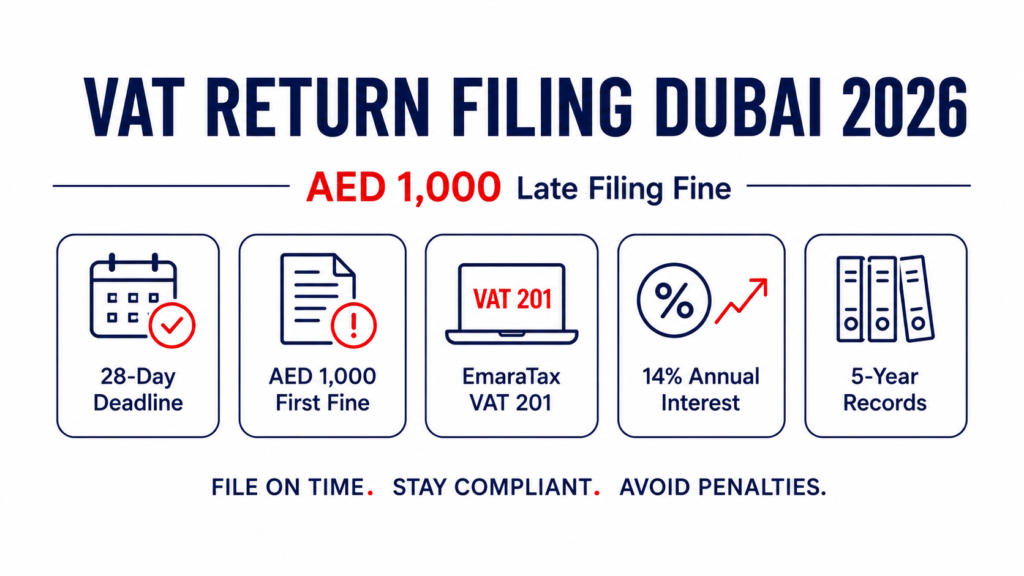
Miss your VAT return by a single day and you face an AED 1,000 fine on the spot – repeat it within 24 months and that doubles to AED 2,000. From 14 April 2026, every dirham of unpaid VAT also accrues interest at 14% per annum. Your VAT return is due exactly 28 days after the end of your tax period, filed on EmaraTax using form VAT 201. For most Dubai businesses this means four deadlines a year, and the Federal Tax Authority gives no grace period.
If you have ever scrambled to gather invoices the night before a deadline, or wondered whether hiring a VAT return filing service in Dubai is worth the cost, this guide gives you every verified number, every law reference, and a clear picture of what a professional filing service actually costs versus the risk of getting it wrong on your own.
What Is the 28-Day Rule for VAT Filing in the UAE?
Under Federal Decree-Law No. 8 of 2017, every VAT-registered business in the UAE must submit a VAT return within 28 days of the end of each tax period. A tax period is typically a calendar quarter, so a business with a quarter ending 31 March 2026 must file and pay by 28 April 2026. If your annual taxable turnover exceeds AED 150 million, the FTA assigns you a monthly tax period, meaning 12 deadlines per year instead of four.
The 28-day rule covers both the return submission and the VAT payment. Filing on time but paying late is still a penalty-triggering event under the updated rules introduced by Cabinet Decision No. 129 of 2025. There is no provision under UAE VAT law for an extension of the filing deadline, which makes proactive preparation the only safe strategy.
Key facts about the tax period structure:
- Quarterly filers: turnover below AED 150 million per year
- Monthly filers: turnover AED 150 million or above per year
- The FTA assigns your period at registration; you cannot self-select monthly filing
- Newly registered businesses receive their first return period from the FTA via EmaraTax notifications
- All filing and payment is done on the EmaraTax portal at services.tax.gov.ae
If you are still working out whether your business needs to register, see our guide on UAE VAT registration thresholds and process for 2026. The mandatory registration threshold is AED 375,000 in taxable supplies, with voluntary registration available from AED 187,500 (Federal Decree-Law No. 8 of 2017).
What Are the Penalties for Late VAT Filing and Late Payment in UAE 2026?
Cabinet Decision No. 40 of 2017, as amended by Cabinet Decision No. 49 of 2021, sets two fixed administrative penalties for late filing: AED 1,000 for a first offence and AED 2,000 if the same offence is repeated within a 24-month window. These penalties apply regardless of the size of the VAT amount involved – a zero-VAT return filed one day late still triggers AED 1,000.
For late payment of VAT due, Cabinet Decision No. 129 of 2025 introduced a fundamentally different regime from 14 April 2026. The old system could impose penalties of up to 300% of the unpaid tax. The new regime charges interest at 14% per annum on the outstanding tax balance, calculated monthly. This is a significant structural change: a business carrying AED 100,000 of unpaid VAT for three months now accumulates approximately AED 3,500 in interest charges. For full detail on how these penalties stack, see our dedicated article on UAE VAT late filing penalties for 2026.
| Offence | Penalty / Rate | Legal Basis |
|---|---|---|
| Late VAT return submission – first offence | AED 1,000 | Cabinet Decision No. 40 of 2017 (amended by CD 49/2021) |
| Late VAT return submission – repeated within 24 months | AED 2,000 | Cabinet Decision No. 40 of 2017 (amended by CD 49/2021) |
| Late payment of VAT due (from 14 April 2026) | 14% per annum, calculated monthly | Cabinet Decision No. 129 of 2025 |
| Incorrect return leading to understated tax | 50% of the tax difference where the FTA discovers the error | Cabinet Decision No. 49 of 2021 voluntary disclosure scale |
If you have already missed a deadline or submitted an incorrect return, a voluntary disclosure may reduce exposure. Our guide on UAE VAT voluntary disclosure in 2026 explains the process and the reduced penalty regime that applies when you self-correct before the FTA audits you.
How to File a VAT Return on EmaraTax – Step by Step
The FTA charges no government fee to file a VAT return. You pay only the net VAT due, plus any fee charged by an accountant or tax agent if you use one. The EmaraTax filing process follows these steps:
Step 1: Log in to EmaraTax
Go to services.tax.gov.ae and sign in with your registered UAE Pass or EmaraTax credentials. The dashboard shows your open return periods and their due dates.
Step 2: Open Form VAT 201
Click the active return period. EmaraTax loads form VAT 201, which is divided into sections covering standard-rated supplies, zero-rated supplies, exempt supplies, imports, and input tax credits.
Step 3: Enter Your Output Tax Data
Declare all taxable sales for the period. Standard-rated supplies in the UAE carry 5% VAT. Zero-rated supplies (exports, certain food items, healthcare, education) are entered separately with zero VAT. Exempt supplies such as residential leases are listed but attract no VAT and no input tax recovery.
Step 4: Enter Your Input Tax Data
Input tax is the VAT you paid on business purchases and expenses. Enter the total value of standard-rated purchases and the associated input tax. If your business makes both taxable and exempt supplies, you must apportion input tax; see our guide on UAE VAT input tax apportionment in 2026 for the correct methodology.
Step 5: Declare Imports and Reverse Charge
VAT on imports is declared under the reverse charge mechanism. If your business imports goods or certain services, the VAT is accounted for in the VAT 201 as both output and input tax in the same return, provided the expense is for a taxable business purpose. For a full explanation see our article on UAE VAT reverse charge in 2026.
Step 6: Review and Submit
EmaraTax calculates the net VAT payable or refundable automatically. Review the summary, confirm the figures, and click Submit. You receive a confirmation receipt with a reference number. Keep this receipt as it is your proof of filing.
Step 7: Pay the VAT Due
If the return shows a net payable amount, proceed to pay within the same 28-day window. EmaraTax accepts payment by e-Dirham, credit card, bank transfer, and selected bank payment channels. A refund position is carried forward as a credit unless you formally request a refund from the FTA.
What Documents Do You Need for VAT Return Filing in UAE?
You must retain all records that support your VAT return for a minimum of five years under Federal Decree-Law No. 8 of 2017. Assembling these documents before you open EmaraTax saves significant time and reduces the risk of errors that could trigger an FTA audit query.
- VAT registration certificate confirming your Tax Registration Number (TRN)
- Sales invoices issued to customers during the period, including zero-rated and exempt invoices
- Purchase invoices and expense receipts showing input VAT paid to suppliers
- Bank statements covering the full tax period
- Credit notes and debit notes issued or received
- Import customs declarations and related shipping documents
- Export customs declarations for zero-rated export claims
- Any intercompany or related-party transaction documentation
Businesses operating across UAE free zones and the mainland must be particularly careful about documenting the physical movement of goods, as the VAT treatment differs depending on whether a designated zone is involved. Sloppy record-keeping is the most common reason the FTA raises queries during routine reviews.
How Much Does a VAT Return Filing Service Cost in Dubai?
The FTA charges nothing to file a VAT return on EmaraTax. Your cost is either your own time or a service fee paid to an accountant or registered tax agent. The market in Dubai has a wide range depending on the complexity of your business, transaction volume, and whether you bundle VAT filing with bookkeeping.
| Service Type | How the Fee Works | What Is Included |
|---|---|---|
| DIY on EmaraTax | AED 0 (your time only) | You gather all records, reconcile accounts, and file form VAT 201 yourself |
| Standalone VAT return filing service | Fixed fee per return (request a quote) | Accountant or tax agent reviews your data, prepares and files the return, provides a filing confirmation |
| Full monthly bookkeeping and VAT package | Monthly retainer (request a quote) | Ongoing bookkeeping, reconciliation, VAT return preparation and filing, year-round query support |
The right fee depends on your industry, transaction volume, number of employees, whether you have import and export activity, and how organised your records are when you hand them over. Contact Qaspro Global for a fixed quote tailored to your business size and filing frequency.
For a broader comparison of tax consultant fees in Dubai across different service types, see our guide on tax consultant costs in Dubai for 2026.
Can a Free Zone Company File VAT Returns in UAE?
Yes. Free zone companies that are registered for VAT in the UAE file the same form VAT 201 on EmaraTax and face the same 28-day deadline as mainland businesses. The VAT treatment of transactions differs depending on whether your free zone is a Designated Zone under UAE VAT law. Supplies between businesses within the same designated zone may be outside the scope of UAE VAT, while supplies from a designated zone to the UAE mainland are treated as imports and subject to VAT under the reverse charge mechanism. If your free zone is not a designated zone, standard VAT rules apply in full. Always verify your free zone’s status on the FTA list of designated zones.
Does Dubai World Trade Centre Have Any Role in VAT Return Filing?
No physical visit to Dubai World Trade Centre, or to any other location, is required to file a VAT return today. All UAE VAT returns are filed entirely online through the Federal Tax Authority’s EmaraTax portal at services.tax.gov.ae, regardless of whether your business is registered in DWTC, another free zone, or the Dubai mainland. DWTC is a well known Dubai business, exhibition, and free zone hub, and it played a role in the UAE’s earlier free zone and company registration history, but VAT registration and return filing have been fully digital since VAT was introduced in 2018 under Federal Decree-Law No. 8 of 2017, and further centralised on the EmaraTax platform from December 2022. If a search for VAT filing led you toward DWTC expecting a tax service counter, use the EmaraTax portal directly instead, or engage a registered tax agent such as Qaspro Global to prepare and submit the return on your behalf.
What Is UAE E-Invoicing and Does It Affect Your VAT Return in 2026?
The UAE’s e-invoicing framework is live in voluntary pilot phase from 1 July 2026. Businesses with annual revenue of AED 50 million or more must appoint an Accredited Service Provider by 30 October 2026, with mandatory system go-live on 1 January 2027. E-invoicing does not replace the VAT 201 return; it is a parallel data-reporting layer where invoice data flows to the FTA in near real time. Businesses preparing for mandatory e-invoicing should review our detailed guide on UAE e-invoicing requirements and penalties for 2026.
For businesses below the AED 50 million threshold, e-invoicing remains voluntary in 2026, but early adoption positions you ahead of the phased rollout expected to cover all VAT-registered businesses in subsequent years.
Why Use a VAT Return Filing Service in Dubai Rather Than Filing Yourself?
Filing your own VAT return is legally permitted and technically straightforward for very simple businesses with a handful of standard-rated transactions. The risk grows quickly with business complexity. Input tax apportionment errors, incorrect treatment of imports under reverse charge, miscategorised zero-rated or exempt supplies, and rounding differences that accumulate across periods are all common errors the FTA identifies during reviews. A single understated return found by the FTA can attract a penalty of up to 50% of the tax difference in addition to the outstanding amount itself.
Qaspro Global, a UAE-based tax and accounting consultancy, works with businesses across Dubai, Abu Dhabi, and the Northern Emirates to handle VAT compliance from bookkeeping through to return filing and FTA correspondence. For most businesses, having a quarterly return handled by a professional costs less than the penalty for a single late filing on a return you could have had filed correctly and on time by someone who does this every day.
Key reasons businesses in Dubai use a VAT return filing service:
- Eliminates the risk of missing the 28-day deadline when business operations are demanding
- Ensures correct treatment of complex transactions including imports, exports, reverse charge, and designated zone supplies
- Provides year-round records that are audit-ready if the FTA contacts you
- Gives you a qualified tax agent on record who can represent you in FTA correspondence
- Frees management time for revenue-generating activities
Keep track of all UAE tax deadlines in 2026 using our consolidated guide on UAE tax deadlines for 2026 covering VAT, corporate tax, and other federal obligations.
Setting up a new company on the Dubai mainland and wondering about the full cost before VAT even applies? See the complete Dubai mainland company setup cost breakdown for 2026 from our sister service Yalah Dubai.
If a VAT return was filed with an error, use the Voluntary Disclosure UAE guide to decide whether to correct the next return or file a disclosure.
VAT reverse charge reminder: Before filing, review our reverse charge VAT filing checklist to confirm invoice wording, TRN evidence, and VAT return treatment.
Frequently Asked Questions
When is the VAT return filing deadline in UAE?
Your VAT return is due 28 days after the end of each tax period under Federal Decree-Law No. 8 of 2017. For a quarterly period ending 31 March, the deadline is 28 April. For a quarter ending 30 June, the deadline is 28 July. There are no extensions and the FTA does not issue reminders, so you must track deadlines yourself or use a tax agent.
How do I file a VAT return on EmaraTax?
Log in to services.tax.gov.ae with your UAE Pass or EmaraTax credentials, open the active return period, and complete form VAT 201. You declare output tax on sales, input tax on purchases, and any reverse charge on imports. EmaraTax calculates the net payable amount automatically. After reviewing the figures, click Submit and then pay any amount due before the 28-day deadline expires.
What documents are needed for VAT return filing in UAE?
You need your TRN certificate, all sales invoices, purchase and expense invoices showing input VAT, bank statements, credit notes, debit notes, and import and export customs declarations for the period. All records must be retained for five years under Federal Decree-Law No. 8 of 2017. Incomplete records are the most common trigger for FTA review queries.
What is the penalty for late VAT filing in UAE?
The penalty is AED 1,000 for a first offence and AED 2,000 if you repeat the late filing within 24 months, under Cabinet Decision No. 40 of 2017 as amended by Cabinet Decision No. 49 of 2021. These penalties apply even if your net VAT due is zero. Late payment of the VAT itself incurs additional interest at 14% per annum from 14 April 2026 under Cabinet Decision No. 129 of 2025.
Can I file my own VAT return in UAE without an accountant?
Yes. Any VAT-registered person or their authorised representative can log in to EmaraTax and file form VAT 201 without engaging a tax agent. There is no legal requirement to use a professional. However, errors in input tax recovery, reverse charge, or supply categorisation can result in a penalty of up to 50% of the understated tax when the FTA finds the error first, which makes professional filing cost-effective for businesses with complex transactions.
How much does a VAT return filing service cost in Dubai?
The fee depends on your transaction volume, filing frequency, and whether you bundle VAT filing with bookkeeping. The FTA itself charges no fee to file the return. Contact Qaspro Global for a fixed quote based on your specific business profile.
What happens if I miss the VAT return deadline in UAE?
You immediately incur an AED 1,000 administrative penalty (AED 2,000 if repeated within 24 months). If you also owe VAT, interest accrues at 14% per annum on the unpaid balance from 14 April 2026 under Cabinet Decision No. 129 of 2025. You should file and pay as soon as possible after the deadline to stop interest accumulating. A voluntary disclosure may also be relevant if the return contained errors.
How often do I need to file VAT in UAE, monthly or quarterly?
Most UAE businesses file quarterly, meaning four returns per year. If your annual taxable turnover exceeds AED 150 million, the FTA assigns you a monthly tax period, which means 12 returns per year. The FTA determines your period at registration based on your projected turnover. You cannot voluntarily elect monthly filing if your turnover is below the threshold.
Can a free zone company file VAT returns?
Yes. Free zone companies registered for UAE VAT file the same form VAT 201 on EmaraTax and face the same 28-day deadline. The VAT treatment of specific transactions varies depending on whether your free zone is a Designated Zone under UAE VAT law. Supplies within a designated zone may be outside scope, while supplies to the UAE mainland are treated as taxable imports. Check the FTA’s official designated zone list for your free zone’s status.
Do I need to visit Dubai World Trade Centre to file my VAT return?
No. VAT return filing in the UAE is done entirely online through the EmaraTax portal at services.tax.gov.ae. Dubai World Trade Centre does not operate a VAT filing counter, and no physical visit to any location is required to submit form VAT 201, regardless of where your business is registered in Dubai.
What is the late payment penalty for VAT in UAE 2026?
From 14 April 2026, late payment of VAT carries interest at 14% per annum on the outstanding tax balance, calculated on a monthly basis, under Cabinet Decision No. 129 of 2025. This replaced the previous penalty regime which could reach up to 300% of unpaid tax. On AED 50,000 of unpaid VAT held for one month, the monthly interest charge is approximately AED 583. Filing and paying on time remains the only way to avoid this cost.
Need Expert Help?
VAT compliance in the UAE has tightened considerably since the introduction of the 14% interest regime in April 2026. Whether you need a one-off return filed correctly, ongoing monthly or quarterly compliance support, or representation in an FTA review, Qaspro Global handles the full process so you never face a penalty for a missed deadline or a preventable error.
Contact us today for a fixed quote on VAT return filing services in Dubai and across the UAE. Response within one business day.
Related Reading
- UAE VAT Late Filing Penalties 2026 – What You Will Pay and How to Avoid It
- UAE VAT Registration 2026 – Thresholds, Process and Timeline
- UAE E-Invoicing 2026 – Requirements, Deadlines and Penalties

Founder & CEO, Qaspro Global — UAE tax expert with 16+ years of experience in VAT, corporate tax and FTA audit support.