Published: 7 August 2026
Last updated: 9 September 2026
Quick answer: Setting up a non-regulated company in DIFC (Dubai International Financial Centre) in 2026 typically costs between AED 20,000 and AED 100,000+ in the first year, including registration, licence and mandatory office space. A DFSA-regulated financial services company costs significantly more, with professional fees often exceeding AED 100,000 and a minimum authorised share capital requirement starting at USD 50,000 (roughly AED 183,000). Non-regulated setups usually finish in 6-8 weeks; DFSA-regulated licences take 6-12 months because of the depth of the regulatory review.
DIFC is not just another Dubai free zone. It runs its own common-law court system, its own companies law, and its own financial regulator, the DFSA (Dubai Financial Services Authority). That single difference changes almost every decision in the setup process, from which licence you apply for to how quickly you can start operating. This guide walks through real 2026 costs, the DFSA question, the corporate tax treatment, and the exact steps to register, using DIFC’s own portal and published fee structure.
Why DIFC Is Different From Every Other UAE Free Zone
Every other UAE free zone, including DMCC, IFZA, JAFZA and RAKEZ, operates under UAE federal civil law with the free zone authority as the local regulator for licensing. DIFC operates under its own independent common-law framework, modelled on English law, with its own courts (the DIFC Courts) and its own arbitration centre. For international finance, funds, wealth management, insurance and fintech businesses, this legal certainty is the main reason to choose DIFC over a lower-cost alternative.
The trade-off is cost and process. A DIFC company pays higher registration and office fees than most other free zones, and if the business activity touches financial services, it also needs a separate licence from the DFSA on top of the standard DIFC company registration.
DIFC Company Setup Cost in 2026
Costs vary significantly by activity, licence type and office footprint. The figures below are realistic 2026 planning ranges, not fixed government tariffs, since DIFC issues quotations per application.
| Cost Item | Non-Regulated Company | DFSA-Regulated Company |
|---|---|---|
| Name reservation | Approx. AED 2,940 | Approx. AED 2,940 |
| Incorporation/registration fee | AED 15,000 – 40,000 | AED 40,000+ |
| Licence fee (annual) | AED 10,000 – 20,000 | AED 20,000 – 50,000+ |
| Office space (flexi-desk to dedicated office) | AED 30,000 – 100,000+/year | AED 100,000+/year |
| Professional/legal fees | Included in above or AED 10,000-30,000 | Often AED 100,000+ |
| Minimum share capital | Not always required | USD 50,000 (approx. AED 183,000), not always fully paid up |
| Typical total, first year | AED 20,000 – 100,000+ | AED 150,000 – 300,000+ |
Two lower-cost paths exist for specific business types:
– Innovation Licence: aimed at AI, Web3, fintech and other technology companies, priced at roughly USD 1,500 a year, around 90% subsidised compared to a standard licence.
– Startup/qualifying innovation programmes: some qualifying startups can access fees as low as AED 6,000 a year, valid for up to four years, though eligibility criteria are strict and reviewed by DIFC directly.
A DIFC holding company, used purely to hold shares in other entities without trading, has a separate and generally lower cost structure, starting from roughly USD 8,000, since it does not carry the same office or activity licensing requirements as an operating company.
For pure asset-holding needs, there is an even lower-cost route inside DIFC: the Prescribed Company regime. This is a passive holding vehicle for shares, real estate, IP or securities, and it cannot trade or employ staff. Its government fees are set well below a standard DIFC company: a USD 100 one-off incorporation fee, a USD 1,000 annual licence fee, and a USD 300 annual confirmation statement fee. Under the 2026 regulations, eligibility widened to any natural person or corporate entity regardless of nationality or location, though most applicants must appoint a licensed Corporate Service Provider (CSP), whose professional fees sit on top of these government charges and are not part of the official DIFC tariff.
A physical office in DIFC is mandatory. Virtual offices are not permitted for DIFC-registered companies, unlike some other UAE free zones. Budget AED 30,000-50,000 a year for a flexi-desk, rising to AED 100,000+ for a dedicated office suite, and factor this into any DIFC cost comparison against DMCC or IFZA, where flexi-desk and virtual options are usually cheaper.
Do You Need DFSA Approval?
The DFSA (Dubai Financial Services Authority) is DIFC’s independent financial regulator. You need DFSA authorisation, in addition to your standard DIFC company registration, if your business carries out a “financial service” as defined under DIFC law. This includes:
- Managing or advising on investments
- Operating a collective investment fund
- Banking and deposit-taking
- Insurance intermediation or underwriting
- Dealing in investments as principal or agent
- Providing crypto-related financial services (subject to DFSA’s dedicated crypto token regime)
If your business is a general commercial activity, such as consulting, holding, media, tech development, or professional services that do not involve managing client money or financial products, you typically only need a standard DIFC Commercial Licence and do not need DFSA authorisation.
DFSA authorisation is a separate application from DIFC company registration. The DIFC Registrar approves the company’s existence; the DFSA separately reviews and approves the regulated activity itself, including the fitness and propriety of controllers and senior managers. This is why regulated setups take 6-12 months, compared to 6-8 weeks for non-regulated companies: the DFSA review often includes document review cycles and interviews with the firm’s proposed senior management before final financial services permission is granted.
A 2026 timing note: DFSA prudential rulebook amendments take effect on 1 July 2026. Any business applying for a DFSA-regulated licence in the second half of 2026 should confirm with its DIFC-registered legal or corporate services adviser that its application and capital structure align with the current rulebook version, not an earlier one.
DIFC and the 9% UAE Corporate Tax
DIFC companies are UAE resident companies for corporate tax purposes and fall under the same Federal Decree-Law No. 47 of 2022 framework as every other UAE business, including the Qualifying Free Zone Person (QFZP) regime available to free zone entities.
Standard rule: UAE corporate tax is 0% on taxable income up to AED 375,000 and 9% above that threshold for a standard taxable person.
QFZP rule: A DIFC company that meets the Qualifying Free Zone Person conditions, including maintaining adequate substance in DIFC, earning Qualifying Income (as defined under the Free Zone Corporate Tax Ministerial Decision), and not electing out of the regime, can benefit from a 0% corporate tax rate on Qualifying Income, with the standard 9% rate applying only to any Non-Qualifying Income above the AED 375,000 threshold.
For DFSA-regulated DIFC entities specifically, some categories of financial services income need careful review against the Qualifying Income list, since not every regulated activity automatically counts as Qualifying Income. This is a common area where DIFC businesses lose the 0% rate unintentionally, by earning income that falls outside the Qualifying Income definition without realising it during the tax year. Confirm your DIFC entity’s actual income mix against the current Qualifying Income Ministerial Decision before assuming QFZP status applies to all revenue. See our full breakdown of Qualifying Free Zone Person and Qualifying Income rules for the complete criteria and common disqualifying activities.
Every DIFC company, regulated or not, must still register for UAE corporate tax with the Federal Tax Authority via EmaraTax and file an annual corporate tax return, even if the result is a nil or 0% liability. See our guides on corporate tax registration in the UAE and filing your corporate tax return via EmaraTax for the registration deadlines and filing steps.
Step-by-Step: How to Register a Company in DIFC
- Choose your licence type. Decide between a Commercial Licence (general business activity, no DFSA involvement) or a licence requiring DFSA authorisation (any financial service activity). This decision drives every later step, including timeline and cost.
- Reserve your company name through the DIFC Client Portal. The reservation fee is approximately AED 2,940, and DIFC checks the name against its own naming conventions, which are stricter than most other free zones about implying regulated activity without approval.
- Prepare your incorporation documents. This typically includes Articles of Association, shareholder resolutions, passport copies and CVs for all directors and shareholders, a business plan, and, for regulated applications, detailed compliance and controller documentation for DFSA review.
- Submit your application to the DIFC Registrar through the Client Portal. Standard non-regulated applications are typically reviewed within 5-10 business days; DFSA-regulated applications run on a separate, longer regulatory timeline.
- Receive conditional or in-principle approval. For non-regulated companies, this is usually followed quickly by final approval once outstanding documents are submitted. For regulated companies, in-principle approval from the DFSA is a distinct milestone before final authorisation.
- Secure your DIFC office. Since virtual offices are not permitted, you need a signed lease for a flexi-desk or dedicated office within DIFC before the registrar issues your final licence.
- Pay government and licence fees. Once documents, office lease and any regulatory approval are in place, DIFC issues the certificate of registration and the company is formally incorporated.
- For regulated firms, complete DFSA onboarding. This includes final submissions, and in many cases interviews with proposed senior managers, before the DFSA grants final financial services permission to actually begin regulated activity.
- Register for UAE corporate tax and VAT (if applicable) with the Federal Tax Authority via EmaraTax within the applicable deadline after incorporation, and open a UAE corporate bank account.
DIFC vs Other UAE Free Zones: When It Makes Sense
DIFC is the right choice when your business needs the common-law legal framework, DIFC Courts jurisdiction, or a DFSA-regulated financial services licence specifically, or when international investors and clients expect the credibility of a DIFC-regulated counterparty. For a general trading, consulting, media or tech company with no financial services activity, a lower-cost free zone such as IFZA, DMCC, or RAKEZ will usually deliver the same trading capability at a fraction of the setup and office cost, without the mandatory physical office requirement DIFC applies. Compare the full cost and activity differences in our mainland vs free zone Dubai 2026 guide.
Frequently Asked Questions
What is a DIFC license?
A DIFC license, also written as DIFC licence, is the registration DIFC issues to a company to operate from Dubai International Financial Centre. It is issued as either a standard DIFC Commercial License for general business activity or a DFSA-regulated license for financial services activity, with cost, activity scope and share capital requirements set out below.
What is the DIFC trade licence cost?
DIFC does not issue a standard UAE “trade licence” in the mainland/free-zone sense; it issues its own Commercial Licence or, for financial activities, a DFSA-regulated licence. A non-regulated DIFC Commercial Licence, including licence fees, name reservation, registration, and mandatory office space, typically costs AED 20,000 to AED 100,000+ in the first year. A DFSA-regulated licence costs significantly more, often AED 150,000-300,000+, plus a minimum authorised share capital of USD 50,000.
How much does it cost to set up a company in DIFC in 2026?
A non-regulated DIFC company typically costs AED 20,000 to AED 100,000+ in the first year, covering name reservation, registration, licence fees, and mandatory office space. A DFSA-regulated company costs significantly more, often AED 150,000-300,000+, plus a minimum authorised share capital of USD 50,000.
Do I need DFSA approval to set up a company in DIFC?
Only if your business activity is a defined financial service, such as fund management, investment advisory, banking, insurance, or crypto-related financial services. General commercial, consulting, media, and technology businesses register under a standard DIFC Commercial Licence without DFSA involvement.
How long does DIFC company registration take?
Non-regulated companies typically complete registration in 6-8 weeks. DFSA-regulated companies typically take 6-12 months because of the additional regulatory review, document cycles, and management interviews the DFSA requires.
Is a virtual office allowed in DIFC?
No. DIFC requires every registered company to hold a genuine physical office within DIFC, either a flexi-desk or a dedicated office. Virtual office packages, common in other UAE free zones, are not accepted for DIFC registration.
What is the DIFC Innovation Licence and who qualifies?
The Innovation Licence is a reduced-cost licence, roughly USD 1,500 a year, for AI, Web3, fintech, and other technology companies, designed to lower the barrier to entry for early-stage technology businesses. Eligibility is assessed by DIFC against its innovation and technology sector criteria.
Does a DIFC company pay UAE corporate tax?
Yes, DIFC companies are UAE resident taxpayers under the federal corporate tax law. A DIFC entity that qualifies as a Qualifying Free Zone Person can apply a 0% rate to its Qualifying Income, with the standard 9% rate applying above AED 375,000 to any income that does not meet the Qualifying Income definition.
Can a DIFC company also operate outside DIFC in mainland Dubai?
A DIFC free zone licence is scoped to activity within the DIFC framework and international business. Operating directly in the UAE mainland market generally requires either a mainland presence or working through a licensed distributor or commercial agent, similar to the rules that apply to other UAE free zones.
What is the minimum share capital for a DIFC company?
Non-regulated commercial companies do not always have a fixed minimum share capital requirement, though DIFC reviews this per application. DFSA-regulated entities have a clear minimum authorised share capital, starting at USD 50,000, which must be reflected in the company’s constitutional documents even where it is not required to be fully paid up immediately.
How is a DIFC holding company different from an operating company?
A DIFC holding company exists only to hold shares or assets in other entities and does not carry out trading activity. It has a simpler, generally lower-cost registration path, starting from roughly USD 8,000, since it avoids the office and activity-specific licensing requirements that apply to an operating company.
What happens if I set up a DIFC company for a financial activity without DFSA approval?
Carrying out a regulated financial service in DIFC without the required DFSA authorisation is a serious regulatory breach, subject to DFSA enforcement action. Any business unsure whether its planned activity falls under DFSA’s definition of a financial service should get this confirmed before applying for a standard Commercial Licence, not after.
Get DIFC Setup Right the First Time
DIFC rewards businesses that plan the licence type, DFSA question, and tax position correctly before submitting the application, and penalises those that guess. Qaspro Global helps businesses confirm the right DIFC licence path, prepare DFSA-ready documentation where needed, and register correctly for UAE corporate tax from day one. Contact Qaspro Global on WhatsApp for a DIFC setup consultation.
Founders relocating to run their DIFC company in person should also check their own residency route early. Not every option requires a large investment: our partner site Yalah Dubai has a guide to the UAE Golden Visa nomination route, which grants long-term residency to qualifying professionals without a property purchase or bank deposit.
Related Reading
- Qualifying Free Zone Person and Qualifying Income Rules 2026
- UAE Corporate Tax Registration 2026
- Mainland vs Free Zone Dubai 2026
- IFZA Free Zone Dubai 2026
- DMCC Company Setup Cost 2026
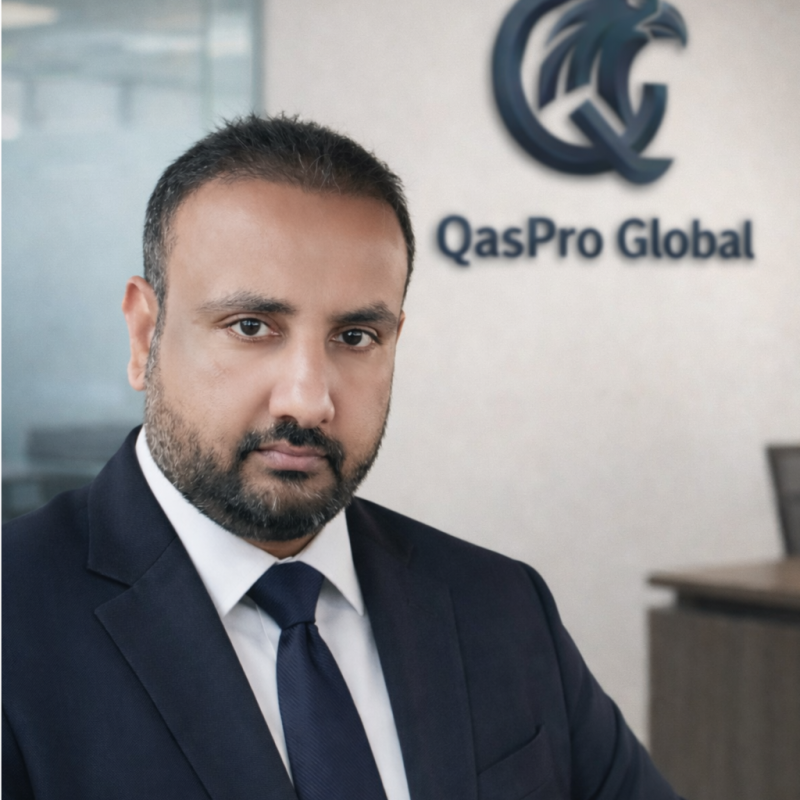
Founder & CEO, Qaspro Global — UAE tax expert with 16+ years of experience in VAT, corporate tax and FTA audit support.