

Published: 6 October 2026
A special purpose vehicle (SPV) is a separate company created for one narrow job, usually to hold an asset, a share in another company, a property or a piece of intellectual property. In the UAE, the two main financial free zones, ADGM in Abu Dhabi and DIFC in Dubai, both offer an SPV structure. Both treat it as a passive entity: it can own things, but it cannot trade, hire staff or invoice customers. This guide explains what an SPV can do, what it cannot do, how it is taxed under UAE Corporate Tax, and which filings still apply even when the company is “just a holding vehicle”.
Quick Answer
A UAE SPV is a passive holding company in a free zone such as ADGM or DIFC. It may hold assets such as shares, real estate, intellectual property and investment portfolios, and it may be used for joint ventures, financing and securitisation. It may not run an operating business, employ staff or sell goods and services to customers. For Corporate Tax, an SPV is a normal taxable person unless it meets every condition to be a Qualifying Free Zone Person (QFZP), in which case its qualifying income is taxed at 0% and any other income at 9%. Registration with the Federal Tax Authority (FTA), annual filing and beneficial-ownership records still apply.
Rules for SPVs changed in 2026, especially at DIFC. Always check the current registrar guidance before you decide on a structure. Figures and decisions named below come from the free zone registrars, the FTA and the Ministry of Finance, and are noted with their source.
What Is an SPV in the UAE?
An SPV, sometimes called a special purpose company (SPC) or, at DIFC, a prescribed company, is a company with its own legal personality. ADGM’s own guidance describes the key feature of an SPV as its separate legal personality, which isolates financial and legal risk from the assets and liabilities of the shareholders or sister companies. ADGM says its regime serves corporates, financial institutions, sovereign wealth funds, family offices and individual investors, and that SPVs are used to set up subsidiaries, project vehicles and joint venture vehicles.
The UAE does not have one federal “SPV law”. The structure exists inside each free zone’s own company law:
| Free zone | Name used | How it is formed |
|---|---|---|
| ADGM (Abu Dhabi) | Special Purpose Vehicle | Private Company Limited by Shares licensed for SPV activities, or a Restricted Scope Company (RSC) with more limited disclosure on the public register |
| DIFC (Dubai) | Prescribed Company (the successor to the older Special Purpose Company) | Private company under DIFC Companies Law, with a licensed Corporate Service Provider unless exempt |
| RAK ICC (Ras Al Khaimah) | Offshore-style company | Governed by RAK ICC’s own rules, see our separate guide linked below |
If you are comparing zones, our guides to ADGM company setup, DIFC company setup and RAK ICC company setup cover the wider picture. This article stays focused on the SPV itself.
What an SPV Can Do (Permitted Uses)
Both free zones describe the SPV as a holding and structuring tool. The permitted uses below come from the ADGM guidance note and the DIFC SPV page.
- Hold assets. DIFC says an SPV can hold any registrable asset from around the world. ADGM lists activity 7029 as holding equity and non-equity assets such as shares, debentures, bonds and other securities, as well as real property, intellectual property and other tangible and intangible assets.
- Investment holding. A family, a fund sponsor or a group can place shares in a separate company, so a loss in one structure does not reach the others.
- Joint venture and project vehicles. Several investors can own one company that holds a single project, with clear rules between them.
- Financing and securitisation. DIFC lists structured financing, including bonds and sukuk issuances, and securitisation. ADGM lists buying, holding or selling an asset, securitising assets and issuing investments.
- Intellectual property holding. The SPV owns a trademark, software or licence rights, and the group pays for their use.
- Family office and succession structures. Law-firm commentary on DIFC’s regime lists family office structures, co-investment and succession planning as common uses.
ADGM licence activity codes
ADGM’s guidance note applies to four controlled activities: 7012 (special purpose company for professional investors), 7013 (special purpose company for professional investment institutions), 7016 (activities of a special purpose company) and 7017 (activities of a special purpose vehicle). Your application must state which activity applies and explain the SPV’s purpose.
What an SPV Cannot Do
This is the part most guides skip, and it is where many structures fail. DIFC states plainly that SPVs “cannot conduct commercial or operational activities, nor employ staff”. ADGM’s SPV is likewise a passive vehicle. In practice an SPV cannot:
- Trade or sell to customers. It cannot issue sales invoices for goods or services as its business.
- Hire employees. It cannot sponsor staff or employees. Management comes from its directors and its corporate service provider.
- Act as a regulated financial firm. It cannot be a fund manager, trustee or regulated financial services provider unless it holds the right authorisation from the regulator (DFSA at DIFC, FSRA at ADGM).
- Act as a general trading company. If you need to buy and sell, you need an operating company in a free zone or on the mainland, not an SPV. Our guide to free zone and mainland expansion explains how groups usually split this.
- Skip the paperwork. Passive does not mean invisible. The company is still a taxable person, still needs a registered office and still keeps books.
If a plan includes staff, customer contracts or day-to-day trading, an SPV is the wrong tool. A common mistake is to form an SPV and then use it to invoice clients “just this once”. That puts the company outside its licensed purpose and can create both a licensing problem and a tax problem.
2026 Rules You Should Know
DIFC: Prescribed Company regime opened to all applicants
DIFC states that its SPV regime is now open to any applicant, following the 2026 amendments to the Prescribed Company regime. Press coverage and law-firm notes report that the updated regulations were enacted on 24 July 2026 and remove the earlier eligibility gate. Under the new approach, unless exempt, a prescribed company must appoint a DIFC-licensed Corporate Service Provider (CSP) as its main administrative and compliance contact. Commentary also reports that a non-exempt prescribed company incorporated before 24 July 2026 must appoint a licensed CSP by 24 January 2027 unless the Registrar approves an extension. Check DIFC’s legal database for the exact wording before you rely on a deadline.
DIFC publishes these fees on its SPV page: USD 100 for incorporation and USD 1,000 for the annual licence, plus an AED 20 Knowledge and Innovation Dirham fee on the licence. These are government fees and can change.
ADGM: the nexus requirement
ADGM’s Registration Authority guidance note (published March 2020) asks applicants to show an appropriate connection, called a nexus, to ADGM, the UAE or the GCC region. The guidance gives examples of how to show it:
- The SPV is owned or controlled by a UAE or GCC-based private company, family or family office, or individual.
- The SPV holds assets located in the UAE or the GCC.
- The SPV facilitates transactions connected to the UAE, or provides real or economic benefit to the UAE.
- The SPV’s purpose includes issuing securities that will be admitted to the FSRA Official List or to trading on a recognised exchange or licensed platform in ADGM.
The note adds that an SPV wholly owned by a foreign non-resident person that holds only assets outside the UAE and GCC would not meet the nexus requirement, and that appointing a UAE-based corporate service provider alone does not create a nexus. The Registrar keeps discretion to decide each case. Some law-firm commentary discusses later amendments to the nexus test, so confirm the current test with ADGM before you apply.
Corporate Tax Treatment of a UAE SPV
An SPV is not outside the UAE Corporate Tax system. Federal Decree-Law No. 47 of 2022 applies to juridical persons that are resident in the UAE, which includes a company incorporated in a UAE free zone. Four questions decide the tax result.
1. Is the SPV a Qualifying Free Zone Person?
A free zone company is a Qualifying Free Zone Person (QFZP) only if it meets all the conditions in Article 18 of Federal Decree-Law No. 47 of 2022 and Cabinet Decision No. 100 of 2023. In summary, it must:
- Have adequate substance in the free zone (assets, people and expenditure, judged against the activity).
- Earn qualifying income, as defined by ministerial decision.
- Keep non-qualifying revenue below the de minimis limit, which is the lower of AED 5 million or 5% of total revenue.
- Prepare audited financial statements.
- Comply with transfer pricing rules.
- Not have elected to be taxed under the standard regime.
A QFZP pays 0% on qualifying income and 9% on non-qualifying income that is not de minimis. Fail one condition and the company loses QFZP status for the tax period and the next four, so the 9% rate applies to all taxable income for five years. Our detailed guides to QFZP status and qualifying income explain each condition.
2. Is the SPV’s income qualifying income?
Qualifying income is defined by Ministerial Decision No. 265 of 2023 on qualifying and excluded activities, as amended by Ministerial Decision No. 229 of 2025 (see our guide to qualifying activities and Ministerial Decision 229). Holding shares and other securities for investment purposes appears among the qualifying activities, and certain income from qualifying intellectual property is also covered. Income from excluded activities, and most income from dealing with the UAE mainland, is not qualifying. Verify the exact activity wording in the current decision before you assume a particular income stream is covered, because a small difference in the activity description can change the result.
Typical SPV income and how it is usually reviewed:
| Income type | Usual treatment to check |
|---|---|
| Dividends from a subsidiary | May be exempt under the participation exemption, or may be qualifying income for a QFZP. Check each route. |
| Gain on sale of shares | May fall under the participation exemption if its conditions are met, otherwise review as qualifying or taxable income |
| Rental income from real property | Real property income needs careful review. Commercial property rules differ from other property. |
| Interest on loans to group companies | Review transfer pricing and the qualifying income definition |
| Royalties from IP | Depends on whether the IP qualifies and on the nexus calculation |
3. Can the participation exemption apply?
Separately from QFZP status, UAE Corporate Tax exempts dividends and some capital gains from a qualifying shareholding if the conditions are met. These include a minimum ownership percentage and holding period, and a subsidiary that is itself subject to a minimum level of tax. Our guide to the UAE participation exemption lists the conditions. For a pure holding SPV, this exemption is often the main tax route, so it should be tested before you assume the 0% QFZP route.
4. What about the standard 9% rate?
If the SPV is not a QFZP, the standard regime applies: 0% on taxable income up to AED 375,000 and 9% above that, subject to the rules in the law. Our UAE corporate tax holding company guide shows how a holding company is usually modelled under this regime.
Substance: Can a Company With No Staff Qualify?
DIFC and ADGM say an SPV cannot employ staff. The QFZP test, however, asks for adequate substance. The FTA’s free zone guidance (CTGFZP1) discusses core income-generating activities, qualified staff and operating expenditure, and it allows some outsourcing when strict conditions are met. A passive holding SPV that earns only investment income often has low substance needs, but you must show how the activity is controlled and managed in the free zone, usually through directors and a service provider. Do not assume an SPV passes this test just because the company exists. Document who makes decisions, where, and what the service provider does.
Beneficial Ownership and Other Filings
Even a holding company must file and keep records. The usual list:
- Corporate Tax registration. Every free zone company, including an SPV with no income yet, must register with the FTA through EmaraTax. See our guide to free zone corporate tax registration.
- Annual Corporate Tax return. Due within nine months of the end of the tax period.
- Audited financial statements. Required for a QFZP and commonly requested by free zone registrars.
- Beneficial ownership (UBO) register. Companies must keep and file ultimate beneficial owner information with their licensing authority. See our UBO declaration guide.
- Transfer pricing. Transactions with related parties, such as loans to or from the shareholder, must be at arm’s length. See our guide to UAE transfer pricing.
- Annual licence renewal and registered office. Each free zone sets its own deadline and fee.
The UAE’s Economic Substance Regulations have been abolished for periods after the 2022 financial year, so the old annual ESR notification no longer applies. See our note on ESR being abolished.
Step by Step: Setting Up a UAE SPV
- Define the single purpose. Write one sentence that states what the SPV will hold and why. ADGM expects the purpose to be clear in the business plan.
- Pick the zone. ADGM suits groups with Abu Dhabi links or a need for English common law; DIFC suits Dubai-based structures and DFSA-related financing. Compare them before you decide.
- Check the nexus or eligibility rule. For ADGM, confirm you meet the nexus test. For DIFC, confirm whether a CSP is required in your case.
- Prepare documents. Expect shareholder and director identity documents, proof of source of funds, constitutional documents and a business plan. Registrars run anti-money-laundering checks.
- Appoint the corporate service provider where required.
- Incorporate and obtain the licence.
- Register for Corporate Tax with the FTA and set up accounting from day one.
- Plan the QFZP and participation exemption analysis before the first year ends, not after.
Common Mistakes
- Using the SPV to trade. This breaches its licensed purpose and may break QFZP status.
- Assuming 0% tax is automatic. It is not. The company must meet each QFZP condition every year.
- Ignoring non-qualifying income. Small amounts are tolerated under the de minimis rule, but crossing the limit costs five years of QFZP status.
- Skipping Corporate Tax registration because there is “no income”.
- Forgetting audited accounts. A QFZP needs them, and so does a company that wants to prove its position later.
- Relying on old guides. DIFC’s rules changed in July 2026.
An SPV cannot employ staff or sell services, so individuals who earn by teaching or consulting privately need a personal permit instead. Our sister site Yalah Dubai explains one example in its guide to the MOHRE Private Tutor Permit.
Related Reading
- Private Tutor Permit in the UAE 2026 (Yalah Dubai)
- ADGM company setup in 2026
- DIFC company setup in 2026
- RAK ICC offshore company setup
- UAE corporate tax and holding companies
- Qualifying Free Zone Person status
- UAE free zone excluded activities
Frequently Asked Questions
What is an SPV in the UAE?
It is a separate company, usually in ADGM or DIFC, created to hold a specific asset or carry out a narrow structuring purpose such as a joint venture, financing or IP holding. It has its own legal personality and is passive.
Can a UAE SPV trade or sell to customers?
No. DIFC states that SPVs cannot conduct commercial or operational activities, and ADGM treats its SPV as a passive entity. A trading business needs an operating company.
Can an SPV employ staff?
No. DIFC says SPVs cannot employ staff. Administration is handled by directors and a corporate service provider.
Does an SPV pay Corporate Tax in the UAE?
Yes, it is a taxable person like other UAE companies. The rate depends on its status. A Qualifying Free Zone Person pays 0% on qualifying income and 9% on other income above the de minimis limit. A company that is not a QFZP is taxed under the standard regime.
What is the de minimis limit for a QFZP?
Non-qualifying revenue must not exceed the lower of AED 5 million or 5% of total revenue in the tax period.
Does an ADGM SPV need a connection to the UAE or GCC?
ADGM’s guidance note asks for a nexus to ADGM, the UAE or the GCC, shown through ownership, asset location, UAE-linked transactions or ADGM-listed securities. Confirm the current test with ADGM, because commentary mentions later amendments.
Is a corporate service provider mandatory for a DIFC SPV?
Under the 2026 prescribed company rules, DIFC says applicants must appoint a licensed CSP unless exempt. Existing non-exempt companies are reported to have until 24 January 2027, unless the Registrar approves an extension. Verify the details with DIFC.
Does an SPV need to register for Corporate Tax?
Yes. A UAE free zone company must register with the FTA, even if it has no income yet, and must file an annual return.
Is a UBO filing required for an SPV?
Yes. Companies must keep a register of beneficial owners and file it with their licensing authority.
Does the SPV need audited financial statements?
A QFZP must prepare audited financial statements. Registrars and banks may also ask for them, so plan for an audit.
Are the Economic Substance Regulations still relevant?
No. They have been abolished for periods after the 2022 financial year, but the substance test for QFZP status under Corporate Tax still applies.
Need Help With an SPV Structure?
Choosing the zone, testing QFZP status and filing the first Corporate Tax return are easier when the numbers are modelled before incorporation. To discuss your structure, message Qaspro Global on WhatsApp: https://wa.me/971551539679.
This article is general information based on the free zone registrars’ published guidance, the FTA and the Ministry of Finance as read in October 2026. It is not legal or tax advice for a specific case. Verify each figure and deadline against the current official source before you act.
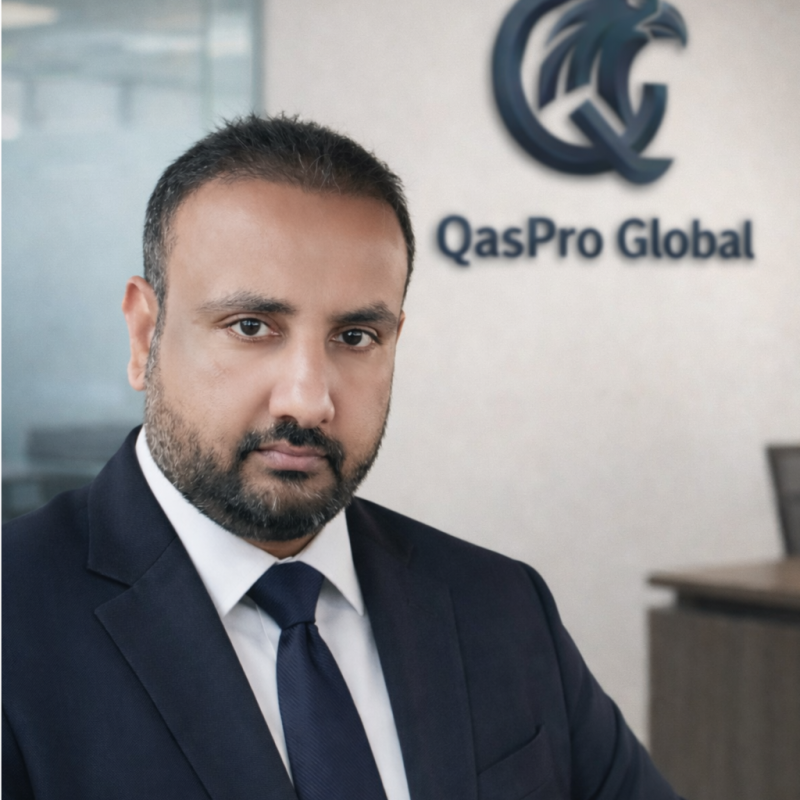
Founder & CEO, Qaspro Global — UAE tax expert with 16+ years of experience in VAT, corporate tax and FTA audit support.