

Published: 11 September 2026 | Last updated: 17 September 2026
Quick answer: KEZAD (Khalifa Economic Zones Abu Dhabi) is Abu Dhabi’s largest free zone, formed by merging KIZAD (Khalifa Industrial Zone Abu Dhabi) and ZonesCorp. A company licence starts from roughly AED 9,350, allows 100% foreign ownership, and can access Abu Dhabi’s mainland market through a separate ADDED permit rather than a second full licence. Most straightforward applications with complete documents are approved within one to two weeks.
If your business plans, however small, ever touch Abu Dhabi (logistics through Khalifa Port, light manufacturing, general trading, or a services base near the capital), KEZAD is the free zone almost nobody outside Abu Dhabi’s own business community talks about, despite being the largest free zone in the UAE by land area. This guide covers exactly what it costs, how the licence types differ, how the ADDED mainland route works, and how KEZAD companies are treated for UAE Corporate Tax.
What Is KEZAD?
KEZAD stands for Khalifa Economic Zones Abu Dhabi. It was created by combining two entities that used to operate separately:
- KIZAD (Khalifa Industrial Zone Abu Dhabi): the industrial and logistics free zone built around Khalifa Port, focused on manufacturing, warehousing, and trade.
- ZonesCorp (Higher Corporation for Specialized Economic Zones): the operator of several smaller specialized industrial zones across Abu Dhabi, including areas focused on food, chemicals, and metals.
The merged entity, KEZAD Group, was officially launched by AD Ports Group on 19 September 2022, bringing together 12 economic zones across Abu Dhabi, Al Ain, and Al Dhafra with a combined area of over 550 square kilometres, including 100 square kilometres designated specifically as Free Zones and more than 300,000 square metres of prebuilt warehouse facilities. It is marketed as the world’s largest free zone by land area. Unlike free zones built primarily around office towers (DIFC, ADGM, JAFZA’s headquarters cluster), KEZAD’s core strength is industrial land, warehousing, and direct port access, alongside standard office-based trading and service licences for companies that don’t need physical facilities.
Why This Matters for Business Owners
Most UAE company-formation guidance defaults to Dubai free zones (IFZA, DMCC, JAFZA) because that is where the bulk of demand sits. But for businesses in logistics, manufacturing, food processing, chemicals, or heavy trading, KEZAD offers something Dubai free zones generally cannot match at the same price: direct access to a deep-water port (Khalifa Port), industrial land at a materially lower cost than Dubai or Sharjah equivalents, and a still-developing ecosystem with less competition for the same customer base.
For a services or general trading company with no physical facility requirement, KEZAD also competes directly on price with Dubai’s cheaper flexi-desk zones, while still sitting inside Abu Dhabi, which matters if your clients, government contracts, or supply chain are concentrated there.
KEZAD Licence Types
KEZAD issues several licence categories depending on the intended activity:
| Licence type | Typical use case |
|---|---|
| Trading licence | Buying, selling, and distributing specific goods |
| General trading licence | Trading across multiple, unrelated product categories |
| Logistics licence | Warehousing, freight forwarding, distribution |
| Industrial / manufacturing licence | Production, processing, assembly, packaging |
| Service licence | Consulting, management, marketing, and other professional services |
The activity you select drives both the licence fee and whether you need physical warehouse or industrial space rather than a standard office or flexi-desk package.
KEZAD Setup Costs in 2026
Exact pricing depends on activity, office/warehouse type, and the number of visas required, but the typical published cost ranges for 2026 are:
| Item | Approximate cost (AED) |
|---|---|
| Company licence (starting package) | 9,350 – 16,341+ |
| Per-visa processing cost | 1,500 – 2,750 |
| Trade name reservation and initial approval | Included in most starter packages |
| ADDED mainland permit (optional) | Around 3,000 |
Higher-tier packages that include warehouse space, multiple visas, or an industrial licence cost significantly more than the entry-level trading or service packages. As with any free zone, always confirm the current fee schedule directly with KEZAD or a licensed corporate services provider before budgeting, since packages and inclusions are revised periodically.
100% foreign ownership applies across all KEZAD licence types, consistent with UAE free zone rules generally. There is no local sponsor or local service agent requirement for the free zone licence itself.
The ADDED Mainland Route
A free zone licence, including a KEZAD licence, does not by itself allow a company to trade directly with mainland UAE customers or bid on most mainland government contracts. KEZAD companies that need mainland market access typically use one of two routes:
- ADDED Permit: an additional permit issued in coordination with the Abu Dhabi Department of Economic Development (ADDED), allowing a KEZAD-licensed company to conduct specific mainland activities without setting up a second, fully separate mainland company. This is generally the faster and cheaper of the two routes, often processed within one to two weeks once the underlying free zone licence is active.
- Mainland branch or dual licence: registering a mainland branch of the free zone company, which involves a separate mainland licence process through ADDED and generally higher setup and renewal costs than the permit route.
Which route makes sense depends on how much mainland business the company expects to do and how quickly it needs to start. A company doing occasional mainland work alongside its main free zone activity typically finds the permit route sufficient; a company planning to run substantial mainland operations may need the full branch/dual-licence route instead.
Khalifa Port and Logistics Access
For logistics, trading, and manufacturing companies specifically, KEZAD’s direct connection to Khalifa Port is one of its strongest practical advantages. Khalifa Port is a deep-water container and general cargo port with direct road and rail links into the KEZAD industrial zones, meaning companies with warehouse or industrial facilities inside KEZAD can move imported goods from ship to storage without a separate inland trucking leg through public roads. This is a meaningful cost and time saving for import-heavy trading businesses compared with a warehouse located elsewhere in the emirate.
Corporate Tax Treatment for KEZAD Companies
KEZAD-registered companies are Free Zone Persons under UAE Corporate Tax Law and can qualify for the 0% Corporate Tax rate on Qualifying Income if they meet the conditions to be treated as a Qualifying Free Zone Person (QFZP). In summary, a KEZAD company generally needs to:
- Maintain adequate substance in the free zone (real staff, assets, and operating expenditure appropriate to the activity).
- Derive its income only, or predominantly, from Qualifying Activities as defined under Ministerial Decision No. 229 of 2025, and avoid Excluded Activities.
- Meet the de minimis threshold for any non-qualifying income.
- Prepare audited financial statements and maintain transfer pricing documentation where relevant.
- Not have elected to be subject to the standard Corporate Tax regime.
Income that does not meet the Qualifying Income conditions, and income earned from a Non-Qualifying Free Zone Person exceeding the de minimis threshold, is generally taxed at the standard 9% Corporate Tax rate rather than 0%. For the full list of Qualifying Activities, Excluded Activities, and the detailed QFZP conditions, see our dedicated guides: Qualifying Free Zone Person (QFZP) and Corporate Tax, UAE Free Zone Qualifying Activities under Ministerial Decision 229, and UAE Free Zone Excluded Activities.
Every KEZAD company, regardless of whether it qualifies for the 0% rate, must still register for Corporate Tax with the FTA through EmaraTax. See our guide on UAE Free Zone Corporate Tax Registration on EmaraTax for the registration steps and deadlines.
KEZAD vs Other Abu Dhabi and UAE Free Zones
KEZAD is often confused with ADGM (Abu Dhabi Global Market), but the two serve very different purposes. ADGM is Abu Dhabi’s financial free zone, built around Al Maryah Island, focused on financial services, fintech, asset management, and holding companies operating under its own common-law framework. KEZAD is an industrial, logistics, and general trading free zone spread across mainland Abu Dhabi with direct port access. A finance or fund-management business should look at our ADGM Company Setup guide instead; a trading, logistics, or manufacturing business is better matched to KEZAD.
Compared with Dubai and Sharjah free zones such as JAFZA, DMCC, and Hamriyah Free Zone, KEZAD generally offers lower industrial land and facility costs, reflecting Abu Dhabi’s overall lower commercial real estate pricing compared with Dubai, while offering broadly similar Corporate Tax and ownership benefits under the federal free zone rules.
Setup Timeline
A typical KEZAD setup, once all documents are ready, follows this rough sequence:
- Trade name reservation and initial approval (1-2 business days).
- Submission of licence application, shareholder documents, and activity selection (2-3 business days for review).
- Lease agreement for office, flexi-desk, warehouse, or industrial plot, depending on licence type.
- Licence issuance.
- Establishment card and visa processing, if required (per-visa timelines vary by Emirates ID appointment availability).
- ADDED permit application, if mainland access is needed, submitted after the free zone licence is active.
Straightforward service or trading licence applications with complete paperwork are commonly completed within one to two weeks; industrial or warehouse-based licences that require a physical facility inspection can take longer.
Documents Required for KEZAD Company Registration
Requirements vary slightly by licence type and shareholder structure, but a typical KEZAD application needs:
- Passport copies of all shareholders and the appointed manager.
- Passport-size photographs of shareholders.
- A business plan or activity description, particularly for industrial and logistics licences.
- No Objection Certificate (NOC) from a current UAE sponsor, if a shareholder is already a UAE resident under another employer’s sponsorship.
- Corporate documents (certificate of incorporation, memorandum of association, board resolution) if a shareholder is itself a corporate entity rather than an individual.
- Proof of address and, for some activities, a bank reference letter.
Corporate shareholder documents originating outside the UAE typically need attestation before submission, which can add several days to the timeline if not prepared in advance.
Renewal Costs and Ongoing Compliance
A KEZAD licence is renewed annually, and renewal fees are generally close to the original licence fee, adjusted for any change in visa quota or facility size. Beyond the licence renewal itself, KEZAD companies need to budget for:
- Annual establishment card renewal.
- Visa renewals for any sponsored employees, following the standard UAE Emirates ID and medical fitness process.
- Corporate Tax return filing every financial year, regardless of whether the company qualifies for the 0% QFZP rate.
- VAT registration and filing if turnover exceeds the mandatory VAT threshold, or voluntary registration if it exceeds the voluntary threshold.
- Audited financial statements, which are a condition for maintaining Qualifying Free Zone Person status, not an optional extra.
Missing a licence or visa renewal deadline can result in fines and, in more serious cases, suspension of the trade licence until the company’s status is regularized.
Who Should Choose KEZAD Over a Dubai Free Zone
KEZAD tends to make the most sense for:
- Logistics and freight companies that need direct, low-friction access to a deep-water port and want to avoid Dubai’s higher warehouse rental rates.
- Manufacturers producing goods for export or for the UAE’s domestic market, where industrial land cost is a major factor in overall margins.
- General trading companies whose customer base or supply chain already runs through Abu Dhabi, or who simply want the lowest-cost entry point for a trading licence with a UAE address.
- Businesses with existing Abu Dhabi government or semi-government contracts, where being based inside the emirate, even under a free zone licence with an ADDED permit, can simplify vendor registration.
A services business with no physical facility needs and a client base concentrated in Dubai will often still find a Dubai-based free zone more convenient purely on proximity, even if KEZAD’s headline licence fee is competitive.
Common Mistakes to Avoid
- Choosing the wrong licence type up front. Switching from a service licence to a trading or industrial licence later usually means a fresh approval cycle and additional fees, so confirm the exact activities you plan to carry out before applying.
- Underestimating visa quota needs. Visa allocation is tied to office or facility size; choosing the smallest package to save on setup cost can leave a growing company short of visas within the first year.
- Assuming the free zone licence covers mainland sales. Without an ADDED permit or a mainland branch, direct mainland sales activity outside the free zone is not permitted under the base licence.
- Delaying Corporate Tax registration. Registration on EmaraTax is required regardless of expected tax liability, and missing the deadline carries an administrative penalty.
Frequently Asked Questions
What is KEZAD?
KEZAD (Khalifa Economic Zones Abu Dhabi) is Abu Dhabi’s largest free zone, formed by merging KIZAD (Khalifa Industrial Zone Abu Dhabi) and ZonesCorp, and is managed under AD Ports Group.
Is KEZAD the same as KIZAD?
KIZAD is now part of KEZAD. KIZAD refers specifically to the industrial and port-linked zone around Khalifa Port; KEZAD is the combined entity that also includes the former ZonesCorp specialized zones.
How much does a KEZAD licence cost?
Entry-level licence packages typically start from around AED 9,350, with higher costs for packages that include multiple visas, warehouse space, or an industrial licence.
Can a foreigner own 100% of a KEZAD company?
Yes. KEZAD, like other UAE free zones, allows 100% foreign ownership with no local sponsor requirement for the free zone licence.
Can a KEZAD company sell directly to mainland UAE customers?
Not under the free zone licence alone. A KEZAD company needs either an ADDED permit or a mainland branch/dual licence to conduct mainland activities.
What is the ADDED permit?
It is a permit issued in coordination with the Abu Dhabi Department of Economic Development that allows a KEZAD-licensed company to carry out specific mainland activities without setting up a fully separate mainland company.
How long does it take to set up a company in KEZAD?
Straightforward service or trading licences with complete documents are typically approved within one to two weeks. Industrial or warehouse-based licences can take longer due to facility inspections.
Do KEZAD companies pay UAE Corporate Tax?
KEZAD companies must register for Corporate Tax, but can qualify for a 0% rate on Qualifying Income if they meet the Qualifying Free Zone Person conditions. Non-qualifying income is taxed at the standard 9% rate.
What is the difference between KEZAD and ADGM?
ADGM is a financial free zone focused on financial services, fintech, and asset management. KEZAD is an industrial, logistics, and general trading free zone with direct access to Khalifa Port.
Does KEZAD offer warehouse and industrial land, not just office space?
Yes. Unlike office-focused free zones, KEZAD’s core offering includes industrial plots, warehouses, and logistics facilities connected to Khalifa Port, in addition to standard office and flexi-desk packages for trading and service companies.
Related Reading
- ADGM Company Setup in Abu Dhabi
- UAE Free Zone Corporate Tax Registration on EmaraTax
- Mainland vs Free Zone: Which Is Right for Your Business?
Need Help Setting Up in KEZAD?
Qaspro Global helps businesses choose the right UAE free zone, complete licence applications, and stay compliant with Corporate Tax and VAT from day one. Contact us on WhatsApp to discuss whether KEZAD fits your business plans.
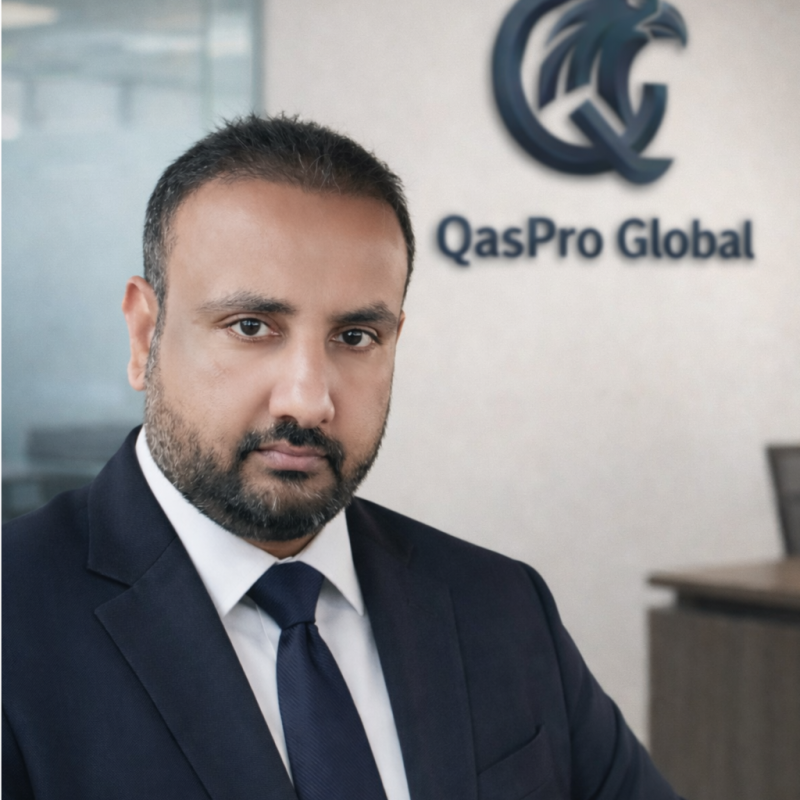
Founder & CEO, Qaspro Global — UAE tax expert with 16+ years of experience in VAT, corporate tax and FTA audit support.