What Is Meydan Free Zone in 2026?
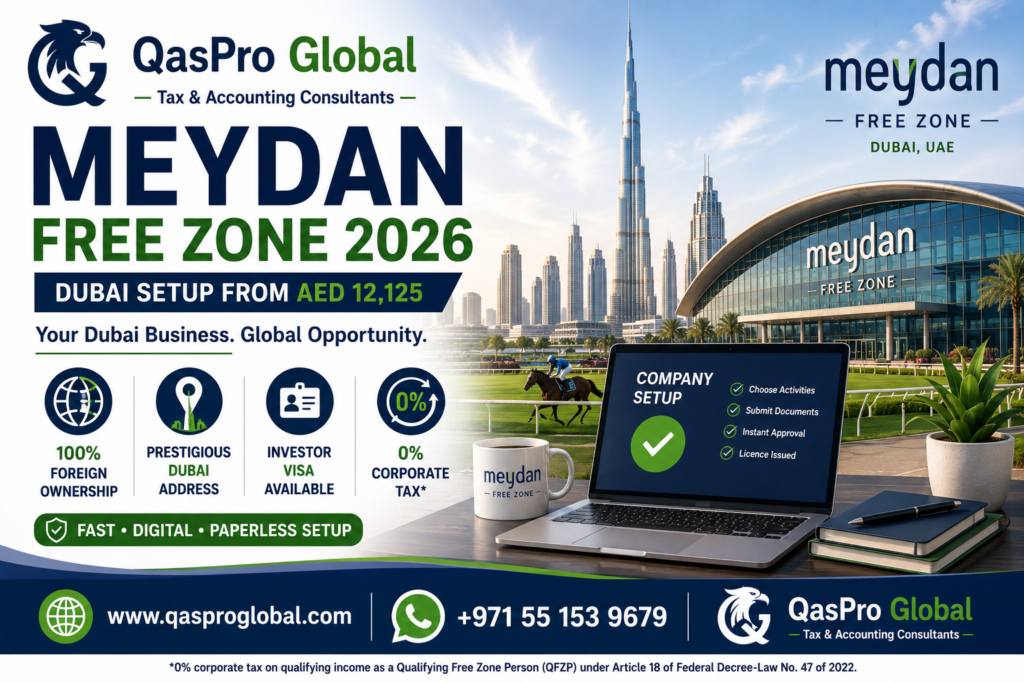
Meydan Free Zone is a Dubai-based free zone in Nad Al Sheba, next to the Meydan Racecourse, that lets you register a 100% foreign-owned company from AED 12,125 for the licence, with a prestigious Dubai address and a fully digital, paperless setup. It is one of the few free zones that sits inside the city of Dubai rather than a distant industrial belt, which is why freelancers, startups, holding companies and consultancies have made it one of the fastest-growing zones in the Emirate. In this guide, Qaspro Global breaks down the real 2026 cost of a Meydan licence, how its companies reach a 0% corporate tax rate, and the one compliance test most founders get wrong.
The detail most people miss is the tax angle. A Meydan Free Zone company is not automatically tax-free. It can legally pay 0% UAE corporate tax, but only if it qualifies as a Qualifying Free Zone Person under Article 18 of Federal Decree-Law No. 47 of 2022. Get that wrong and the same company pays 9% on its profits for five years.
Quick answer: Meydan Free Zone 2026 starts at AED 12,125 for the trade licence plus a mandatory AED 375 shared desk, with all prices inclusive of VAT and government fees. A typical setup with one investor visa works out to about AED 21,080. The company pays 0% corporate tax on qualifying income if it meets the Qualifying Free Zone Person conditions in Article 18 of Federal Decree-Law 47 of 2022, otherwise 9%.
Published: 17 June 2026 | Last updated: 3 August 2026
Why Do Founders Choose Meydan Free Zone Over Other Dubai Zones?
Founders choose Meydan Free Zone because it combines a genuine Dubai city address with a fast, low-friction digital licence and flexible activity rules. Unlike many free zones tied to a single industry or a remote location, Meydan is affiliated with Meydan City Corporation, a Dubai Government entity, and sits minutes from Downtown Dubai. That central position makes a real difference when you open bank accounts, sign client contracts, or invite staff and partners to your registered address.
The features that pull most applicants to Meydan in 2026 are:
- 100% foreign ownership with no local sponsor or service agent required.
- No paid-up share capital blocked in a bank account to start the company.
- Up to three activity groups on a single licence, covering more than 1,500 commercial, consultancy and media activities.
- A prestigious Nad Al Sheba business address without renting a full physical office.
- A fully digital application, with the trade licence often issued within a few working days.
- Full profit repatriation and 0% personal income tax on salaries and dividends drawn by owners.
If you are still weighing locations, compare Meydan against the cluster Qaspro Global has covered in depth: the IFZA free zone in Dubai, the cost-driven RAKEZ free zone, the logistics-heavy JAFZA free zone beside Jebel Ali Port, and the commodities hub at DMCC in JLT. Each suits a different business model, and the right choice depends on where your customers and suppliers actually are.
How Much Does It Cost to Set Up in Meydan Free Zone in 2026?
A Meydan Free Zone company costs AED 12,125 for the one-year trade licence plus a mandatory AED 375 shared desk, so the base package is AED 12,500 before visas. A complete setup with one investor or partner visa, the establishment card, a single visa allocation and the medical and Emirates ID comes to about AED 21,080. All Meydan prices are inclusive of VAT and government fees, and a 15% discount is applied automatically on multi-year setups for the licence and visa allocation fees.
| Item | Cost (AED) | Notes |
|---|---|---|
| Business licence (1 year) | 12,125 | Core trade licence, up to 3 activity groups |
| Shared desk facility | 375 | Mandatory with every licence package |
| Visa allocation (per person, per year) | 1,850 | Multiplied by the number of licence years |
| Immigration / establishment card | 2,000 | Renewal is 2,200 |
| Investor or partner visa processing | 4,000 | Per person |
| Employee visa processing | 3,500 | Per person |
| Status change inside the UAE | 1,500 | Per person, only if needed |
| Medical and Emirates ID | 710 | AED 388 medical + AED 322 Emirates ID, per visa holder |
| Knowledge and innovation fee | 20 | Added to each invoice |
Two cost rules catch founders out. First, the shared desk at AED 375 is not optional, it is required with every package. Second, visa allocations are multiplied by the number of licence years, so a 2-year licence with one visa means you pay for two allocations, one per year. Qaspro Global builds the full figure, including the medical and Emirates ID at AED 710 (AED 388 medical plus AED 322 Emirates ID) for each visa holder, into a single quote so there are no surprises after you commit.
What License Types Does Meydan Free Zone Offer?
Meydan Free Zone issues three core licence categories: commercial, consultancy or service, and media. You select up to three activity groups under one licence, and within each group you can list multiple related activities. This bundling is what lets a single Meydan company trade goods, offer advisory services, and run a media or marketing arm without three separate licences.
- Commercial licence: import, export, wholesale trading, distribution, e-commerce and general trading of permitted goods.
- Consultancy and service licence: management consulting, IT services, marketing, HR, business advisory and other professional services.
- Media licence: advertising, content production, communications and digital media services.
For solo founders and remote operators, the consultancy and e-commerce licences are the most popular because they need the least physical infrastructure. If you run a one-person operation, also read our guide on the UAE freelance visa to see whether a freelance permit or a full free zone company fits you better.
How Does the 0% Corporate Tax Work for a Meydan Free Zone Company?
A Meydan Free Zone company pays 0% corporate tax on its qualifying income only if it is a Qualifying Free Zone Person (QFZP) under Article 18 of Federal Decree-Law No. 47 of 2022. Income that does not qualify, and any company that fails the test, is taxed at the standard 9% rate above the AED 375,000 threshold set in Cabinet Decision No. 49 of 2023. The 0% rate is a benefit you earn through compliance, not a free pass that comes with the licence.
To keep the 0% rate, a Meydan company must meet every QFZP condition, not just one. The conditions in Article 18 are:
- Maintain adequate substance in the UAE (real people, premises and activities, not just a paper address).
- Derive qualifying income as defined by Cabinet Decision and Ministerial Decision.
- Not have elected to be subject to the standard 9% corporate tax.
- Comply with the arm’s length principle and transfer pricing documentation rules.
- Prepare audited financial statements, which Ministerial Decision No. 84 of 2025 makes mandatory for every QFZP regardless of revenue size.
- Stay within the de minimis limit on non-qualifying revenue.
The de minimis test is the trap. Under the de minimis rule, your non-qualifying revenue must not exceed the lower of AED 5,000,000 or 5% of total revenue in a tax period. Cross that line and you lose QFZP status for the current tax period and the following four tax periods, paying 9% for five years. Qaspro Global advises every free zone founder to map their income streams against the qualifying income list before they sign their first contract, because a single mainland-facing revenue stream can quietly break the test. For the full mechanics, see our deep dive on the Qualifying Free Zone Person rules and the side-by-side free zone 0% versus mainland 9% comparison.
Meydan Free Zone vs Dubai Mainland 2026: Which Pays Less Tax?
Both a Meydan Free Zone company and a Dubai mainland company can now be 100% foreign-owned, so the real difference in 2026 is tax treatment and market access. A Meydan company can reach 0% corporate tax on qualifying income, while a mainland company pays 9% on taxable profit above AED 375,000. The trade-off is that a mainland company can sell directly to the UAE domestic market without restriction, whereas a free zone company’s onshore sales can become non-qualifying revenue.
| Factor | Meydan Free Zone | Dubai Mainland (DED) |
|---|---|---|
| Foreign ownership | 100% | 100% for most activities |
| Corporate tax | 0% on qualifying income as a QFZP, else 9% | 9% above AED 375,000 |
| Audited accounts | Mandatory for QFZP (MD 84/2025) | Required above AED 50M revenue (MD 84/2025) |
| UAE domestic market sales | Possible but can be non-qualifying revenue | Unrestricted |
| Office requirement | Flexi-desk or shared desk accepted | Physical office with Ejari usually required |
| Setup speed | Fast, fully digital | Slower, more government touchpoints |
For a wider view of this decision beyond tax, read our full mainland versus free zone Dubai comparison.
What Are the Steps to Set Up a Company in Meydan Free Zone?
Setting up a Meydan Free Zone company in 2026 is a digital process you can complete remotely in a few working days. The licence is issued first, and the residence visa process follows. The core steps are:
- Step 1: Choose your activity groups (up to three) and confirm they all sit within Meydan’s permitted list.
- Step 2: Reserve your company name following UAE naming rules (no offensive terms, no abbreviations of personal names).
- Step 3: Submit shareholder passports, photographs and the application through Meydan’s online portal.
- Step 4: Pay the licence fee of AED 12,125 plus the AED 375 shared desk and receive your trade licence, usually within a few working days.
- Step 5: Apply for your establishment card and residence visa allocation under the package you selected.
- Step 6: Complete Emirates ID and medical steps, then open a corporate bank account.
The step most founders underestimate is the bank account. UAE banks run strict compliance checks, and a thin business profile or an unclear activity mix causes rejections. Our guide on the UAE business bank account explains exactly what banks want to see before you apply.
Can a Meydan Free Zone Company Get Residence Visas?
Yes. A Meydan Free Zone company can sponsor UAE residence visas for its owner, employees and their dependents, with the number of visas tied to the package you choose. Each visa allocation costs AED 1,850 per year, investor or partner visa processing is AED 4,000 per person, and employee visa processing is AED 3,500 per person, plus AED 710 for the medical and Emirates ID of each visa holder. A residence visa from your own company gives you an Emirates ID, the right to live in the UAE, and the ability to sponsor family members.
If you plan to bring family, factor in the salary and accommodation evidence the immigration authority asks for when you sponsor dependents. For timelines on each stage, see our guide to UAE visa processing time and the Emirates ID renewal process.
Does a Meydan Free Zone Company Need to Register for Corporate Tax and VAT?
Yes. Every Meydan Free Zone company must register for UAE corporate tax through the EmaraTax portal, even if it expects to pay 0% as a Qualifying Free Zone Person. Corporate tax registration is mandatory for all taxable persons, including free zone companies claiming the 0% rate, and missing the registration deadline triggers a penalty regardless of how much tax you owe. A free zone company that does no business at all still has filing duties, as we explain in trade licence but no business.
VAT is separate. A Meydan company must register for VAT once its taxable supplies and imports exceed AED 375,000 in a 12-month period, and may register voluntarily above AED 187,500. Many free zone consultancies invoicing overseas clients fall below the threshold, but e-commerce and trading companies usually cross it quickly. Qaspro Global recommends confirming both registrations within your first 90 days of trading to avoid late penalties.
What Are the Ongoing Compliance Requirements for a Meydan Company?
A Meydan Free Zone company must renew its trade licence annually, keep proper accounting records for at least seven years, and file an annual corporate tax return within nine months of its financial year end. If you intend to keep the 0% QFZP rate, you must also prepare audited financial statements every year under Ministerial Decision No. 84 of 2025, and maintain transfer pricing documentation for any related-party transactions. The immigration card renews at AED 2,200.
Skipping the audit is the most common and most expensive mistake. Without audited accounts, a QFZP simply does not qualify, so the 0% rate is lost even if every other condition is met. Build the audit into your annual budget from year one. For the full record-keeping framework, read our guide on UAE bookkeeping laws and the deadline calendar in trade licence renewal.
Who Should Choose Meydan Free Zone, and Who Should Not?
Meydan Free Zone is the strongest fit for consultants, digital businesses, holding companies, e-commerce sellers and service firms that want a Dubai address, fast remote setup and a path to 0% corporate tax. It suits founders whose customers are international or who can structure their UAE income within the qualifying income rules. Meydan, as a Dubai-based zone, also tends to smooth the banking process compared with zones in the outer emirates.
It is a weaker fit if your core business is selling directly to UAE mainland customers, because those onshore sales can push you over the de minimis limit and cost you the 0% rate. It is also not ideal for heavy industrial, manufacturing or port-logistics operations, which belong in a zone built for that purpose such as JAFZA. If most of your revenue is domestic UAE retail or B2C services, a mainland licence is often cleaner. Qaspro Global, a UAE-based tax and accounting consultancy, helps founders model both routes before they commit, because the wrong structure is costly to unwind.
For a lower-cost alternative outside Dubai, compare this with Ajman Free Zone setup, which starts from AED 5,565 all-inclusive.
Why Set Up Your Meydan Free Zone Company With Qaspro Global?
- One team, end to end: Meydan Free Zone licence, establishment card, residence visas, Emirates ID, corporate bank account introduction and FTA corporate tax registration handled together, not by four different agents.
- Tax-correct from day one: we are a tax and accounting firm first. Before you pay a licence fee we check whether your activity and customers fit the 0% Qualifying Free Zone Person rules, so you do not discover a 9% bill a year later.
- Exact, all-inclusive quote: you get one written figure covering authority fees and our service fee. No add-ons appear after you sign.
- Remote setup: the licence can be issued before you travel. You only need to be in the UAE for the visa medical and Emirates ID biometrics.
- After the licence: the same team runs your bookkeeping, VAT and corporate tax filings, licence renewals and audit if you need one.
How the Meydan Free Zone Setup Works With Us
- Free 20-minute consultation: we confirm the right licence type, activities, visa count and whether this free zone is actually the best fit for your business or whether another zone or mainland would serve you better.
- Written quote and document list: passport copies, photo and a short application form are usually all that is needed.
- Trade name, application and licence: we file, follow up with the authority and send you the licence and incorporation documents.
- Visas, bank and tax registration: entry permit, medical, Emirates ID, bank account introduction and corporate tax registration on EmaraTax within the legal deadline.
IFZA vs Ajman Free Zone vs Meydan: Which Low-Cost Zone Fits You?
| Factor | IFZA (Dubai) | Ajman Free Zone | Meydan (Dubai) |
|---|---|---|---|
| Licence from | AED 12,900 (0 visa) | AED 5,565 (0 visa) | AED 12,125 |
| With 1 visa | AED 14,900 + visa costs | AED 13,131 all-inclusive | From about AED 16,000 |
| Activities per licence | Multiple related activities | Up to 10 | Up to 3 standard |
| Address | Dubai Silicon Oasis | Ajman | Nad Al Sheba, Dubai |
| Best for | Consultants, IT, e-commerce wanting a Dubai licence | Lowest total cost with visas | Trading and holding with a Dubai address |
| Guide | IFZA setup guide | Ajman setup guide | Meydan setup guide |
Not sure which jurisdiction is right? Start from our business setup services page, which covers mainland, 30+ free zones and offshore in one place.
Frequently Asked Questions
How much does it cost to set up a company in Meydan Free Zone in 2026?
A Meydan Free Zone company starts at AED 12,125 for the one-year licence plus a mandatory AED 375 shared desk, so AED 12,500 before visas. A full setup with one investor visa, the establishment card, a visa allocation and the medical and Emirates ID is about AED 21,080, with all prices inclusive of VAT and government fees.
Is the Meydan shared desk facility mandatory?
Yes. The shared desk costs AED 375 and is required with every Meydan business licence package. It provides your registered desk address and cannot be removed to lower the price.
Is there a discount for a multi-year Meydan licence?
Yes. Meydan applies a 15% discount automatically on multi-year setups, covering the licence fees and the visa allocation fees. Remember that visa allocations are multiplied by the number of licence years, so a 2-year licence with one visa is billed for two allocations.
Is a Meydan Free Zone company really tax-free in 2026?
Not automatically. A Meydan company pays 0% corporate tax only on qualifying income and only if it meets all Qualifying Free Zone Person conditions in Article 18 of Federal Decree-Law 47 of 2022. Non-qualifying income and companies that fail the test are taxed at 9% above AED 375,000.
What is the de minimis rule for a Meydan free zone company?
The de minimis rule says your non-qualifying revenue must stay below the lower of AED 5,000,000 or 5% of total revenue in a tax period. Exceeding it under Cabinet Decision No. 100 of 2023 means you lose Qualifying Free Zone Person status for that year and the next four tax periods.
Does a Meydan Free Zone company need audited financial statements?
Yes, if it wants the 0% rate. Ministerial Decision No. 84 of 2025 makes audited financial statements mandatory for every Qualifying Free Zone Person, regardless of revenue. A QFZP without an audit loses its 0% status for that tax period.
How many residence visas can a Meydan free zone company get?
The number depends on the package you choose. Each visa allocation costs AED 1,850 per year, investor visa processing is AED 4,000 and employee visa processing is AED 3,500 per person, plus AED 710 medical and Emirates ID per visa holder. Each visa covers the owner or an employee and can be used to sponsor dependents.
Can a Meydan free zone company sell to the UAE mainland?
It can, but onshore sales to the UAE market are generally non-qualifying revenue. Too much mainland income can break the de minimis limit and cost you the 0% rate. Businesses focused on the domestic market often choose a mainland licence instead.
How long does it take to set up a Meydan free zone company?
The trade licence is often issued within a few working days because the process is digital and paperless. The residence visa stage adds one to two weeks for the establishment card, Emirates ID and medical steps.
Need Expert Help?
Qaspro Global’s business setup and tax consultants can help you choose the right Meydan Free Zone licence, build an exact cost from the AED 12,125 base, and structure your income to protect the 0% Qualifying Free Zone Person rate, handling corporate tax registration, VAT and audit from day one. Contact us today for a free consultation and a clear, all-inclusive quote.
With the July 31 deadline approaching, see our detailed step-by-step guide on the UAE Corporate Tax Penalty Waiver 2026: Remove the AED 10,000 FTA Fine Before July 31 — including how to trigger the automatic waiver and what to do if you already paid the AED 10,000 penalty.
Related Reading
- UAE Qualifying Income 2026: The Full QFZP 0% List
- Ajman Free Zone 2026: Company Setup From AED 5,565
- Sharjah Publishing City 2026: The AED 5,750 Free Zone License
- JAFZA Free Zone 2026: The Port Edge Other Zones Can’t Match
- RAKEZ Free Zone 2026: Setup and Who Gets 0% Tax
- IFZA Dubai 2026: The Setup Most Businesses Get Wrong
- UAE Qualifying Free Zone Person: The 0% Tax Test
- Meydan Free Zone 2026: AED 12,125 Setup and the QFZP Tax Test
- UAE Offshore Company 2026: 0% Tax but You Still Must Register
- Cheapest Business Setup in Dubai 2026: Full Cost Guide
- Mainland vs Free Zone Dubai 2026: Which to Choose
- Business Setup Dubai 2026: Every Cost, Step and Requirement
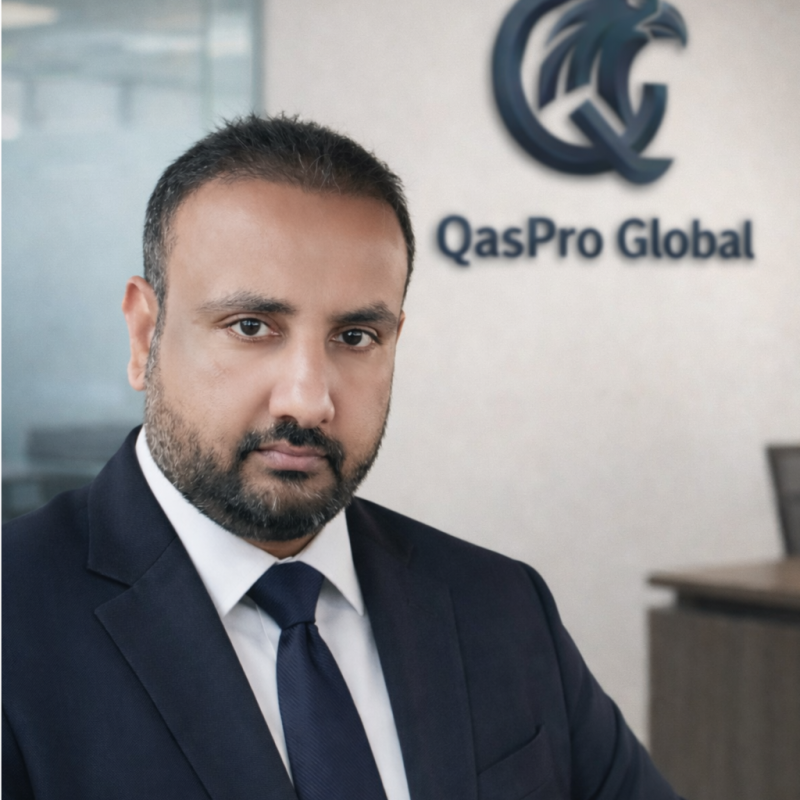
Founder & CEO, Qaspro Global — UAE tax expert with 16+ years of experience in VAT, corporate tax and FTA audit support.