
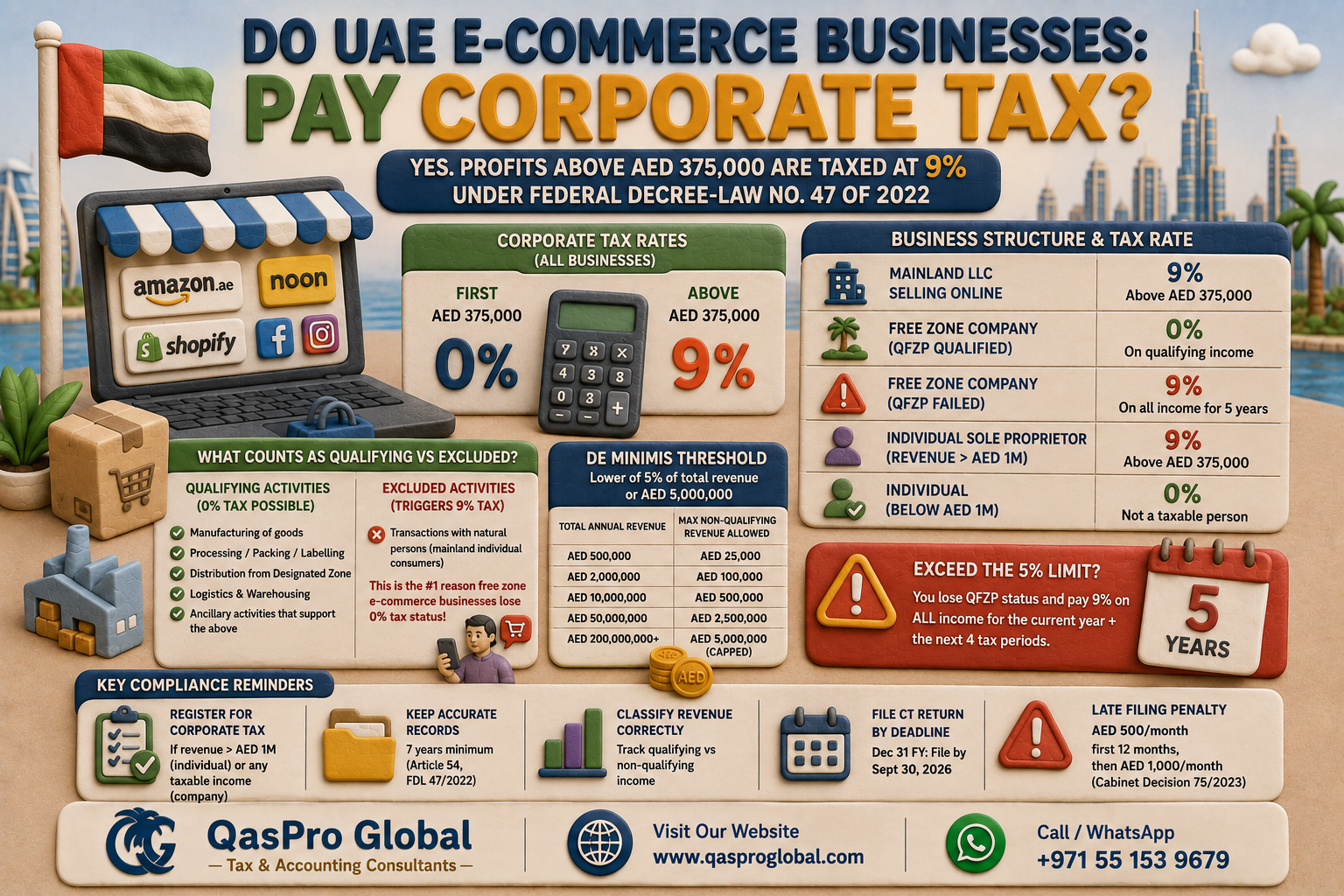
Do UAE E-Commerce Businesses Pay Corporate Tax?
Thousands of UAE entrepreneurs run online stores through Amazon.ae, noon.com, Shopify, and social media platforms. Many set up in a free zone assuming they will pay 0% corporate tax on all their income. That assumption is wrong, and the consequences are severe: lose your Qualifying Free Zone Person (QFZP) status once, and the FTA charges 9% on your entire income for the current year plus the next four tax periods.
In this guide, Qaspro Global breaks down exactly how UAE corporate tax applies to e-commerce businesses, which online sales qualify for 0%, which trigger 9%, and the structuring decisions that determine your tax bill for the next five years.
How Does UAE Corporate Tax Apply to Online Businesses?
UAE corporate tax under Federal Decree-Law No. 47 of 2022 applies to every business earning taxable income in the UAE, including e-commerce. The standard rates are 0% on the first AED 375,000 of taxable income and 9% on everything above that threshold. There is no separate e-commerce tax category. Online businesses follow the same rules as offline ones.
The critical question is not whether you pay corporate tax, but at what rate. That depends entirely on your business structure and who your customers are.
| Business Structure | CT Rate | Key Condition |
|---|---|---|
| Mainland LLC selling online | 9% above AED 375,000 | Standard rate, no QFZP benefit |
| Free zone company (QFZP qualified) | 0% on qualifying income | Must pass all QFZP tests including de minimis |
| Free zone company (QFZP failed) | 9% on all income for 5 years | Mainland consumer sales exceeded threshold |
| Individual sole proprietor (online) | 9% above AED 375,000 | Only if annual revenue exceeds AED 1 million (Cabinet Decision 49/2023) |
| Individual below AED 1M revenue | 0% | Not a taxable person under Article 11 |
What Is a Qualifying Free Zone Person and Why Does It Matter for E-Commerce?
A Qualifying Free Zone Person (QFZP) is a free zone entity that meets all conditions under Article 18 of FDL 47/2022 and earns 0% corporate tax on its qualifying income. For e-commerce businesses, the QFZP status is where most sellers get trapped, because selling to mainland individual consumers is classified as an Excluded Activity.
To maintain QFZP status, a free zone e-commerce business must satisfy all of the following conditions simultaneously:
- Adequate substance in the free zone (employees, office space, expenditure proportionate to activities)
- Qualifying income from Qualifying Activities under Ministerial Decision 229 of 2025
- Non-qualifying revenue stays below the de minimis threshold: 5% of total revenue or AED 5,000,000, whichever is lower
- Audited financial statements prepared under IFRS (Ministerial Decision 82 of 2023, updated by MD 84 of 2025)
- Not elected to be taxed at the standard 9% rate
Which E-Commerce Activities Are Qualifying and Which Are Excluded?
Ministerial Decision 229 of 2025 replaced the earlier MD 265 of 2023 and defines exactly which activities qualify for 0% tax. For e-commerce businesses, the critical distinction is between Qualifying Activities and Excluded Activities.
Qualifying Activities Relevant to E-Commerce (MD 229/2025, Article 2(1))
- Manufacturing of goods or materials (paragraph a): if you manufacture products in a free zone and sell them, the manufacturing itself qualifies
- Processing of goods or materials (paragraph b): packaging, labelling, or assembling products in a free zone
- Distribution of goods from a Designated Zone (paragraph l): distributing physical goods from a Designated Zone qualifies
- Logistics services (paragraph m): warehousing, fulfillment, and logistics operations
- Ancillary activities (paragraph n): activities that support the above, such as inventory management
Excluded Activities That Trap E-Commerce Sellers (MD 229/2025, Article 2(2))
- Transactions with natural persons (individuals) (paragraph a): this is the killer rule for e-commerce. If your free zone online store sells to individual consumers on the UAE mainland, that revenue is an Excluded Activity. It does not qualify for 0%.
- Ownership or exploitation of immovable property (paragraph e): if you own warehouse space outside the free zone
The exception under paragraph (a) applies only to ship operations, fund management, wealth management, and aircraft leasing. E-commerce retail is not exempt from this rule.
Why Amazon.ae and Noon.com Sellers Face the Biggest Risk
Most sellers on Amazon.ae and noon.com are free zone companies (often DMCC, IFZA, or RAKEZ) fulfilling orders to individual consumers across the UAE mainland. Every one of those B2C transactions is an Excluded Activity under MD 229/2025 Article 2(2)(a).
Here is what happens in practice:
- A DMCC-licensed company sells AED 2,000,000 worth of products on Amazon.ae
- 90% of buyers are individual mainland consumers: AED 1,800,000 is Excluded Activity revenue
- 10% are free zone businesses or international buyers: AED 200,000 is qualifying revenue
- Non-qualifying revenue (AED 1,800,000) is 90% of total revenue, far above the 5% de minimis
- Result: QFZP status is lost. The FTA taxes the entire AED 2,000,000 at 9% for the current year plus four additional tax periods
The five-year lockout is the most punishing aspect. Under Article 18(5) of FDL 47/2022, a free zone entity that fails to meet QFZP conditions cannot re-elect for QFZP status until five consecutive tax periods have passed at 9%.
What Is the De Minimis Threshold and How Does It Work?
The de minimis threshold is the safety margin that allows a small amount of non-qualifying revenue without losing QFZP status. Under Cabinet Decision 100 of 2023, the threshold is the lower of 5% of total revenue or AED 5,000,000.
| Total Annual Revenue | Maximum Non-Qualifying Revenue Allowed | Threshold Applied |
|---|---|---|
| AED 500,000 | AED 25,000 | 5% rule |
| AED 2,000,000 | AED 100,000 | 5% rule |
| AED 10,000,000 | AED 500,000 | 5% rule |
| AED 50,000,000 | AED 2,500,000 | 5% rule |
| AED 200,000,000 | AED 5,000,000 | AED 5M cap |
For a typical e-commerce seller with AED 2 million in annual revenue, only AED 100,000 of mainland consumer sales is allowed before the entire QFZP status collapses. That is roughly 50 orders at AED 2,000 each. Most Amazon.ae sellers exceed this in the first month.
How Should UAE E-Commerce Businesses Structure to Minimize Tax?
Qaspro Global advises e-commerce businesses to choose their structure based on their actual customer base, not on the headline 0% rate that free zones advertise. Here are the practical options:
Option 1: Mainland LLC (Best for B2C Online Sellers)
If most customers are individual UAE consumers, a mainland LLC is the straightforward choice. You pay 9% above AED 375,000, but you avoid the QFZP compliance burden and the risk of a five-year penalty. A mainland e-commerce business with AED 2 million revenue and AED 500,000 profit pays AED 11,250 in corporate tax ((500,000 – 375,000) x 9%).
Option 2: Free Zone Company (Only for B2B or Export)
A free zone structure works for e-commerce businesses that sell exclusively to other free zone persons, international customers outside the UAE, or businesses (not individuals) within Designated Zones. Examples include wholesale distributors, B2B marketplace sellers, and cross-border exporters.
Option 3: Dual Structure (Mainland + Free Zone)
Some businesses split operations: a free zone entity handles international B2B sales and warehousing (qualifying activities), while a mainland entity handles domestic B2C sales. This is legally permitted but requires genuine substance in both entities, arm’s length pricing between them, and careful transfer pricing documentation. The FTA scrutinizes dual structures under the General Anti-Abuse Rule (Article 50, FDL 47/2022).
Option 4: Individual Below AED 1 Million
If your total online sales are below AED 1 million annually and you operate as an individual (not through a company), you are not a taxable person under Cabinet Decision 49 of 2023. No corporate tax registration or filing is required. This applies to small-scale sellers on Instagram, TikTok Shop, or personal Shopify stores.
What About Drop-Shipping and Digital Products?
Drop-shipping from a UAE free zone still triggers the same rules. If the end customer is an individual on the mainland, the revenue is non-qualifying regardless of where the physical product ships from. The classification depends on who the buyer is, not where the goods physically move.
Digital products (e-books, courses, software subscriptions, SaaS) sold by a free zone company to mainland individuals are also Excluded Activities under MD 229/2025. There is no carve-out for digital versus physical goods.
International digital sales to customers outside the UAE can qualify as qualifying income if they are not transactions with UAE-resident natural persons and fall within the scope of the free zone license.
What Records Must E-Commerce Businesses Keep for CT Compliance?
Article 54 of FDL 47/2022 requires every taxable person to maintain financial records for seven years. For e-commerce businesses, the FTA expects:
- Transaction records showing each sale, the buyer’s identity (individual versus business), and the buyer’s location (free zone, mainland, international)
- Revenue classification splitting qualifying income from non-qualifying income for every tax period
- Platform reports from Amazon Seller Central, noon Partner Portal, or Shopify showing order-level detail
- Bank statements reconciled to sales reports
- Inventory records showing goods movement between free zone, Designated Zones, and mainland
- Transfer pricing documentation if operating a dual structure with related parties
QFZP entities must also produce audited financial statements under IFRS (Ministerial Decision 84 of 2025). The audit must confirm the revenue split between qualifying and non-qualifying income.
Common Mistakes UAE Online Sellers Make with Corporate Tax
- Assuming free zone means 0% tax on everything: QFZP 0% only applies to qualifying income. Mainland B2C sales are excluded.
- Not tracking customer type: The FTA requires you to classify each transaction as qualifying or non-qualifying. Without records, you cannot defend your QFZP claim.
- Mixing personal and business bank accounts: Individual sellers above AED 1 million revenue must register for CT. Mixed accounts make it impossible to determine taxable income.
- Ignoring the September 30 filing deadline: E-commerce businesses with a December 31 financial year end must file their CT return by September 30, 2026. Late filing triggers AED 500 per month for the first 12 months, increasing to AED 1,000 per month thereafter (Cabinet Decision 75 of 2023).
- Not registering at all: Some online sellers believe they are too small to register. If your business exceeds AED 1 million in revenue (individuals) or earns any taxable income (companies), you must register on EmaraTax.
Online sellers who misreport VAT on a filed return should correct it with a VAT voluntary disclosure before an audit notice arrives.
VAT reverse charge reminder: Before filing, review our reverse charge rules for e-commerce transactions to confirm invoice wording, TRN evidence, and VAT return treatment.
Frequently Asked Questions
Do I need to pay corporate tax on my Amazon.ae sales in UAE?
Yes. If you sell on Amazon.ae through a UAE company (mainland or free zone), your profits above AED 375,000 are subject to 9% corporate tax. Free zone sellers may access 0% only on qualifying income that does not include sales to mainland individual consumers.
Can a free zone e-commerce company get 0% corporate tax?
Only if the company sells exclusively to other free zone persons, international customers, or within Designated Zones. Selling to mainland individual consumers is an Excluded Activity under Ministerial Decision 229 of 2025. If these excluded sales exceed 5% of revenue, the company loses QFZP status for five years.
What happens if my non-qualifying revenue exceeds the 5% de minimis?
You lose QFZP status for the current tax period and the following four consecutive tax periods. During those five years, your entire income is taxed at 9%, not just the non-qualifying portion.
Is selling on noon.com different from Amazon.ae for tax purposes?
No. The corporate tax treatment depends on your business structure and customer type, not the marketplace platform. Both Amazon.ae and noon.com sales to mainland individual consumers are treated identically under FDL 47/2022 and MD 229/2025.
Do Instagram and TikTok sellers pay corporate tax in UAE?
Individual sellers with total annual revenue below AED 1 million are not taxable persons under Cabinet Decision 49 of 2023. Above AED 1 million, they must register for corporate tax. Businesses operating through a company pay CT regardless of the sales channel.
Is drop-shipping from UAE taxable under corporate tax?
Yes. If the drop-shipping operation is conducted through a UAE entity, profits are subject to corporate tax at the standard rates. The tax treatment depends on the buyer’s location and type, not the product’s shipping origin.
What is the corporate tax deadline for e-commerce businesses?
For businesses with a financial year ending December 31, 2025, the CT return must be filed and tax paid by September 30, 2026. The general rule is nine months after the end of the financial year. Late filing incurs AED 500 per month (Article 51, FDL 47/2022, Cabinet Decision 75 of 2023).
Do I need an audited financial statement for my online store?
Yes, if you are a QFZP (all qualifying free zone persons must have audited statements under MD 82/2023 and MD 84/2025) or if your annual revenue exceeds AED 50 million. Mainland e-commerce companies below AED 50 million do not need an audit unless specifically requested by the FTA.
Can I split my business between mainland and free zone to save tax?
Yes, but only with genuine substance and arm’s length pricing. A free zone entity handling exports and a mainland entity handling domestic B2C sales is legally permitted. However, the FTA reviews dual structures under the General Anti-Abuse Rule (Article 50, FDL 47/2022) and transfer pricing rules (Article 34-36). Consult a tax advisor before implementing this structure.
What if I sell digital products from a UAE free zone?
Digital products sold to mainland individual consumers are Excluded Activities under MD 229/2025, identical to physical product sales. Digital exports to international customers may qualify as qualifying income if they fall within your free zone license scope.
Need Expert Help?
Qaspro Global’s tax consultants help e-commerce businesses choose the right structure, calculate their qualifying versus non-qualifying income split, and file corporate tax returns before the September 30 deadline. Whether you sell on Amazon.ae, noon.com, Shopify, or social media, getting the QFZP classification right today saves you five years of unnecessary tax. Contact us today for a free consultation, or reach us on WhatsApp: +971 55 153 9679.
Related Reading
- UAE Qualifying Income 2026: The Full QFZP 0% List
- VAT Voluntary Disclosure UAE 2026: Fix Errors Before the FTA Does
- Fail This One Test and Your UAE Free Zone Company Pays 9% Corporate Tax for 5 Years
- Free Zone 0% vs Mainland 9% Tax UAE 2026: Who Actually Pays Less?
- How to Get an E-Commerce License in UAE 2026
- UAE VAT Return Filing 2026: Deadlines, Steps and How to Avoid Fines
- UAE VAT Registration 2026: Step-by-Step Guide
- Do I Need to Register for VAT in UAE? 2026 Guide
- UAE VAT Reverse Charge 2026: The Box 3 Mistake Importers Make
- UAE VAT Input Tax Apportionment 2026: Most Businesses Overpay
- VAT Designated Zones UAE 2026: Complete List
- UAE Tax Penalties Change on 14 April 2026

Founder & CEO, Qaspro Global — UAE tax expert with 16+ years of experience in VAT, corporate tax and FTA audit support.