
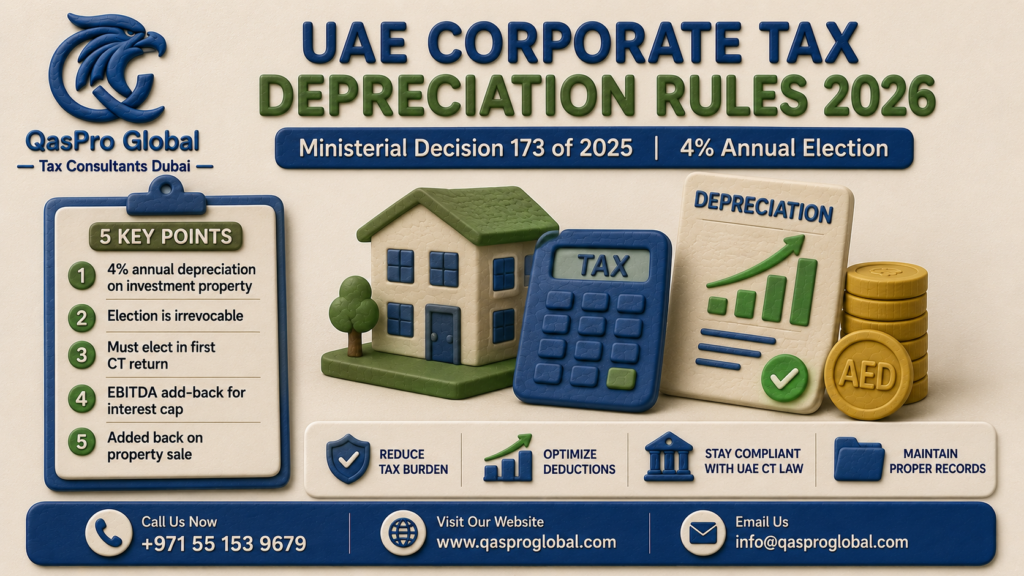
Quick view: depreciation and your Corporate Tax
- UAE Corporate Tax has no separate depreciation table. The depreciation in your IFRS accounts is normally your tax deduction.
- Typical yearly rates: computers and IT 25%-33.3%, furniture 10%-20%, vehicles 20%-25%, buildings 2%-4%.
- Investment property held at fair value can take a flat 4% yearly deduction under Ministerial Decision No. 173 of 2025.
- The 4% election is irrevocable and must be made in the correct CT return, or the right is lost.
- Depreciation is added back when working out the 30% EBITDA interest limit.
UAE Corporate Tax calculator
Guide only, based on the 0% / 9% rates (Cabinet Decision No. 116 of 2023) and Small Business Relief for tax periods ending on or before 31 December 2029 (Ministerial Decision No. 131 of 2026). Asset rates are typical accounting ranges, not fixed tax rates. Your real tax depends on your full return.
How Does Depreciation Work Under UAE Corporate Tax in 2026?
Last updated: 19 August 2026
UAE corporate tax depreciation rules in 2026 determine how much of an asset’s cost you can deduct against taxable income each year. Most businesses follow their existing accounting depreciation without adjustment. But Ministerial Decision No. 173 of 2025, effective for tax periods starting on or after 1 January 2025, changes the calculation for anyone holding investment property at fair value. Qaspro Global breaks down the complete depreciation framework below, covering every asset type from office furniture to commercial buildings.
What Are the General UAE Corporate Tax Depreciation Rules?
UAE corporate tax does not prescribe separate tax depreciation rates the way many other countries do. Instead, Article 20 of Federal Decree-Law No. 47 of 2022 states that taxable income is calculated based on the net profit or loss in the financial statements prepared under the applicable accounting standards. This means your accounting depreciation equals your tax depreciation in most cases.
Under full IFRS and IFRS for SMEs, a business must depreciate tangible fixed assets over their estimated useful lives using a systematic method (straight-line, reducing balance, or units of production). The same principle applies to amortization of intangible assets such as patents, trademarks, and software licences.
Key points for the 2026 CT return:
- Depreciation and amortization charges in your audited or reviewed financial statements flow directly into taxable income
- No separate “tax depreciation schedule” is required unless you hold investment property at fair value (see MD 173/2025 below)
- Ministerial Decision No. 114 of 2023 sets the accounting standard tiers: full IFRS for revenue above AED 50 million, IFRS for SMEs for revenue up to AED 50 million, and Cash Basis for revenue up to AED 3 million
- Cash Basis businesses recognise asset purchases as an immediate expense, not depreciation over time
- UAE CT Interest Deduction Cap 2026: The AED 12M Rule
What Depreciation Percentage Do UAE Businesses Commonly Use by Asset Type?
Since UAE corporate tax does not set its own depreciation rate table, the accounting depreciation rate a business already applies under IFRS carries through as the tax deduction. Based on the useful lives commonly applied by UAE businesses, typical depreciation percentages are:
| Asset Type | Typical Useful Life | Typical Annual Depreciation Rate |
|---|---|---|
| Computers and IT equipment | 3-4 years | 25% to 33.3% |
| Office furniture and fixtures | 5-10 years | 10% to 20% |
| Motor vehicles | 4-5 years | 20% to 25% |
| Plant and machinery | 5-15 years | 6.7% to 20% |
| Buildings | 20-40 years | 2.5% to 5% |
| Investment property (fair value election) | 25 years (statutory) | 4% (Ministerial Decision No. 173 of 2025, see below) |
These rates are the useful lives commonly applied in UAE business practice under IFRS, not a rate table set by the FTA. A business must use the depreciation policy already applied consistently in its own audited or reviewed financial statements; it cannot switch to a different rate purely to reduce taxable income. The one FTA-set statutory percentage is the 4% investment property election explained next.
Which Assets Can Be Depreciated for UAE Corporate Tax?
Any tangible or intangible asset that has a finite useful life and is used in the business can be depreciated or amortized for UAE corporate tax purposes. The deduction is allowed under Article 28 of FDL 47/2022, which permits expenses incurred wholly and exclusively for business purposes.
| Asset Category | Typical Useful Life (IFRS) | Straight-Line Depreciation Percentage | CT Treatment |
|---|---|---|---|
| Office furniture and fixtures | 5-10 years | 10%-20% per year | Depreciate per accounting policy |
| Computer equipment and IT hardware | 3-5 years | 20%-33.3% per year | Depreciate per accounting policy |
| Motor vehicles | 4-5 years | 20%-25% per year | Depreciate per accounting policy |
| Machinery and equipment | 5-15 years | 6.7%-20% per year | Depreciate per accounting policy |
| Leasehold improvements | Lease term or useful life (shorter) | Varies with lease term | Depreciate per accounting policy |
| Buildings (cost model) | 25-50 years | 2%-4% per year | Depreciate per accounting policy |
| Investment property (fair value model) | Not depreciated under IFRS | 4% flat (deemed, not useful-life based) | 4% election under MD 173/2025 |
| Software and licences | 3-5 years | 20%-33.3% per year | Amortize per accounting policy |
| Goodwill | Not amortized under full IFRS | Not applicable | No deduction (impairment only) |
| Land | Indefinite (not depreciated) | 0% (never depreciated) | No deduction |
How these percentages are calculated: UAE corporate tax has no separate statutory depreciation rate table (see below), so these are standard straight-line percentages derived by dividing 100% by the typical useful life in years under IFRS – the same method used by the “wholly and exclusively” test in Article 28. A 5-year asset depreciates at 100% ÷ 5 = 20% per year; a 10-year asset at 100% ÷ 10 = 10% per year. The one fixed statutory percentage in UAE corporate tax law is the 4% investment property rate under MD 173/2025, which is not tied to useful life at all.
Important: Assets held purely for personal use or assets not connected to the business activity are not deductible. The FTA can disallow depreciation on assets that do not meet the “wholly and exclusively for business” test under Article 28.
What Is the New 4% Investment Property Depreciation Rule?
Ministerial Decision No. 173 of 2025 introduces a deemed depreciation deduction of 4% per year on investment properties held at fair value under IAS 40. This is the single biggest depreciation change since UAE corporate tax began. Before this Decision, businesses holding buildings at fair value got no depreciation deduction because IAS 40 fair value model does not charge depreciation, and fair value gains or losses were taxable or deductible as they arose.
Under the new rule, if a business elects:
- Fair value gains and losses on investment property are excluded from taxable income (realisation basis)
- Instead, the business claims a flat 4% annual depreciation deduction based on original cost
- When the property is eventually sold, the total depreciation claimed is added back to taxable income
- The election applies to all investment properties, not selectively
- The election is irrevocable
How Does the 4% Depreciation Election Work? AED Example
Qaspro Global walks through a practical example to show the tax impact:
Scenario: A UAE company bought an office building for AED 5,000,000 in 2020. Under IAS 40 fair value model, the building is now worth AED 6,200,000 in 2025. The company’s first CT tax period is calendar year 2025.
Without the MD 173/2025 election:
- Fair value gain of AED 1,200,000 is included in taxable income over the relevant tax periods
- No depreciation deduction (IAS 40 fair value model does not depreciate)
- CT on the unrealised gain: up to AED 108,000 (9% of AED 1,200,000) before the property is even sold
With the MD 173/2025 election:
- Fair value changes are excluded from taxable income entirely
- Annual depreciation deduction: 4% x AED 5,000,000 = AED 200,000 per year
- Tax saving per year: AED 200,000 x 9% = AED 18,000
- No CT on unrealised gains until the property is sold
- On sale, all previously claimed depreciation is added back
Opening Value calculation: If the company held the property since 2020 (5 years before the first CT period), the Opening Value is the original cost reduced by 4% for each prior year: AED 5,000,000 – (5 x 4% x AED 5,000,000) = AED 5,000,000 – AED 1,000,000 = AED 4,000,000. The annual depreciation deduction cannot exceed this Tax Written Down Value.
What Are the Conditions for the Investment Property Depreciation Election?
The election under MD 173/2025 is not automatic. Seven conditions must be met:
- Property qualifies as Investment Property under IAS 40 – buildings or parts of buildings held to earn rent or for capital appreciation. Land is excluded. Owner-occupied property is excluded.
- Property is held at fair value – businesses using the cost model under IAS 40 already depreciate normally and do not need this election.
- Election covers all investment properties – you cannot cherry-pick. The election applies to every investment property the business holds at fair value.
- Election is irrevocable – once made, it cannot be reversed for the life of the business.
- Election must be made in the correct CT return – for most businesses, this is the tax return for the first tax period starting on or after 1 January 2025. Miss this window and the right is forfeited permanently.
- Depreciation rate is fixed at 4% – calculated on original cost, prorated for partial years or shorter/longer tax periods.
- Realisation basis applies simultaneously – electing the depreciation deduction also means electing to recognise gains and losses only when the property is sold, not as fair value changes occur.
When Must the Election Be Made?
The deadline depends on when the business first holds an investment property:
| Situation | Election Deadline |
|---|---|
| Business holds investment property during first CT tax period (most companies) | In the CT return for that first tax period |
| Business acquires first investment property in a later tax period | In the CT return for the tax period when the first property is acquired |
| Business previously elected Small Business Relief (Article 21) and now exits SBR | In the CT return for the first tax period when SBR no longer applies |
| New subsidiary joins a Tax Group | Opening Value is recalculated for the joining tax period |
Critical warning: If a business does not make the election within these deadlines, Article 3(4) of MD 173/2025 states the right is permanently forfeited. There is no mechanism to apply late.
What Happens When You Sell the Investment Property?
Upon realisation (sale, disposal, transfer, or derecognition), the total depreciation previously claimed under the election is added back to taxable income in the year of sale. This prevents a double benefit: you cannot claim annual depreciation deductions and also benefit from a lower taxable gain on disposal.
Realisation events include:
- Sale or disposal of the property
- Transfer to another party (unless covered by Article 26 or 27 restructuring relief)
- Change of accounting policy from fair value to cost model
- Business becomes an Exempt Person or elects Small Business Relief
- Liquidation or dissolution of the business
Anti-abuse rule (Article 6): If investment property is transferred between Related Parties without a valid commercial reason, the FTA can disallow the depreciation deduction claimed by the transferee. This prevents artificial transfers designed to reset the depreciation base.
How Does Depreciation Interact with the 30% EBITDA Rule?
For businesses calculating deductible amounts, the UAE corporate tax interest deduction cap (GIDLR) may also affect total deductible expenditure.
Under Ministerial Decision No. 126 of 2023, the interest deduction limitation caps Net Interest Expenditure at the higher of AED 12 million or 30% of tax-adjusted EBITDA. For this calculation, EBITDA means Earnings Before Interest, Tax, Depreciation and Amortization.
This means depreciation and amortization are added back when calculating the EBITDA cap:
| Component | Amount (AED) |
|---|---|
| Taxable income before interest | 2,000,000 |
| Add back: Depreciation | 500,000 |
| Add back: Amortization | 100,000 |
| Tax-adjusted EBITDA | 2,600,000 |
| 30% EBITDA cap | 780,000 |
| AED 12 million de minimis | 12,000,000 |
| Interest deduction limit (higher of the two) | 12,000,000 |
For most UAE SMEs, the AED 12 million de minimis means the EBITDA rule does not apply. But for larger businesses with significant financing, higher depreciation charges increase the EBITDA base and allow a larger interest deduction.
How Do Transitional Rules Affect Depreciation?
Under Article 61 of FDL 47/2022 and Ministerial Decision No. 120 of 2023, businesses can elect the fair market value of assets at the start of their first CT tax period as the opening tax base. This affects depreciation because:
- If you elect fair value as the opening base, depreciation for CT purposes is calculated on the fair value at transition, not the original purchase cost
- If you do not elect, depreciation continues on the historical cost net book value from your accounting records
- The election applies to all assets and liabilities, not selectively
- For the MD 173/2025 investment property election, the Opening Value is calculated separately using the 4% formula based on original cost, regardless of the Article 61 election
Example: A machine bought for AED 300,000 in 2019 with accumulated depreciation of AED 180,000 has a net book value of AED 120,000. If fair market value at CT start is AED 200,000, electing the transitional relief means future depreciation is based on AED 200,000, not AED 120,000, giving a higher annual deduction.
Which Depreciation Methods Are Accepted?
UAE corporate tax accepts any depreciation method that complies with the applicable accounting standard:
| Method | How It Works | Best For |
|---|---|---|
| Straight-line | Equal annual charge over useful life | Most fixed assets (furniture, buildings, vehicles) |
| Reducing balance | Higher charge in early years, declining over time | Assets that lose value faster initially (technology) |
| Units of production | Charge based on actual usage or output | Manufacturing equipment, vehicles by mileage |
The method must be applied consistently. Changing depreciation methods is a change in accounting estimate under IFRS and must be applied prospectively. The FTA may question a change in method if it appears designed to manipulate taxable income.
What About Depreciation for Small Business Relief (SBR) Companies?
Businesses that elect Small Business Relief under Article 21 of FDL 47/2022 (revenue up to AED 3 million) are treated as having no taxable income for the period. Depreciation still appears in the financial statements but has no CT impact because taxable income is deemed zero.
However, when a business exits SBR, either by exceeding the AED 3 million threshold or because SBR ends after 2026, the depreciation base continues from the accounting net book value. No “catch up” depreciation is allowed for the SBR years. For investment property, MD 173/2025 allows the election to be made in the first CT return after exiting SBR.
Common Depreciation Mistakes That Trigger FTA Scrutiny
Qaspro Global advises businesses to watch for these errors when preparing the 2026 CT return:
- Depreciating land: Land has an indefinite useful life and is never depreciated. If your building sits on owned land, you must split the purchase price between land and building components.
- Wrong useful life estimates: Using unrealistically short useful lives to accelerate deductions. The FTA can challenge estimates that do not reflect the asset’s actual economic life.
- Depreciating fully written-off assets: Once an asset reaches zero net book value, no further deduction is allowed even if the asset is still in use.
- Missing the MD 173/2025 election deadline: The investment property depreciation election must be made in the correct CT return or the right is permanently forfeited.
- Mixing personal and business assets: Depreciation on a vehicle used 50% for personal purposes is only 50% deductible under Article 28.
- Ignoring component depreciation: IFRS requires significant components of an asset (e.g., a building’s roof, lift, HVAC system) to be depreciated separately if they have different useful lives.
- Not adjusting for the 30% EBITDA rule: Depreciation must be added back when calculating the EBITDA base for interest deduction limitation purposes.
Depreciation Checklist for the September 2026 CT Filing
Use this checklist before submitting your corporate tax return on EmaraTax:
- Verify all asset registers are complete and match the balance sheet
- Confirm useful life estimates are reasonable and documented
- Split land and building components for owned property
- Decide on the MD 173/2025 election for investment properties at fair value (irrevocable)
- Calculate the Opening Value for investment properties if electing the 4% depreciation
- Check whether the Article 61 transitional election affects your depreciation base
- Add back depreciation and amortization for the 30% EBITDA interest limitation test
- Remove depreciation on non-business assets or personal-use portions
- Document your depreciation policy for FTA audit readiness
Depreciation feeds directly into your taxable income. See the full method in our guide on how to calculate UAE corporate tax.
A depreciation-driven loss only counts if reported, so file a nil or loss corporate tax return.
Depreciation is matched to each tax period, beginning with your first tax period opening balance sheet.
Fair-value movements on assets are taxed differently once you make the realisation basis election, so review it alongside your depreciation choices.
Depreciation workings support the adjustments in the documents and schedules of your corporate tax return.
Frequently Asked Questions
What is the fixed asset depreciation rate in the UAE?
There is no single fixed statutory depreciation rate for most UAE fixed assets. Businesses apply the rate implied by the asset’s IFRS useful life: computers and IT equipment 25% to 33.3% per year, office furniture and fixtures 10% to 20% per year, motor vehicles 20% to 25% per year, plant and machinery 6.7% to 20% per year, and buildings 2.5% to 5% per year. The one fixed statutory rate is the 4% annual deduction for investment property held at fair value under Ministerial Decision No. 173 of 2025, applied to original cost regardless of useful life. The FTA requires every business to maintain a fixed asset register recording each asset’s description, acquisition date, original cost, useful life, depreciation method, accumulated depreciation, and net book value.
What is the depreciation percentage in UAE corporate tax?
There is no single fixed depreciation percentage for most assets under UAE corporate tax. Businesses apply the straight-line percentage implied by the asset’s IFRS useful life: office furniture 10%-20% per year, computer equipment and software 20%-33.3% per year, motor vehicles 20%-25% per year, machinery and equipment 6.7%-20% per year, and buildings (cost model) 2%-4% per year. The one exception with a fixed statutory percentage is investment property held at fair value, which gets a flat 4% annual depreciation deduction under Ministerial Decision No. 173 of 2025, calculated on original cost regardless of useful life.
Does UAE corporate tax have its own depreciation rates?
No. UAE corporate tax follows the depreciation charged in the financial statements under the applicable accounting standard (full IFRS, IFRS for SMEs, or Cash Basis). There are no separate statutory tax depreciation rates, except the 4% deemed depreciation for investment properties under MD 173/2025.
Can I claim depreciation on a rented office?
You can depreciate leasehold improvements made to a rented office over the shorter of the useful life or the remaining lease term. The rent itself is an operating expense, not a depreciable asset. Right-of-use assets under IFRS 16 are depreciated over the lease term.
What is the 4% investment property depreciation under MD 173/2025?
Ministerial Decision No. 173 of 2025 allows businesses holding investment property at fair value under IAS 40 to claim a 4% annual depreciation deduction based on original cost. The election also switches fair value gains and losses to a realisation basis. The election is irrevocable and applies to all investment properties.
What happens if I miss the MD 173/2025 election deadline?
You permanently lose the right to make the election. Article 3(4) of MD 173/2025 states that if the election is not made within the specified timeline, the taxable person is considered to have forfeited the right. There is no late application or appeal mechanism.
Is depreciation on a company car fully deductible?
Only the business-use portion is deductible. If a company car is used 70% for business and 30% for personal purposes, only 70% of the annual depreciation charge is a deductible expense under Article 28 of FDL 47/2022.
How does depreciation affect the 30% EBITDA interest cap?
Depreciation and amortization are added back to taxable income when calculating tax-adjusted EBITDA under Ministerial Decision No. 126 of 2023. Higher depreciation increases the EBITDA base, which increases the 30% cap and allows a larger interest deduction. Most SMEs are below the AED 12 million de minimis threshold and are not affected.
Can I change my depreciation method after starting corporate tax?
Changing a depreciation method is treated as a change in accounting estimate under IFRS and must be applied prospectively. The FTA may challenge changes that appear designed to manipulate taxable income rather than better reflect the asset’s consumption pattern.
Does the Article 61 transitional election affect my depreciation?
Yes. If you elected fair market value as the opening base under Article 61 and MD 120/2023, your depreciation for CT purposes is calculated on the revalued amount, not the original historical cost. This can increase or decrease your annual depreciation charge compared to pre-CT accounting records.
Is goodwill amortized for UAE corporate tax?
Under full IFRS, goodwill is not amortized but is tested annually for impairment. Impairment losses are recognised in profit or loss and reduce taxable income. Under IFRS for SMEs, goodwill is amortized over its estimated useful life (maximum 10 years if not reliably estimated), and the amortization charge is deductible.
What records must I keep for depreciation?
The FTA requires a fixed asset register showing each asset’s description, date of acquisition, original cost, useful life, depreciation method, accumulated depreciation, and net book value. Records must be retained for 7 years under Federal Decree-Law No. 28 of 2022 (Tax Procedures Law). For MD 173/2025 elections, keep documentation of the original cost and the election date.
Need Expert Help?
Qaspro Global’s tax consultants can help you determine the right depreciation strategy for your UAE corporate tax return, including whether the MD 173/2025 investment property election saves your business money. Contact us today for a free consultation, or message us on WhatsApp.
Related Reading
- UAE Corporate Tax Return 2026: 9 Documents You Need to File
- UAE Corporate Tax 2026: Don’t Pay 9% on Unrealised Gains
- UAE Corporate Tax First Tax Period 2026: The 18-Month Rule
- Nil Corporate Tax Return UAE 2026: Zero Profit, AED 500 Fine
- How to Calculate UAE Corporate Tax 2026: 9 Profit Adjustments
- UAE Business Restructuring Relief 2026: Article 27
- UAE Small Business Relief 2026: 0% Tax Under AED 3 Million
- UAE Corporate Tax Bad Debt 2026: The Write-Off Rule 90% of Businesses Get Wrong
- UAE Corporate Tax Deductible Expenses 2026: Complete Guide
- UAE Corporate Tax Transitional Rules 2026: The Pre-CT Election
- The 30% EBITDA Rule: Is Your Business Loan Interest Deductible?
- UAE R&D Tax Credit 2026: 50% Back and Most Businesses Miss It

Founder & CEO, Qaspro Global — UAE tax expert with 16+ years of experience in VAT, corporate tax and FTA audit support.