
What Is the UAE R&D Tax Credit and How Much Can Your Business Claim?
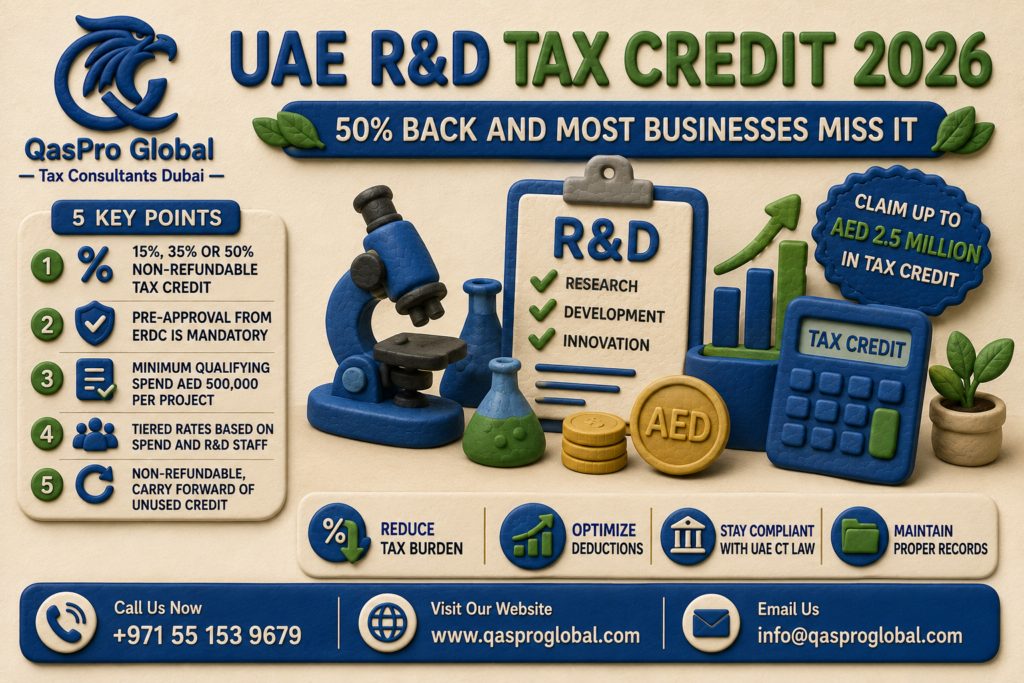
Quick Answer: The UAE R&D tax credit, introduced by Cabinet Decision No. 215 of 2025 and Ministerial Decision No. 24 of 2026, lets businesses claim a non-refundable corporate tax credit of 15%, 35% or 50% on qualifying research and development spending. The maximum qualifying expenditure is AED 5 million per year, meaning a business could offset up to AED 2.5 million against its corporate tax bill. Pre-approval from the Emirates Research and Development Council is mandatory.
The UAE government introduced one of its most significant corporate tax incentives in March 2026: a tiered R&D tax credit that rewards businesses investing in innovation. Published under Article 46 of Federal Decree-Law No. 47 of 2022, the framework took effect for tax periods beginning on or after 1 January 2026. Despite the generous rates, most UAE businesses either do not know the credit exists or assume it only applies to tech companies. It does not. Any business conducting systematic research that meets the qualifying criteria can claim it.
In this guide, Qaspro Global breaks down every rule, threshold and step involved in claiming the UAE R&D tax credit in 2026.
Which Laws Govern the UAE R&D Tax Credit?
The R&D tax credit regime sits on three legal foundations. Article 46 of Federal Decree-Law No. 47 of 2022 (the Corporate Tax Law) provides the enabling provision for tax credits and incentives. Cabinet Decision No. 215 of 2025 establishes the framework, eligibility conditions and tiered credit rates. Ministerial Decision No. 24 of 2026 sets the detailed implementation rules, qualifying expenditure definitions and documentation requirements.
Together, these three instruments create a complete R&D incentive regime. The Ministry of Finance has described the current framework as “Phase 1,” signalling that enhanced benefits, including potentially refundable credits and higher expenditure caps, may follow in Phase 2.
How Much Is the R&D Tax Credit Worth?
The credit uses a tiered structure that rewards both higher spending and larger R&D teams. The rates scale based on qualifying expenditure and the number of full-time R&D staff employed in the UAE.
| Qualifying R&D Expenditure | Credit Rate | Minimum R&D Staff Required | Maximum Credit Value |
|---|---|---|---|
| First AED 1,000,000 | 15% | 2 full-time R&D employees | AED 150,000 |
| AED 1,000,001 to AED 2,000,000 | 35% | 6 full-time R&D employees | AED 350,000 |
| AED 2,000,001 to AED 5,000,000 | 50% | 14 full-time R&D employees | AED 1,500,000 |
| Total maximum | – | 14+ | AED 2,000,000 |
Important: The credit is non-refundable. It offsets your corporate tax liability but cannot generate a cash refund. If your CT bill is AED 300,000 and your R&D credit is AED 500,000, you pay zero CT but do not receive the remaining AED 200,000 as a refund. Unused credits can be carried forward to future tax periods.
Worked Example: AED 3 Million R&D Spend
Consider a UAE technology company that spent AED 3 million on qualifying R&D in 2026, employing 16 full-time R&D staff.
| Expenditure Tier | Amount | Rate | Credit |
|---|---|---|---|
| First AED 1,000,000 | AED 1,000,000 | 15% | AED 150,000 |
| AED 1M to AED 2M | AED 1,000,000 | 35% | AED 350,000 |
| AED 2M to AED 3M | AED 1,000,000 | 50% | AED 500,000 |
| Total | AED 3,000,000 | – | AED 1,000,000 |
If the company’s taxable profit is AED 15 million, its corporate tax at 9% would be AED 1,350,000. After applying the AED 1,000,000 R&D credit, the company pays AED 350,000 in corporate tax. That is a 74% reduction in its tax bill from R&D alone.
What Counts as Qualifying R&D Activity?
Ministerial Decision No. 24 of 2026 adopts the OECD Frascati Manual definition. An activity qualifies as R&D if it meets all five criteria simultaneously:
- Novel: The activity aims to produce new findings, knowledge or outcomes not previously available
- Creative: It involves original concepts, hypotheses or approaches rather than routine application of existing knowledge
- Uncertain: The outcome, methodology or both are not known in advance at the start of the project
- Systematic: The work follows a documented plan with an allocated budget and defined objectives
- Transferable or reproducible: The results can be transferred to others or reproduced under similar conditions
- UAE CT Interest Deduction Cap 2026: The AED 12M Rule
All five conditions must be met. Routine product testing, quality control, market research, cosmetic design changes and minor software updates do not qualify.
What Expenditure Qualifies for the Credit?
Qualifying R&D expenditure includes direct costs incurred in the UAE as part of an approved R&D project. The minimum qualifying expenditure is AED 500,000 per R&D project per year.
Qualifying costs include:
- Salaries and wages of R&D staff working directly on the project in the UAE
- Materials and consumables used in R&D activities
- Equipment and machinery acquired specifically for R&D (depreciation portion)
- Payments to UAE-based subcontractors for R&D services
- Software licences and cloud computing costs directly related to R&D
- Costs of obtaining patents and intellectual property registration arising from R&D
Non-qualifying costs include:
- R&D conducted outside the UAE
- General administrative overheads not directly attributable to R&D
- Marketing and commercialisation expenses
- Acquisition of existing intellectual property from third parties
- Routine data collection, surveys and market research
- Expenditure below AED 500,000 per project per year
Who Can Claim the UAE R&D Tax Credit?
The credit is available to any UAE corporate tax-registered business, whether mainland or free zone, that meets the following conditions:
- The business is a Taxable Person under Federal Decree-Law No. 47 of 2022
- The R&D activity is conducted in the UAE
- The R&D project has been pre-approved by the Emirates Research and Development Council
- Qualifying R&D expenditure is at least AED 500,000 per project per year
- The business employs the minimum number of full-time R&D staff in the UAE for the claimed credit tier
- Proper documentation is maintained for at least 7 years
Free zone companies with Qualifying Free Zone Person (QFZP) status already pay 0% on qualifying income. The R&D credit becomes relevant for their non-qualifying income taxed at 9%, or for free zone companies that do not hold QFZP status.
How to Claim the R&D Tax Credit: Step-by-Step Process
Step 1: Identify qualifying R&D projects
Review all ongoing and planned projects against the five Frascati Manual criteria. Document why each project meets the novelty, creativity, uncertainty, systematic and transferability tests.
Step 2: Apply for pre-approval from the Emirates Research and Development Council
Submit an application to the Emirates Research and Development Council before or during the tax period. The Council evaluates whether the project meets the qualifying criteria. Pre-approval is mandatory; retroactive claims without Council approval are not accepted.
Step 3: Track qualifying expenditure separately
Maintain a dedicated cost centre or tracking system for each R&D project. Ensure all claimed costs are directly attributable to the approved project and incurred in the UAE.
Step 4: Verify staffing thresholds
Confirm the number of full-time R&D employees in the UAE meets the minimum for the credit tier you intend to claim. Staff must be employed (not contracted) and working on R&D activities.
Step 5: Calculate the credit in your CT return
Apply the tiered rates to your qualifying expenditure in your corporate tax return filed on EmaraTax. The credit reduces your CT liability directly.
Step 6: Maintain documentation for 7 years
Keep all project plans, Council approval letters, expenditure records, staff contracts, timesheets and project reports for at least 7 years from the end of the relevant tax period.
R&D Tax Credit vs Other UAE Corporate Tax Incentives
| Incentive | Benefit | Eligibility | Can Be Combined? |
|---|---|---|---|
| R&D Tax Credit (Article 46) | 15-50% credit on R&D spend | Any CT-registered business with approved R&D | Yes, with other incentives |
| Small Business Relief | 0% CT on all income | Revenue under AED 3M (ends Dec 2026) | No, replaces CT calculation |
| QFZP 0% Rate | 0% on qualifying income | Free zone companies meeting QFZP conditions | R&D credit applies to non-qualifying income only |
| Loss Carry Forward (Article 37) | Offset losses against 75% of future profit | Any taxable person with prior losses | Yes, losses offset first, then R&D credit applies |
| Participation Exemption (Article 23) | 0% on qualifying dividends/gains | 5% shareholding or AED 4M cost | Yes, exempts specific income streams |
Which Industries Benefit Most from the R&D Tax Credit?
While the credit is sector-agnostic, certain industries naturally generate qualifying R&D expenditure:
- Technology and software: AI development, cybersecurity research, SaaS product development, blockchain applications
- Pharmaceuticals and healthcare: Drug development, clinical trials, medical device innovation
- Manufacturing: Process optimisation research, new material development, automation R&D
- Energy and sustainability: Renewable energy research, carbon capture technology, water desalination innovation
- Agriculture and food tech: Vertical farming research, food preservation innovation, desert agriculture solutions
- Construction and engineering: Building material innovation, structural engineering research, smart city technology
- Financial services: Fintech product development, risk modelling research, RegTech solutions
Qaspro Global advises businesses not to self-exclude based on industry assumptions. The qualifying test is activity-based, not sector-based. A construction company developing a new concrete mixture qualifies just as a biotech firm developing a new compound does.
Common Mistakes That Disqualify R&D Tax Credit Claims
- No pre-approval: Applying for the credit without Emirates Research and Development Council pre-approval invalidates the entire claim
- Below AED 500,000 threshold: Projects with qualifying expenditure under AED 500,000 per year do not qualify, even if the R&D is genuine
- Offshore R&D costs: Only expenditure incurred in the UAE qualifies. Outsourcing R&D to India, Pakistan or Eastern Europe does not count
- Insufficient staff: Claiming the 35% rate with only 4 R&D employees instead of the required 6 reduces the entire claim to the 15% tier
- Routine activities labelled as R&D: Regular software maintenance, bug fixes, quality testing and market research are not R&D regardless of how the company classifies them internally
- Poor documentation: Missing timesheets, vague project descriptions or no cost allocation methodology will fail an FTA review
Small Business Relief Ends December 2026: R&D Credit Becomes More Important
Small Business Relief, which allows businesses with revenue under AED 3 million to pay 0% corporate tax, applies only to tax periods ending on or before 31 December 2026. No extension has been announced. From 2027, these businesses will face the standard 9% rate on profit above AED 375,000.
For small businesses investing in innovation, the R&D tax credit provides an alternative mechanism to reduce their corporate tax bill after SBR expires. A startup with AED 2 million in revenue and AED 600,000 in qualifying R&D spend could claim an AED 90,000 credit (15% of AED 600,000), effectively wiping out most or all of its CT liability even without Small Business Relief.
Frequently Asked Questions
Is the UAE R&D tax credit refundable?
No. The R&D tax credit under Cabinet Decision No. 215 of 2025 is non-refundable. It reduces your corporate tax liability to zero but does not generate a cash payment. Unused credits can be carried forward to offset future CT liabilities.
What is the minimum R&D spend to qualify for the credit?
The minimum qualifying R&D expenditure is AED 500,000 per R&D project per year. Projects below this threshold do not qualify for the credit regardless of how innovative the work is.
Can free zone companies claim the R&D tax credit?
Yes. Free zone companies can claim the R&D credit against the 9% corporate tax on their non-qualifying income. Companies with QFZP status already pay 0% on qualifying income, so the credit is most useful for their mainland-sourced or non-qualifying revenue streams.
Do I need government approval before starting R&D?
Yes. Pre-approval from the Emirates Research and Development Council is mandatory under Ministerial Decision No. 24 of 2026. You must apply before or during the tax period in which the R&D is conducted. Claims without Council approval are automatically rejected.
Can I claim the R&D credit and Small Business Relief together?
No. Small Business Relief treats all income as non-taxable, so there is no corporate tax liability to offset with the R&D credit. You must choose one. If your R&D spend is substantial, running the numbers on both options before filing is advisable.
What happens if the FTA audits my R&D tax credit claim?
The FTA can review R&D credit claims within the standard 5-year assessment period (extended to 15 years for fraud). You must produce the Emirates Research and Development Council approval letter, detailed project documentation, expenditure records, staff employment contracts and timesheets. Failure to substantiate the claim results in reversal of the credit plus penalties.
Does the R&D credit apply to software development?
Only if the software development involves genuine novelty and uncertainty. Building a new AI algorithm with uncertain outcomes qualifies. Customising an existing CRM or developing a standard e-commerce website does not. The Frascati Manual test applies: is it novel, creative, uncertain, systematic and transferable?
When does the R&D tax credit regime take effect?
The regime is effective for tax periods beginning on or after 1 January 2026. This means businesses filing their 2026 corporate tax return (due September 2027 for calendar-year filers) can claim the credit for qualifying R&D conducted during 2026.
Is there a cap on the total R&D tax credit?
Yes. The maximum qualifying expenditure is AED 5 million per year. At the highest tier (50%), this produces a maximum credit of approximately AED 2 million. The Ministry of Finance has indicated that Phase 2 may increase this cap.
Can I carry forward unused R&D tax credits?
Yes. If your R&D credit exceeds your corporate tax liability for the period, the excess can be carried forward to offset CT in future tax periods. This is particularly relevant for startups and early-stage businesses that may not yet have sufficient taxable profit to absorb the full credit.
Need Expert Help?
Qaspro Global’s tax consultants help UAE businesses identify qualifying R&D activities, prepare Emirates Research and Development Council applications, track qualifying expenditure and claim the maximum R&D tax credit on their corporate tax returns. Contact us today for a free consultation, or message us on WhatsApp.
Related Reading
- UAE Corporate Tax Bad Debt 2026: The Write-Off Rule 90% of Businesses Get Wrong
- UAE Corporate Tax Deductible Expenses 2026: Complete Guide
- UAE Small Business Relief 2026: Pay 0% Corporate Tax
- UAE Corporate Tax Exemptions 2026: Complete List
Related Reading

Founder & CEO, Qaspro Global — UAE tax expert with 16+ years of experience in VAT, corporate tax and FTA audit support.