
Is Your UAE Business Ready for the End of Small Business Relief?
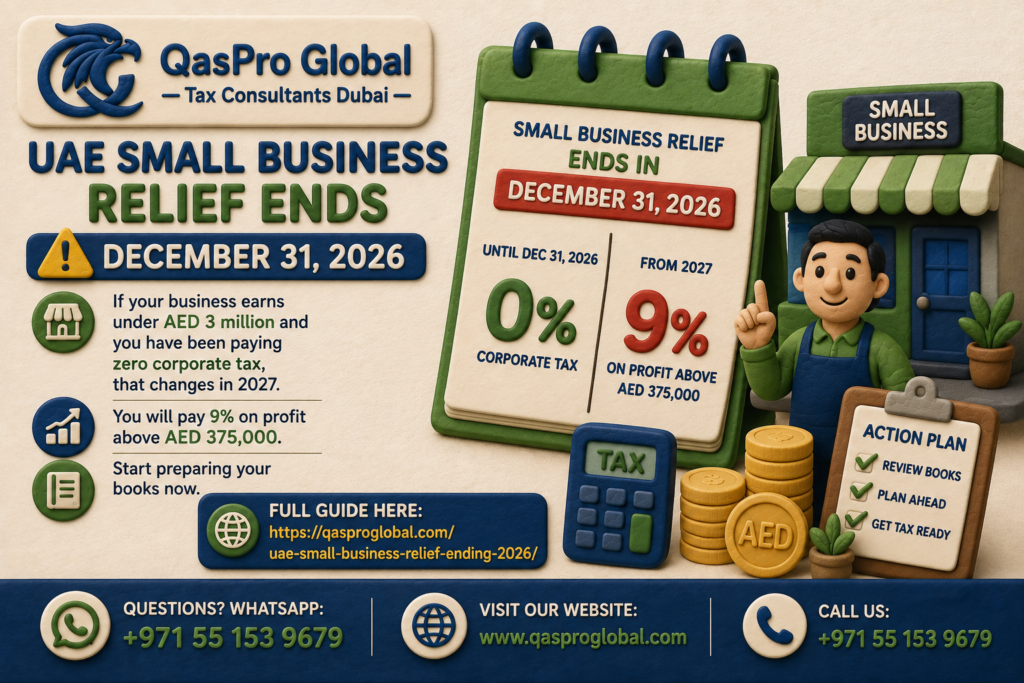
UAE Small Business Relief ending 2026 is the single biggest tax change hitting small businesses since corporate tax launched in June 2023. Under Ministerial Decision No. 73 of 2023, the relief only applies to tax periods ending before or on 31 December 2026. After that date, the AED 3 million revenue threshold disappears entirely, and every qualifying business moves into the standard 9% corporate tax regime.
Qaspro Global has been advising UAE businesses on this transition since the original SBR rules were issued. In this guide, we break down exactly what changes, when it changes, how much more tax you will pay, and the 7-month action plan every small business should follow before the deadline hits.
What Is Small Business Relief and Why Is It Ending?
Small Business Relief is a temporary measure under Article 21 of Federal Decree-Law No. 47 of 2022 that allows eligible resident businesses with annual revenue of AED 3 million or less to elect zero taxable income. When a business makes this election on its corporate tax return, it pays AED 0 in corporate tax regardless of how much profit it earned. For cryptocurrency and digital asset scenarios, see our guide on crypto traders using Small Business Relief.
The key word is temporary. Article 2(2) of Ministerial Decision No. 73 of 2023 states clearly:
“The threshold shall apply to Tax Periods commencing on or after 1 June 2023 and such threshold shall only continue to apply to subsequent Tax Periods that end before or on 31 December 2026.”
The UAE government introduced SBR to give small businesses time to build their accounting systems, hire tax advisors, and prepare for corporate tax compliance. That preparation window closes on 31 December 2026. No extension has been announced by the Ministry of Finance or the FTA as of May 2026.
When Exactly Does Small Business Relief Expire?
SBR expires based on when your tax period ends, not when it starts. This is a critical distinction that catches many businesses off guard.
| Financial Year End | Last SBR-Eligible Period | First Standard Tax Period |
|---|---|---|
| 31 December | 1 Jan 2026 to 31 Dec 2026 | 1 Jan 2027 to 31 Dec 2027 |
| 31 March | 1 Apr 2025 to 31 Mar 2026 | 1 Apr 2026 to 31 Mar 2027 (already standard rate) |
| 30 June | 1 Jul 2025 to 30 Jun 2026 | 1 Jul 2026 to 30 Jun 2027 (already standard rate) |
| 30 September | 1 Oct 2025 to 30 Sep 2026 | 1 Oct 2026 to 30 Sep 2027 (already standard rate) |
Warning for non-December year ends: If your financial year ends on 31 March 2027, your tax period ends after 31 December 2026. That means you are already in the standard regime for your current tax period. You cannot elect SBR for this period. Many businesses with March, June, or September year ends do not realize this.
How Much More Tax Will You Pay After SBR Ends?
The financial impact depends on your taxable profit. Under the standard regime, you pay 0% on the first AED 375,000 of taxable income and 9% on everything above that threshold.
| Annual Taxable Profit | Tax Under SBR (2026) | Tax Under Standard Regime (2027) | Annual Increase |
|---|---|---|---|
| AED 200,000 | AED 0 | AED 0 | AED 0 |
| AED 375,000 | AED 0 | AED 0 | AED 0 |
| AED 500,000 | AED 0 | AED 11,250 | AED 11,250 |
| AED 800,000 | AED 0 | AED 38,250 | AED 38,250 |
| AED 1,500,000 | AED 0 | AED 101,250 | AED 101,250 |
| AED 2,500,000 | AED 0 | AED 191,250 | AED 191,250 |
| AED 3,000,000 | AED 0 | AED 236,250 | AED 236,250 |
A typical Dubai consultancy with AED 2.5 million revenue and AED 800,000 annual profit goes from paying nothing to paying AED 38,250 per year in corporate tax starting 2027. That is real money coming directly from your bottom line.
What Are the 5 Eligibility Conditions for SBR in 2026?
Before the relief expires, make sure you are properly claiming it for your final eligible period. Under Ministerial Decision No. 73 of 2023 and Article 21 of FDL 47/2022, all five conditions must be met:
- Revenue under AED 3 million in the current tax period AND every previous tax period since 1 June 2023. If you exceeded AED 3 million in any single period, you are permanently disqualified.
- Resident Person only. Non-resident businesses cannot elect SBR.
- Not a Qualifying Free Zone Person (QFZP). If you are already claiming 0% under the QFZP regime, SBR does not apply to you.
- Not part of a Multinational Enterprise Group with consolidated global revenue exceeding AED 3.15 billion (EUR 750 million).
- Election made on the CT return. SBR is not automatic. You must actively elect it each tax period on your corporate tax return filed on EmaraTax.
- UAE CT Interest Deduction Cap 2026: The AED 12M Rule
What Happens to Tax Losses During SBR Periods?
Tax losses incurred during a period where SBR is elected cannot be carried forward to future tax periods. This is stated explicitly in Article 4 of Ministerial Decision No. 73 of 2023.
However, losses from periods where SBR was not elected can still be carried forward under the normal rules of Article 37 of FDL 47/2022. This creates a strategic decision for 2026: if your business made a loss this year, you may want to skip the SBR election and instead carry that loss forward to offset taxable income in 2027 when you will actually owe tax.
The same rule applies to net interest expenditure. Any excess interest deduction incurred during an SBR period is lost permanently. Interest from non-SBR periods can still be carried forward.
Should You Skip SBR in 2026 to Preserve Tax Losses?
This is the most important strategic question for businesses approaching the December 31 deadline. Here is a worked example:
Scenario: Tech startup with AED 2 million revenue and AED 150,000 loss in 2026
Option A: Elect SBR in 2026
- 2026 tax: AED 0 (SBR elected)
- 2026 loss: AED 150,000 is permanently lost (cannot carry forward)
- 2027 profit: AED 600,000 taxable
- 2027 tax: (AED 600,000 – AED 375,000) x 9% = AED 20,250
Option B: Skip SBR in 2026
- 2026 tax: AED 0 (loss year, no taxable income anyway)
- 2026 loss: AED 150,000 carried forward
- 2027 profit: AED 600,000 – AED 150,000 loss offset (75% cap) = AED 487,500 taxable
- 2027 tax: (AED 487,500 – AED 375,000) x 9% = AED 10,125
- Tax saved: AED 10,125
If your business is making a loss or breaking even in 2026, skipping SBR and preserving the loss for 2027 offset can save you real money. Consult a qualified tax consultant to run the numbers for your specific situation.
What Is the FTA Anti-Avoidance Rule on Artificial Separation?
Article 6 of Ministerial Decision No. 73 of 2023 contains a critical anti-avoidance provision. If the FTA determines that one or more persons have artificially separated their business to keep each entity below the AED 3 million threshold, the arrangement is treated as an abuse under Article 50 of FDL 47/2022 (General Anti-Abuse Rule).
The FTA looks at financial, economic, and organisational links between the entities. If a business owner splits one AED 5 million operation into two separate entities each earning AED 2.5 million purely to qualify for SBR, the FTA can deny the relief and impose administrative penalties.
With SBR ending in 2026, this rule becomes less relevant going forward. But any historical abuse during the 2023-2026 SBR period remains subject to FTA audit for up to five years.
The 7-Month Action Plan Before SBR Expires
Qaspro Global advises every small business currently using SBR to take these steps before 31 December 2026:
Month 1-2 (June-July 2026): Get Your Books Right
- Ensure all 2026 transactions are recorded in proper accounting software
- Reconcile bank accounts monthly
- Separate business and personal expenses completely
- Choose the correct accounting standard (IFRS for SMEs if revenue under AED 50 million, or Cash Basis if under AED 3 million)
Month 3-4 (August-September 2026): Maximize Deductions
- Review all deductible expenses and ensure proper documentation
- Accelerate any planned capital expenditure to 2026 to claim depreciation from January 2027
- Document all entertainment expenses (only 50% deductible)
- Review related party transactions for arm’s length pricing
Month 5-6 (October-November 2026): Tax Planning
- Calculate projected 2027 taxable income and expected CT liability
- Decide whether to elect SBR for the final 2026 period or skip it to preserve losses
- Set aside a tax provision in your accounts (9% of profit above AED 375,000)
- Evaluate whether QFZP status in a free zone would benefit your business long-term
Month 7 (December 2026): Final Checks
- File your final SBR election on EmaraTax (if choosing to elect)
- Confirm all records meet the 5-year retention requirement under FTA bookkeeping rules
- Engage a tax consultant for your first standard CT return due in 2027
- Budget for quarterly tax provisions from January 2027
Does SBR Expiry Affect Free Zone Companies?
Free zone companies that hold QFZP status are not affected by the SBR expiry. QFZP businesses already pay 0% on qualifying income under Article 18 of FDL 47/2022, and this regime has no expiry date.
However, free zone companies that do not qualify as QFZP (because they fail the substance test, the de minimis test, or earn non-qualifying income) may have been relying on SBR instead. These businesses face a double problem in 2027: no QFZP status and no SBR fallback. They will pay 9% on all taxable income above AED 375,000.
If you are a free zone company currently using SBR rather than QFZP, use 2026 to evaluate whether restructuring to achieve QFZP status is possible and worthwhile.
Will the UAE Government Extend Small Business Relief?
Yes — this has now happened. On 29 July 2026 the Ministry of Finance issued Ministerial Decision No. 131 of 2026, extending Small Business Relief from tax periods ending on or before 31 December 2026 to tax periods ending on or before 31 December 2029. The AED 3 million revenue threshold and all other conditions set under Ministerial Decision No. 73 of 2023 remain unchanged — only the end date moved.
Businesses should not plan on an extension. Even if one were announced, it would likely come with stricter conditions or a lower revenue threshold. The prudent approach is to prepare for the standard 9% regime starting 2027 and treat any potential extension as a bonus, not a plan.
Frequently Asked Questions
What is the last date to claim Small Business Relief in UAE?
Following the extension under Ministerial Decision No. 131 of 2026, the last eligible tax period must now end on or before 31 December 2029, not 2026 as originally legislated. For businesses with a calendar year (January to December), the 2029 tax period is the last one eligible.
How much corporate tax will I pay after SBR ends in 2027?
You will pay 0% on the first AED 375,000 of taxable income and 9% on everything above that. A business with AED 800,000 taxable profit pays AED 38,250. A business with AED 1.5 million taxable profit pays AED 101,250 annually.
Can I carry forward tax losses from my SBR period?
No. Under Article 4 of Ministerial Decision No. 73 of 2023, any tax losses incurred in a period where SBR was elected cannot be carried forward. Losses from non-SBR periods can be carried forward under Article 37 of FDL 47/2022, subject to the 75% utilisation cap.
Should I skip SBR in 2026 if my business has losses?
Potentially yes. If your business is loss-making in 2026, skipping SBR allows you to carry forward that loss to offset 2027 taxable income. This can save up to 9% of the loss amount in future tax. Consult a tax advisor to run the calculation for your specific numbers.
Does SBR expiry affect sole proprietors and freelancers?
Yes. Sole proprietors with turnover above AED 1 million and freelancers who have been using SBR will move to the standard 9% regime in 2027. They must start maintaining proper books, tracking deductible expenses, and filing standard CT returns.
What accounting records do I need for 2027 without SBR?
Without SBR, you must maintain full accounting records under the applicable standard (IFRS for SMEs or Cash Basis). This includes a chart of accounts, general ledger, bank reconciliations, invoices, receipts, payroll records, and a trial balance. Records must be retained for 5 years minimum under FTA rules.
Can I move to a free zone to keep paying 0% tax after SBR ends?
Only if your business qualifies as a Qualifying Free Zone Person (QFZP). This requires conducting qualifying activities, meeting substance requirements, passing the de minimis test, and having audited financial statements. Simply being in a free zone does not guarantee 0% tax.
Is there a penalty for not filing corporate tax after SBR ends?
Yes. Late CT registration carries an AED 10,000 penalty. Late filing costs AED 500 per month for the first 12 months, then AED 1,000 per month. Late payment triggers a 14% annual penalty under Cabinet Decision No. 129 of 2025.
What if my revenue drops below AED 375,000 in 2027?
If your taxable income is AED 375,000 or below, you pay 0% under the standard regime anyway. SBR expiry does not change this threshold. The impact only hits businesses with taxable profit above AED 375,000.
Do I still need to file a CT return if my profit is under AED 375,000 in 2027?
Yes. Every registered taxpayer must file a corporate tax return on EmaraTax regardless of whether tax is owed. The AED 375,000 threshold only affects the tax rate, not the filing obligation.
Need Expert Help?
Qaspro Global’s corporate tax consultants help UAE businesses prepare for the post-SBR transition. From setting up proper accounting systems to calculating your 2027 tax liability and filing your first standard CT return, we handle the full process. Contact us today for a free consultation, or message us directly on WhatsApp: +971 55 153 9679.
Related Reading
- UAE Corporate Tax Bad Debt 2026: The Write-Off Rule 90% of Businesses Get Wrong
- UAE Small Business Relief 2026: Complete Eligibility Guide
- UAE Corporate Tax Deductible Expenses 2026: Complete Guide
- How to File UAE Corporate Tax Return on EmaraTax 2026
- Is Crypto Tax-Free in Dubai 2026?
If you plan to close your company instead of paying tax in 2027, factor in the corporate tax deregistration deadline: 3 months from cessation.
If you do not elect Small Business Relief, you must run the full corporate tax calculation on your adjusted profit.
Even on Small Business Relief you must register for corporate tax on time. A late registration carries a AED 10,000 penalty that the FTA’s 2025 waiver can still erase if you file early.
Electing Small Business Relief still means filing, read how to lodge a nil corporate tax return to claim the relief.
A long first tax period is not pro-rated, so it can push you over the AED 3 million Small Business Relief cap sooner.
If you elect Small Business Relief, you still file, so check the corporate tax return document checklist.
Related Reading
- UAE Corporate Tax Return 2026: 9 Documents You Need to File
- UAE Corporate Tax First Tax Period 2026: The 18-Month Rule
- Nil Corporate Tax Return UAE 2026: Zero Profit, AED 500 Fine
- How to Calculate UAE Corporate Tax 2026: 9 Profit Adjustments
- Corporate Tax Deregistration UAE 2026: The 3-Month Rule and AED 10,000 Penalty
- Got an FTA Audit Notice? The AED 20,000 Mistake Most UAE Businesses Make Next
- UAE 15% Minimum Tax 2026: Who Pays the New DMTT
- UAE Corporate Tax Penalties 2026: Every FTA Fine Explained
- How to File UAE Corporate Tax Return on EmaraTax 2026
- Company Liquidation UAE 2026: How to Close Your Business
- UAE Tax Penalties Change on 14 April 2026
- UAE Voluntary Disclosure 2026: Fix Tax Errors Before FTA Finds Them
Fiscal year reminder: If your year-end affects revenue testing or filing dates, review our financial year planning for Small Business Relief before finalising the Corporate Tax return.

Founder & CEO, Qaspro Global — UAE tax expert with 16+ years of experience in VAT, corporate tax and FTA audit support.