

A trading company sells through its own customers and through Amazon and Noon. Every month the finance team keys in sales invoices, matches supplier bills, works through hundreds of bank lines, reconciles marketplace payouts against orders and then builds the reports management has been waiting for since the 1st. The books close on the 18th. By then the numbers describe a month that is almost over.
At Qaspro we see this pattern in trading and e-commerce businesses of every size, in the UAE and internationally, and we serve clients remotely. This guide is written for finance managers and CFOs who already know the work and want a straight answer to three questions: which tasks can AI and automation take over, which controls must stay in human hands, and what slow books really cost. The short version of our position is that AI does the routine work and qualified accountants review and sign off. If you want the wider picture first, start with our hub on AI accounting automation in the UAE.
Published: 27 October 2026
Quick Answer
- Automation is strongest on high-volume, rule-based work: capturing invoices and receipts, drafting entries, matching bank lines and marketplace payouts, chasing missing documents and preparing standard reports.
- Judgement stays with a qualified accountant: classification of unusual items, accounting policy, estimates and provisions, related-party and one-off transactions, and the final sign-off.
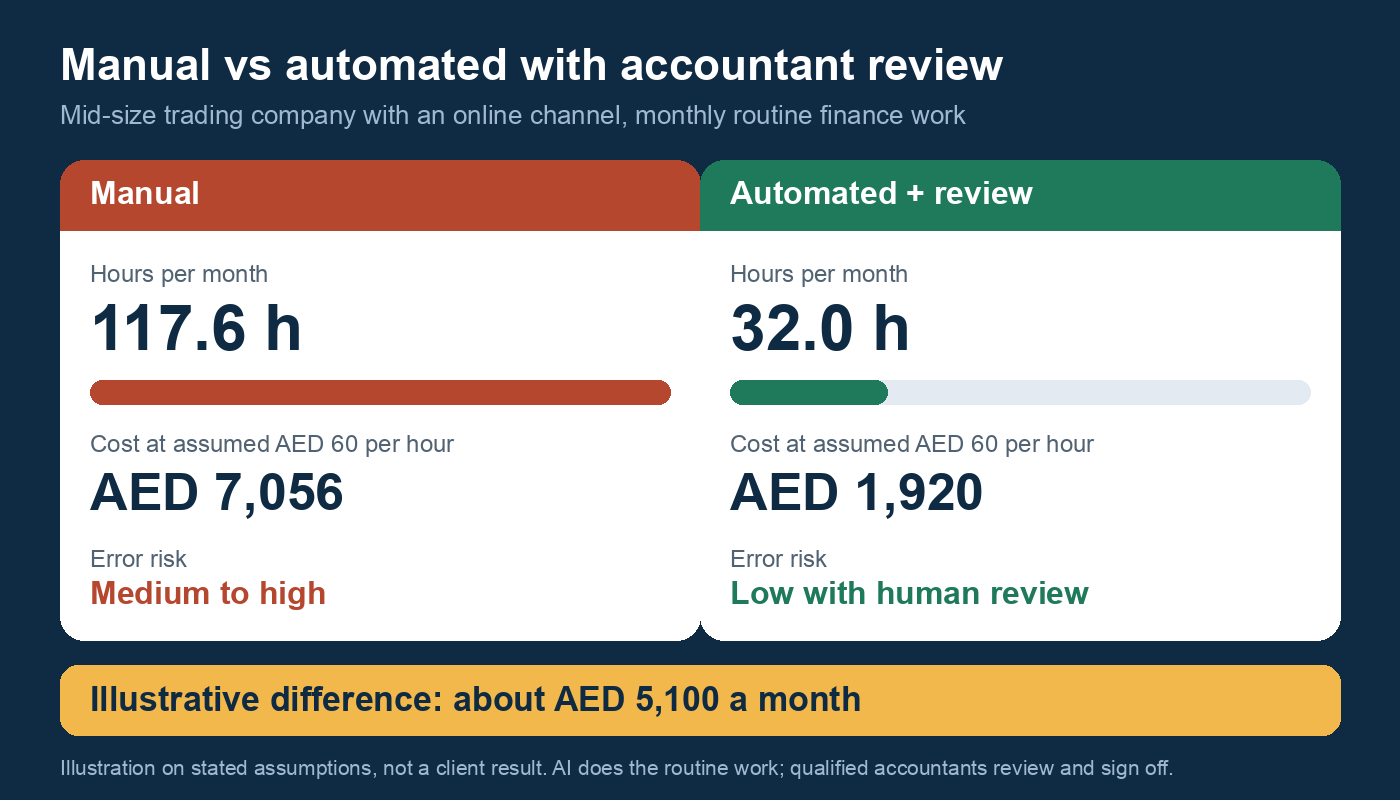
- In the illustration below, a mid-size trading company moves from about 118 hours of routine finance work a month to about 32 hours of review time. These are hypothetical numbers on stated assumptions, not a promise.
- The hidden costs of manual work are rarely on a budget line: staff hours, late closes, rework after mistakes, missed cash and decisions taken on old numbers.
- Before you hand any finance work to AI, demand human review, a full audit trail, access controls and a data-protection position that fits the UAE Personal Data Protection Law, Federal Decree-Law No. 45 of 2021.
Which Tasks Automation Can Take Over
Not every finance task is equal. The useful test is simple: is the task repetitive, based on rules a person could write down, and checkable afterwards? If yes, automation is a strong fit. If it needs judgement about what a transaction means, a qualified person must make the call.
| Finance task | Automation role | Qualified accountant role |
|---|---|---|
| Sales invoice and supplier bill capture | Reads documents, drafts the entry, flags missing fields | Reviews exceptions and new suppliers |
| Receipts and expense claims | Reads, categorises, flags duplicates | Approves policy exceptions |
| Bank statement matching | Proposes matches by amount, reference and date | Decides unmatched and unusual lines |
| Amazon and Noon settlement matching | Splits payouts into sales, fees, refunds and holds | Reviews disputed items and fee changes |
| Accounts receivable follow-up | Prepares ageing, drafts reminders | Decides credit limits and write-offs |
| Accounts payable runs | Prepares payment lists, checks against bills | Approves the payment release |
| Landed cost and stock valuation inputs | Collects freight, duty and supplier costs against shipments | Approves allocation method and valuation |
| Month-end reports and dashboards | Builds standard reports from posted entries | Explains movements and signs off |
| Estimates, provisions and policy | Not delegated | Fully owned by the accountant |
Our earlier guide on bank reconciliation automation in the UAE covers one of these tasks in more depth, and our note on AI employees and accounting costs explains why the model works for firms that review the output properly.
Why trading and e-commerce companies gain more than most
Three features of the business make automation pay back faster:
- High transaction counts with small values. Marketplace sales produce many small lines. The cost of handling one line by hand is low, but the monthly total is large.
- Settlement files that do not match orders one to one. Platforms pay out net of fees, refunds and holds. Matching that payout to the underlying sales is exactly the repetitive pattern-matching that software does well.
- Cost layers that have to follow the goods. Freight, duty, clearing and supplier costs belong to specific shipments. Collecting those inputs reliably is routine work, even though choosing the allocation method is an accounting decision.
Before and After: An Illustration
The table below is a hypothetical example, not a client result and not a guarantee. The assumptions are stated so you can replace them with your own numbers.
Assumptions for a mid-size trading company with an online channel:
- 400 sales invoices a month, 250 supplier bills a month, 600 bank lines a month, 16 marketplace payout files a month
- Manual handling: 5 minutes per sales invoice, 8 minutes per supplier bill, 1.5 minutes per bank line
- With automation and human review of exceptions: 1 minute per sales invoice, 2 minutes per supplier bill, 0.3 minutes per bank line
- A loaded finance staff cost of AED 60 per hour (an assumed figure for the illustration)
| Monthly task | Manual hours | Automated plus review hours | Error risk, manual | Error risk, with review |
|---|---|---|---|---|
| Sales invoice entry | 33.3 | 6.7 | Medium: typing and duplicates | Low: checked against source |
| Supplier bill entry | 33.3 | 8.3 | Medium: wrong account, duplicates | Low to medium: exceptions reviewed |
| Bank line matching | 15.0 | 3.0 | Medium: wrong match under time pressure | Low: proposals reviewed |
| Marketplace payout matching | 16.0 | 4.0 | High: fees and refunds mixed | Low to medium: disputed items reviewed |
| Month-end checks and reports | 20.0 | 10.0 | Medium: late and rushed | Low: standard reports ready earlier |
| Total | 117.6 | 32.0 |
At the assumed AED 60 an hour, manual handling costs about AED 7,056 a month and the reviewed, automated version about AED 1,920. The illustrative difference is about AED 5,100 a month, or about AED 61,600 a year, before the cost of the service itself and before any benefit from faster decisions. Your volumes, your hourly cost and your data quality will move this up or down, so build the same table with your own figures.
Two honest points about the illustration. First, the review time does not go to zero, and it should not. The saving comes from moving people from typing to checking. Second, the saving compares with an in-house team doing the same work by hand. It is not a claim that AI alone replaces an accountant. It does not.
The Hidden Costs of Slow Books
The staff hours above are the visible cost. The ones below do not appear on any invoice, which is why they are underestimated.
- Late closes. When the books close on the 18th, management reads last month’s results in the middle of this month. Pricing, purchasing and stock decisions are taken on old information.
- Rework after mistakes. A wrong account or a duplicated bill found at quarter end costs far more to unwind than the same item caught on entry.
- Missed cash. Slow receivable follow-up lets overdue invoices sit. Slow payable runs can mean missed early-payment terms or late-payment friction with suppliers.
- Unreliable stock and margin numbers. If landed cost reaches the books late, product margins look better or worse than they really are, and the pricing decision follows the wrong number.
- Person dependency. When one person knows how the marketplace files are matched, a holiday or a resignation freezes the close.
- Weak records at audit and filing time. UAE businesses have record and invoice obligations. See our guides on UAE bookkeeping laws, record-keeping requirements and e-invoicing. Records that are scattered across inboxes and spreadsheets are harder to produce when they are requested.
Want to see what AI could save your business? Chat with us on WhatsApp: https://wa.me/971551539679
What Must Stay With Your Finance Team
Automation without ownership is a risk. These responsibilities should stay with a qualified person, whether in your team or in the firm you outsource to:
- Accounting policy. How you recognise revenue, value stock and treat marketplace fees is a decision, not a data task.
- Estimates and provisions. Doubtful debts, stock write-downs and accruals need judgement and evidence.
- Unusual and related-party transactions. Anything that does not fit a pattern should go to a person.
- Payment approval. The release of money should not be a fully automatic step.
- Sign-off. The person who signs the month-end pack must understand and stand behind it.
Risks and Controls to Demand
Whether you buy a service or build a process, ask for these controls in plain terms.
| Control | What good looks like |
|---|---|
| Human review | A named qualified accountant reviews and signs off the output before it is final |
| Audit trail | Every entry can be traced to a source document, and every change shows who made it and when |
| Segregation of duties | The party that prepares an entry is not the only party that approves a payment |
| Access control | Users see only what their role needs, and access is removed promptly when people leave |
| Exception handling | Items the system is unsure about go to a person instead of being forced through |
| Backups and recovery | Your books and documents can be restored, and you can export them on request |
| Data protection | A clear position on where personal data is stored, who can see it and how long it is kept |
Data protection in the UAE
Invoices, payroll lines and customer details contain personal data. The UAE Personal Data Protection Law, Federal Decree-Law No. 45 of 2021, sets rules for processing personal data. The point for a finance manager is practical: ask any provider, in writing, how personal data in your documents is handled, who has access, whether it is used for anything beyond your own work and what happens to it when the contract ends. If you operate in or serve people in other countries, also ask about the rules that apply there. Free-zone or sector regulators may add their own requirements, so confirm what applies to you.
Where AI errors come from
AI systems can misread a document, match two unrelated items or confidently produce a wrong answer. That is why the controls above are not optional. A good process expects errors and catches them in review, instead of promising there will be none.
A Checklist of Questions for Any Provider
Use this list when you compare outsourced accounting with AI, a software vendor or your own team’s plan.
- Who reviews and signs off the output, and what are their qualifications?
- What happens to a transaction the system is not sure about?
- Can I trace any entry back to its source document in a few clicks?
- Who can see my documents and personal data, and how is access logged?
- Where is my data stored, and can I export everything if I leave?
- How is a mistake corrected, and how do I find out about it?
- Which parts are automated and which are done by people, in plain words?
- How quickly after month-end will I have reports I can act on?
- How does the service handle marketplace settlements, refunds and fees?
- What does the first month look like, and how is the result checked against my current books?
How to Judge Your Own Readiness
You do not need perfect systems to start, but some basics make the result better:
- Your bank statements and marketplace settlement reports can be exported regularly.
- Sales invoices and supplier bills reach one place instead of several personal inboxes.
- Someone owns the chart of accounts and can explain how main items are classified.
- You can say how many documents and bank lines you handle in a normal month. If not, count one month first. That count is the starting point for your own before and after table.
If most of these are true, you are ready for a pilot. If not, fix the document flow first. Growing teams also need staff and family visas handled on time, which our sister site Yalah Dubai explains in its guide to dependent visas when a sponsor dies or cancels. Automation exposes messy inputs fast, and it is cheaper to find that out early.
Frequently Asked Questions
Can AI replace my accountant?
No. AI does routine work such as capturing documents, drafting entries and proposing matches. Judgement, policy, estimates and sign-off stay with a qualified accountant. The saving comes from paying for less manual typing, not from removing review.
Which finance tasks are best to automate first?
Start with the highest-volume, rule-based tasks: invoice and bill capture, bank line matching and marketplace payout matching. They are easy to measure and easy to check.
How do I estimate the saving for my company?
Count your monthly documents and bank lines, time how long each takes by hand, apply your loaded staff cost and compare with an estimate of review time. Our illustration above uses 118 manual hours against 32 review hours, but yours will differ.
Does automation work for Amazon and Noon sellers?
Marketplace payouts net off fees, refunds and holds, so matching them to sales is repetitive and well suited to automation. Disputed items and fee changes still need a person.
Is it safe to give an AI provider my invoices?
It can be, if the provider can show access control, an audit trail, a clear data-protection position under the UAE Personal Data Protection Law and an exit route for your data. Ask for these in writing before you start.
What is the biggest risk of AI in accounting?
Unreviewed errors. A system can misread a document or make a wrong match without signalling it. A qualified reviewer and a traceable audit trail are the defence.
Will automation speed up my month-end close?
It usually brings reports earlier because entries and matches are prepared continuously instead of in one rush at month end. The size of the gain depends on your document flow and data quality.
Do I still need an in-house finance team?
Often yes, in a smaller and more senior form. Many companies keep a finance lead who owns decisions and use an outsourced or automated service for routine processing.
Can you serve businesses outside the UAE?
Yes. We serve businesses in the UAE and internationally, remotely.
Is the AED saving in this article guaranteed?
No. The figures are a hypothetical illustration built on stated assumptions. Your result depends on your volumes, costs and how clean your documents and data are.
Food and beverage owners face a different mix of daily work. See our guide to AI accounting automation for restaurants and cafes.
Related Reading
- AI Accounting Automation for UAE Restaurants and Cafes
- UAE Sponsor Death or Cancellation: Dependents Visas (Yalah Dubai)
- AI accounting automation in the UAE (hub)
- Bank reconciliation automation in the UAE 2026
- AI employees and accounting firm costs
- UAE bookkeeping laws 2026
- UAE e-invoicing 2026: requirements and penalties
- Year-end closing procedures in the UAE 2026
Next Step
For the full picture of what we automate and the controls we keep, see our guide to AI accounting automation in the UAE. Want to see what AI could save your business? Chat with us on WhatsApp: https://wa.me/971551539679
The AED figures in this article are illustrations on stated assumptions, not Qaspro results or prices. Laws and regulator guidance can change, so confirm current requirements before you decide.

Founder & CEO, Qaspro Global — UAE tax expert with 16+ years of experience in VAT, corporate tax and FTA audit support.