
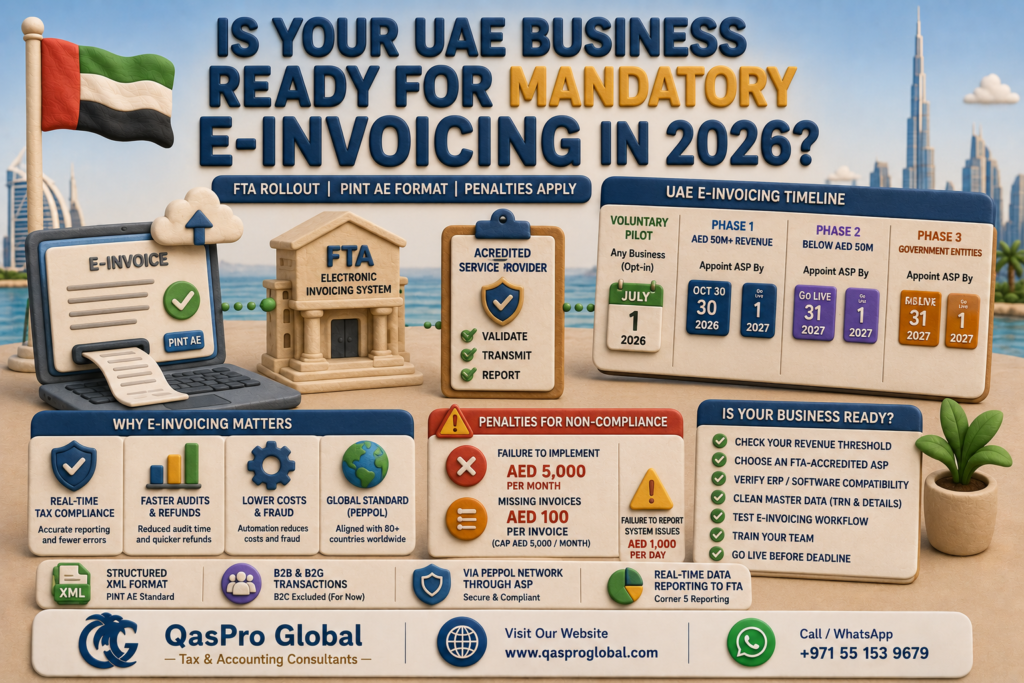
Is Your UAE Business Ready for Mandatory E-Invoicing in 2026?
Quick Answer: The UAE Federal Tax Authority (FTA) launched a voluntary e-invoicing pilot on July 1, 2026, now live. Businesses with annual revenue of AED 50 million or more must appoint an Accredited Service Provider (ASP) by October 30, 2026, and go live by January 1, 2027. Non-compliance carries a fixed penalty of AED 5,000 per month under Cabinet Decision No. 106 of 2025.
Published: 5 June 2026 | Last updated: 11 August 2026
UAE e-invoicing 2026 is the most significant compliance change since the introduction of corporate tax. Under Ministerial Decisions No. 243 and 244 of 2025, every business conducting B2B or B2G transactions in the UAE must transition from PDF and paper invoices to structured electronic invoices transmitted through the FTA’s Electronic Invoicing System (EIS). The system uses the PINT AE format, built on the international Peppol standard, and requires all invoices to pass through an FTA-accredited service provider before reaching the buyer.
The voluntary pilot phase launched on 1 July 2026 and is now live, with the Ministry of Finance and FTA running a Taxpayer Working Group alongside businesses that choose to opt in early. Large businesses (AED 50 million or more in annual revenue) must appoint an Accredited Service Provider (ASP) by 30 October 2026, after the Ministry extended this deadline from the original 31 July 2026 date under Ministerial Decision No. 66 of 2026. Full mandatory go-live for these businesses remains 1 January 2027. Qaspro Global has seen a surge in clients asking about e-invoicing requirements, timelines, and costs. This guide breaks down everything your business needs to know, with exact deadlines, penalty amounts, and a preparation checklist.
What Is UAE E-Invoicing and Why Is the FTA Mandating It?
UAE e-invoicing is a government-mandated system where businesses must issue, transmit, and receive invoices in a structured digital format (XML) through accredited intermediaries. Unlike emailing a PDF invoice, e-invoicing requires the invoice data to flow through an FTA-accredited service provider (ASP) using the Peppol network, with near-real-time reporting to the Federal Tax Authority.
The FTA is mandating e-invoicing for three reasons:
- Tax compliance: Real-time invoice data allows the FTA to cross-check VAT returns against actual transactions, reducing fraud and errors
- Audit efficiency: Instead of requesting paper records during audits, the FTA will already have structured invoice data
- Economic modernization: The UAE aims to align with global e-invoicing standards already adopted by Saudi Arabia (ZATCA), the EU, India (GST e-invoicing), and over 80 other countries
What Is the Legal Basis for UAE E-Invoicing?
The UAE e-invoicing mandate rests on three key pieces of legislation issued in 2025:
| Legislation | Subject | Key Provisions |
|---|---|---|
| Ministerial Decision No. 243 of 2025 | Scope and definitions | Defines who must comply, what qualifies as an electronic invoice, B2B/B2G coverage, and exclusions |
| Ministerial Decision No. 244 of 2025 | Implementation timeline | Sets the phased rollout dates, ASP appointment deadlines, and go-live dates by business size |
| Cabinet Decision No. 106 of 2025 | Penalties | Establishes administrative fines for non-compliance: AED 5,000/month for not implementing, AED 100/missing invoice, AED 1,000/day for unreported issues |
The FTA also issued detailed technical guidance on February 23, 2026, specifying the mandatory data fields for electronic tax invoices and commercial invoices under the PINT AE specification.
What Is the UAE E-Invoicing Timeline? Every Deadline You Must Know
The rollout follows a phased approach based on annual revenue. Here is the complete timeline with every critical date:
| Phase | Who | Revenue Threshold | Appoint ASP By | Go Live By |
|---|---|---|---|---|
| Voluntary Pilot | Any business (opt-in) | No threshold | July 1, 2026 | July 1, 2026 |
| Phase 1 (Mandatory) | Large businesses | AED 50 million+ | October 30, 2026 | January 1, 2027 |
| Phase 2 (Mandatory) | All other businesses | Below AED 50 million | March 31, 2027 | July 1, 2027 |
| Phase 3 (Mandatory) | Government entities | N/A | March 31, 2027 | October 1, 2027 |
Important update: The Ministry of Finance extended the Phase 1 ASP appointment deadline from the original July 31 to October 30, 2026, via an amendment to Ministerial Decision No. 244 of 2025 announced on May 10, 2026. The go-live date of January 1, 2027 remains unchanged.
Who Must Comply with UAE E-Invoicing?
Under Ministerial Decision No. 243 of 2025, the e-invoicing requirement applies to all persons conducting business in the UAE in respect of their B2B and B2G transactions. This is broader than many businesses expect:
- All VAT-registered businesses issuing invoices to other businesses or government entities
- Non-VAT-registered businesses that conduct B2B transactions (the mandate applies regardless of VAT registration status)
- Free zone companies conducting business with mainland or other free zone entities
- Foreign companies with a UAE presence or permanent establishment
Who Is Excluded from UAE E-Invoicing?
The following are currently excluded from the e-invoicing mandate:
- B2C transactions: Sales to individual consumers are excluded until further notice from the FTA
- Sovereign government activities: Government functions that are not in competition with the private sector
- Certain airline services: International passenger and goods transportation by airlines (transitional rules apply)
- Certain exempt financial services: Including those that qualify for zero-rating under VAT law
Even if your business is currently excluded from B2C e-invoicing, Qaspro Global advises preparing your systems now. The FTA has indicated that B2C will eventually be included in a future phase.
What Is PINT AE? The Invoice Format Your System Must Support
PINT AE stands for Peppol International (PINT) – Arab Emirates. It is the UAE’s national e-invoice format, built on the international Peppol BIS Billing 3.0 standard and customized to include UAE-specific tax and regulatory fields.
Key technical requirements:
- Format: Structured XML (not PDF, not Word, not Excel)
- Standard: PINT AE specification as defined by FTA technical guidance (February 2026)
- Transmission: Through the Peppol network via an FTA-accredited service provider (ASP)
- Reporting: Invoice data is reported to the FTA in near-real-time (Corner 5 reporting)
- Mandatory fields: Supplier TRN, buyer TRN, invoice date, line items with amounts, VAT category and rate per line, currency (AED or foreign), and payment terms
Your current accounting software must either natively support PINT AE output or integrate with an ASP that handles the conversion. Most popular UAE accounting platforms (Zoho Books, QuickBooks, Xero, SAP, Oracle) are working on PINT AE integrations.
What Is an Accredited Service Provider (ASP) and How Do You Choose One?
An ASP is a technology company accredited by the FTA to transmit electronic invoices through the Peppol network and report invoice data to the FTA. You cannot send e-invoices directly to buyers or the FTA. Every e-invoice must pass through an ASP.
When choosing an ASP, consider:
- FTA accreditation: Only use providers on the FTA’s official accredited list (published on tax.gov.ae)
- ERP integration: Does the ASP integrate with your accounting software? API-based integration is preferred over manual upload
- Volume pricing: ASPs typically charge per invoice transmitted. Compare rates if your business processes thousands of invoices monthly
- Support: Local UAE support is critical during the transition period
- Multi-entity: If you operate multiple companies or branches, ensure the ASP supports multi-TRN configurations
The Ministry of Finance has published a list of pre-approved ASPs, which is updated regularly. Major providers include e& enterprise, ClearTax, Complyance, EDICOM, and several others.
What Are the Penalties for E-Invoicing Non-Compliance?
Cabinet Decision No. 106 of 2025, issued on December 10, 2025, establishes specific administrative penalties for e-invoicing violations:
| Violation | Penalty | Cap |
|---|---|---|
| Failure to implement the e-invoicing system | AED 5,000 per month | Ongoing until compliant |
| Missing invoices or credit notes not transmitted | AED 100 per invoice | AED 5,000 per month |
| Failure to report system failures or data changes | AED 1,000 per day | Ongoing until reported |
Critical point: Penalties apply only to businesses in a mandatory phase. Voluntary pilot participants are exempt from penalties, which is one reason to join the pilot early: you get to test your systems without financial risk.
For a business that ignores e-invoicing entirely after the mandatory deadline, the cost adds up fast. AED 5,000 per month for not implementing, plus AED 100 for every invoice not transmitted electronically (capped at AED 5,000/month), means a potential AED 10,000 monthly exposure. Over a year, that is AED 120,000 in avoidable penalties.
How Does UAE E-Invoicing Affect Your VAT Returns?
Once your business is on the e-invoicing system, the FTA will have real-time visibility into your invoice data. This has direct implications for VAT compliance:
- Automatic cross-checking: The FTA can compare your VAT return figures against the actual invoice data transmitted through the EIS. Discrepancies will trigger queries or audits.
- Input tax claims: You may need to show that input tax claims match e-invoices received through the system. Paper invoices from suppliers who should be on the system may not be accepted for input tax recovery.
- Faster refunds: The FTA has indicated that businesses with clean e-invoicing records may benefit from faster VAT refund processing.
- Reduced audit burden: Businesses with full e-invoicing compliance may face shorter and less intrusive FTA audits.
Step-by-Step: How to Prepare Your Business for UAE E-Invoicing
Step 1: Determine your phase and deadline
Check your annual revenue against the thresholds above. If your revenue exceeds AED 50 million, you are Phase 1 and must appoint an ASP by October 30, 2026. All other businesses have until March 31, 2027.
Step 2: Audit your current invoicing process
Document how invoices are currently created, sent, and stored. Identify gaps: Are invoices generated from your ERP? Are they sent as PDFs via email? Do you use manual Excel invoicing? Each of these workflows will need to change.
Step 3: Choose an FTA-accredited ASP
Review the FTA’s list of accredited service providers. Request demos from 2-3 providers. Evaluate integration with your accounting software, pricing per invoice, and implementation timeline.
Step 4: Check your accounting software compatibility
Contact your ERP or accounting software provider. Ask specifically: “Do you support PINT AE XML output for UAE e-invoicing?” If yes, request the integration timeline. If no, you will need the ASP to handle format conversion.
Step 5: Clean your master data
E-invoicing requires accurate data for every transaction. Verify that all customer and supplier records include correct TRN numbers, legal entity names, and addresses. Incorrect master data will cause e-invoice rejections.
Step 6: Run internal testing
Before going live, test the full cycle: create an invoice in your ERP, transmit it through the ASP, verify it reaches the test Peppol endpoint, and confirm the FTA reporting works. Fix any errors before the mandatory deadline.
Step 7: Train your team
Finance, accounts receivable, and procurement teams all need to understand the new workflow. The biggest change: invoices are no longer “sent” by email. They are transmitted through the ASP, and buyers receive them through their own ASP connection.
How Much Does UAE E-Invoicing Implementation Cost?
Implementation costs vary based on business size and complexity:
| Business Size | Typical ASP Setup Cost | Monthly ASP Fee | ERP Integration |
|---|---|---|---|
| SME (under 500 invoices/month) | AED 5,000 – 15,000 | AED 500 – 2,000 | AED 5,000 – 20,000 |
| Mid-market (500 – 5,000 invoices/month) | AED 15,000 – 50,000 | AED 2,000 – 10,000 | AED 20,000 – 100,000 |
| Enterprise (5,000+ invoices/month) | AED 50,000+ | AED 10,000+ | AED 100,000+ |
These costs are significantly less than the penalties for non-compliance. A mid-market business paying AED 30,000 for setup and AED 5,000 monthly is far better off than paying AED 10,000 monthly in fines plus the eventual setup cost anyway.
UAE E-Invoicing vs Saudi Arabia ZATCA: Key Differences
If your business operates in both the UAE and Saudi Arabia, understand the key differences:
| Feature | UAE (FTA) | Saudi Arabia (ZATCA) |
|---|---|---|
| Format | PINT AE (Peppol-based) | ZATCA UBL 2.1 |
| Network | Peppol | ZATCA platform (FATOORA) |
| Intermediary | Accredited Service Provider (ASP) | Direct integration or ASP |
| B2C | Excluded (for now) | Included (Phase 2) |
| QR Code | Not yet mandated | Required on simplified invoices |
| Crypto stamp | Not yet mandated | Required (CSID) |
Should You Join the July 2026 Voluntary Pilot?
The voluntary pilot starting July 1, 2026 offers three significant advantages:
- No penalties: Pilot participants are exempt from administrative fines during the pilot period
- Early testing: You discover integration issues, data errors, and workflow gaps before the mandatory deadline when the pressure is real
- FTA support: Pilot participants receive closer support from the FTA and the Taxpayer Working Group
Qaspro Global recommends joining the pilot if your business has the technical capacity. The cost of discovering problems during a no-penalty pilot is zero. The cost of discovering them after the mandatory deadline is AED 5,000 per month plus per-invoice fines.
Where invoicing errors have already flowed into a submitted VAT return, the fix is a VAT voluntary disclosure on EmaraTax.
Frequently Asked Questions
Does UAE e-invoicing apply to businesses not registered for VAT?
Yes. Ministerial Decision No. 243 of 2025 applies to all persons conducting business in the UAE for B2B and B2G transactions, regardless of VAT registration status. If you issue invoices to other businesses, the e-invoicing mandate applies to you.
Can I still send PDF invoices after the mandatory deadline?
No. Once your mandatory phase begins, all B2B and B2G invoices must be transmitted as structured XML through an FTA-accredited ASP. PDF invoices will no longer satisfy the legal requirement for these transaction types.
What happens if my supplier is not on the e-invoicing system?
If your supplier is in a later mandatory phase, they may still issue traditional invoices until their deadline. However, once both parties are in mandatory phases, invoices must flow through the EIS. The FTA has not yet clarified the input tax implications for invoices received outside the system from non-compliant suppliers.
Is B2C e-invoicing required in the UAE?
Not currently. B2C transactions are excluded from the initial phases. The FTA has indicated that B2C will be included in a future phase, but no timeline has been announced.
How much does the AED 5,000 monthly penalty cost per year?
AED 60,000 per year for the system non-implementation penalty alone. Add per-invoice fines of AED 100 each (capped at AED 5,000/month), and the total exposure reaches AED 120,000 annually. This exceeds the cost of full implementation for most SMEs.
What is an Accredited Service Provider (ASP)?
An ASP is a technology company accredited by the FTA to connect businesses to the Peppol e-invoicing network. The ASP converts your invoice data into PINT AE format, transmits it to the buyer’s ASP, and reports the data to the FTA. You cannot bypass the ASP requirement.
Does my accounting software need to change?
Your accounting software must either support PINT AE XML output natively or integrate with an ASP through an API. Contact your software provider to confirm their UAE e-invoicing roadmap. Major platforms like Zoho Books, SAP, and Oracle are developing integrations.
When was the Phase 1 ASP deadline extended?
On May 10, 2026, the Ministry of Finance extended the Phase 1 ASP appointment deadline from July 31, 2026 to October 30, 2026, via an amendment to Ministerial Decision No. 244 of 2025. The Phase 1 go-live date of January 1, 2027 was not changed.
Are free zone companies required to comply with e-invoicing?
Yes. Free zone companies conducting B2B or B2G transactions fall under the e-invoicing mandate. The requirement applies to all businesses in the UAE regardless of licensing authority.
What is the Peppol network?
Peppol (Pan-European Public Procurement OnLine) is an international e-invoicing network used by over 40 countries. The UAE adopted Peppol as its backbone for the EIS, meaning UAE e-invoices follow the same technical standard used across Europe, Singapore, Australia, and other Peppol-member countries. This makes cross-border e-invoicing possible in the future.
Need Expert Help with UAE E-Invoicing Compliance?
Qaspro Global, a UAE-based tax and accounting consultancy, helps businesses navigate the e-invoicing transition from start to finish. From ASP selection and ERP integration to data cleanup and FTA compliance testing, our team ensures your business meets every deadline without penalties. Contact us today for a free e-invoicing readiness assessment, or message us on WhatsApp.
E-invoicing sits on top of the basic VAT invoice rules. For the content a tax invoice and a tax credit note must carry under the VAT law, see our UAE VAT tax invoice and credit note guide.
Related Reading
- UAE VAT Tax Invoices and Credit Notes 2026: Mandatory Invoice Fields, Issue Deadlines and FTA Penalties for Errors
- VAT Return Filing Service Dubai 2026: Real Fees and the 28-Day Rule
- VAT Voluntary Disclosure UAE 2026: Fix Errors Before the FTA Does
- UAE Tax Deadlines 2026: Every Date Your Business Must Know
- UAE VAT Return Filing 2026: Deadlines, Steps and How to Avoid Fines
- UAE Corporate Tax Penalties 2026: Every FTA Fine That Can Hit Your Business
- UAE VAT Registration 2026: Step-by-Step Guide
- Do I Need to Register for VAT in UAE? 2026 Guide
- UAE VAT Reverse Charge 2026: The Box 3 Mistake Importers Make
- UAE VAT Input Tax Apportionment 2026: Most Businesses Overpay
- VAT Designated Zones UAE 2026: Complete List
- UAE Tax Penalties Change on 14 April 2026
- Got an FTA Penalty? The 40-Day Reconsideration Window UAE 2026

Founder & CEO, Qaspro Global — UAE tax expert with 16+ years of experience in VAT, corporate tax and FTA audit support.