
Discovered an Error in Your UAE Corporate Tax Return?
A staggering 15 percent fixed penalty hits your corporate tax liability the moment the Federal Tax Authority discovers an error you failed to report yourself. That means an AED 100,000 underpayment that you stayed silent about could cost you AED 15,000 in a single penalty charge, on top of the monthly accruals already running. The difference between that outcome and a manageable AED 8,000 resolution rests entirely on one decision: filing a UAE corporate tax voluntary disclosure 2026 before the FTA contacts you.
Mistakes happen in CT returns. Depreciation schedules get muddled, transfer pricing documentation has a gap, or an exempt income category is improperly recorded. The FTA built a legal lifeline into the system for exactly this reason. But the lifeline has strict rules, a sliding penalty scale, and a 5-year hard deadline. This guide covers every detail you need to use it correctly.
What Is a UAE Corporate Tax Voluntary Disclosure?
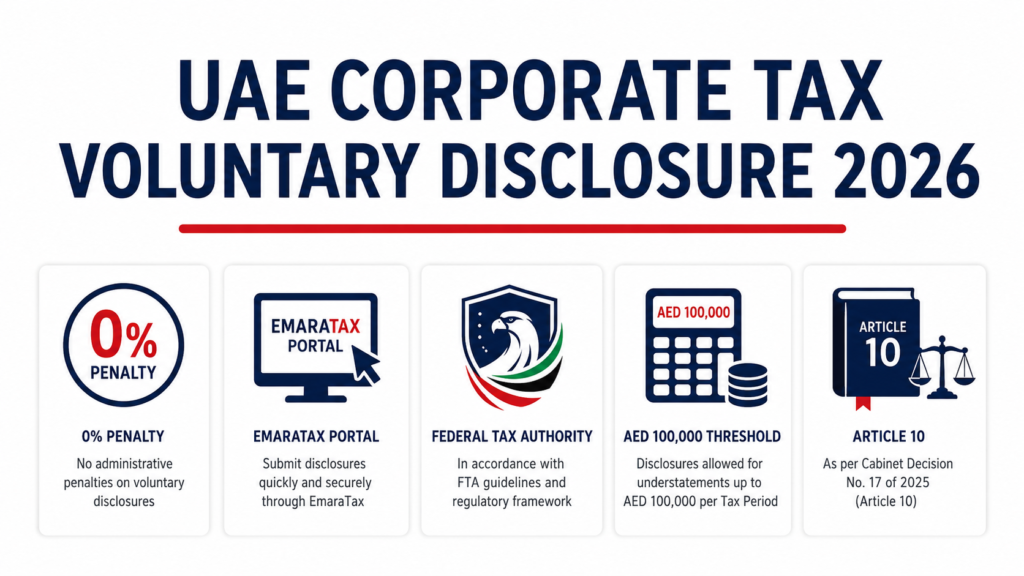
A UAE corporate tax voluntary disclosure is a formal statutory submission made via the EmaraTax portal to correct an error in a previously filed Corporate Tax return, a Tax Assessment, or a tax refund application. It is governed by Article 10 of Federal Decree-Law No. 28 of 2022 (the Tax Procedures Law). The FTA’s philosophy is to reward businesses that self-correct rather than wait to be caught. That philosophy is encoded directly into the penalty structure.
This is not an informal email to your tax agent. A voluntary disclosure legally binds your company to the corrected figures and requires the same rigour as the original return. At Qaspro Global, a UAE-based tax and accounting consultancy, we treat voluntary disclosures as high-stakes engagements because a poorly prepared disclosure can trigger an audit just as easily as an incorrect return.
When Must You Submit vs When May You Submit?
Article 10 of Federal Decree-Law No. 28 of 2022 draws a clear line between mandatory and permissive disclosures. Where your error falls on this spectrum determines whether you have a legal obligation or merely an option.
Situations Where You MUST Submit (Mandatory)
You are legally required to submit a voluntary disclosure in either of these cases:
- Underpayment: Your CT return was incorrect and you paid less tax than was actually owed.
- Overstated refund: A tax refund application you submitted claimed more than you were legally entitled to receive.
Situations Where You MAY Submit (Permissive)
- Overpayment: Your return resulted in you paying more CT than you legally owed.
- Understated refund: Your refund application claimed less than you were actually entitled to.
Errors With No Tax Difference
Even if the error caused no tax difference, you still must submit a voluntary disclosure under Article 10, Clause 5 of Federal Decree-Law No. 28 of 2022. The FTA requires data accuracy for compliance risk profiling.
Step-by-Step EmaraTax Process
Pre-Submission Checklist
- Identify the root cause of the error
- Recalculate the correct taxable income and tax liability
- Determine the exact tax difference
- Prepare revised ledgers, invoices, or depreciation schedules
- Draft the narrative explanation before logging in
EmaraTax Submission Steps
- Step 1: Log into EmaraTax with company credentials.
- Step 2: Navigate to your Corporate Tax dashboard and locate the specific return period.
- Step 3: Select the Voluntary Disclosure option for that return.
- Step 4: Input original figures, corrected figures, and the variance.
- Step 5: Provide a clear, factual explanation of how the error occurred.
- Step 6: Upload all supporting documents.
- Step 7: Review, submit, and pay the principal tax amount immediately.
If your CT return has a filing deadline of 30 September 2026, note that the voluntary disclosure window runs separately. The VD can be submitted at any point within 5 years of the tax period end, but every month you delay costs 1% in accruing penalties.
Penalty Comparison: The Three Scenarios
The penalty regime is governed by Cabinet Decision No. 75 of 2023.
| Scenario | Fixed Penalty | Monthly Accrual | Legal Basis |
|---|---|---|---|
| VD submitted proactively (before FTA audit notice) | None (0%) | 1% per month on the tax difference, from the day after CT return due date until VD submission date | Item 10, Cabinet Decision 75/2023 |
| VD submitted after FTA audit notice | 15% of tax difference | 1% per month on the tax difference | Item 11(a), Cabinet Decision 75/2023 |
| No VD submitted — FTA discovers the error | 15% of tax difference | 1% per month on the tax difference until date of FTA tax assessment | Item 11(b), Cabinet Decision 75/2023 |
Real Calculation: AED 100,000 Underpayment, Discovered 8 Months Late
If you file a proactive VD immediately:
- Fixed penalty: AED 0
- Monthly accrual: 8 months x 1% x AED 100,000 = AED 8,000
- Total penalty: AED 8,000
If the FTA discovers the error during an audit (no VD filed):
- Fixed penalty: 15% x AED 100,000 = AED 15,000
- Monthly accrual: 8% x AED 100,000 = AED 8,000
- Total penalty: AED 23,000
The proactive VD saves you AED 15,000. Compare this with the VAT voluntary disclosure process, which operates on similar principles.
What Triggers an FTA Audit?
Understanding the 7 CT red flags that trigger FTA audits is directly relevant to the voluntary disclosure decision. If you receive an FTA audit notice, the proactive VD window has already closed for that specific issue.
This Corporate Tax guide supports the main Voluntary Disclosure UAE pillar page, which explains VAT, CT, reconsideration and penalty routes together.
Frequently Asked Questions
What is the legal deadline for submitting a UAE corporate tax voluntary disclosure 2026?
You have 5 years from the end of the relevant tax period (Article 10, Federal Decree-Law No. 28 of 2022). The 1% monthly penalty accrues throughout this entire window, so early submission minimises the total cost.
Can I submit a VD after the FTA has notified me of an upcoming audit?
Yes, but the 15% fixed penalty applies under Item 11(a) of Cabinet Decision 75/2023. If the FTA has already issued a Tax Assessment for the specific error, you must use the formal objection process instead.
Do I still need to file a VD if the error caused no tax difference?
Yes. Article 10, Clause 5 requires you to correct any error even if there is no difference in the amount of Due Tax.
How is the 1% monthly penalty calculated?
It accrues on the tax difference from the day after your CT return due date until the date you submit the VD via EmaraTax. If the tax difference is zero, the 1% penalty is zero.
Will filing a VD automatically trigger a full audit?
Not automatically. A clear narrative, sound reasoning, and prompt payment typically results in the file being closed. Professional preparation is the most effective risk mitigation.
What if I made a mistake on the voluntary disclosure itself?
You can submit a second voluntary disclosure to correct the first. The monthly 1% penalty continues from the original CT return due date, not the date of the first disclosure.
Do I need to pay the principal tax at the time of filing?
Yes. Pay the principal amount immediately when you submit via EmaraTax. The penalties may be billed via a separate administrative notice.
Can I recover overpaid corporate tax through a voluntary disclosure?
Yes. A permissive VD under Article 10, Clause 3 allows you to recover excess CT paid, either as a refund to your bank account or a credit against future liabilities.
Need Expert Help With Your CT Voluntary Disclosure?
The UAE corporate tax voluntary disclosure 2026 process is a legal safeguard for businesses that made an honest mistake. The entire difference between a manageable 1% monthly charge and a devastating 15% fixed penalty rests on acting before the FTA contacts you. Contact Qaspro Global today for a confidential consultation.
For businesses closing operations, read our full guide to company liquidation in UAE 2026 with tax clearance and FTA deregistration steps before finalising tax records or licence cancellation.
Related Reading
- UAE Corporate Tax Penalties 2026: Every FTA Fine and How to Avoid Them
- Got an FTA Audit Notice? The AED 20,000 Mistake Most UAE Businesses Make Next
- UAE Corporate Tax Return 2026: 9 Documents You Need to File

Founder & CEO, Qaspro Global — UAE tax expert with 16+ years of experience in VAT, corporate tax and FTA audit support.