
What Is the UAE Foreign Tax Credit Under Article 47 For businesses calculating deductible amounts, the UAE corporate tax interest deduction cap (GILDR) may also affect total deductible expenditure.?
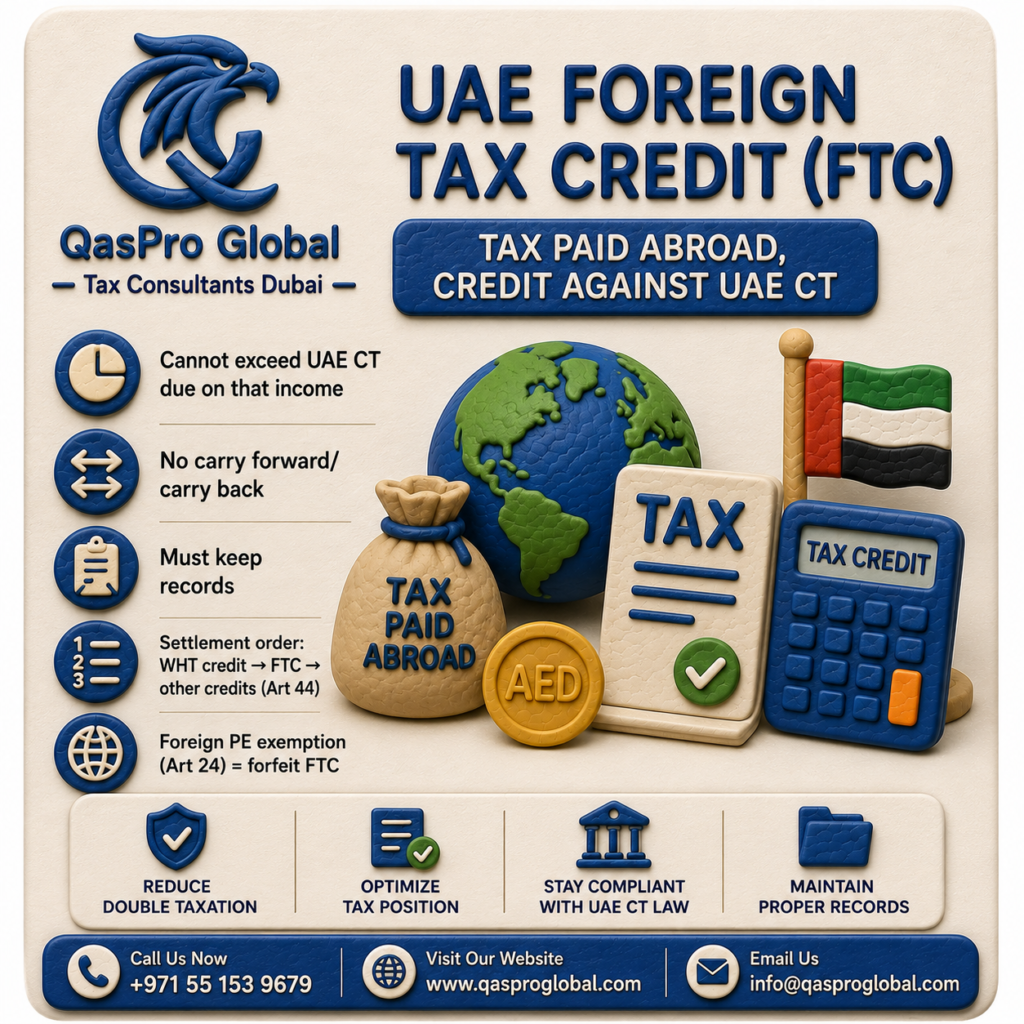
Quick Answer: The UAE foreign tax credit (FTC) under Article 47 of Federal Decree-Law No. 47 of 2022 allows UAE businesses to offset income taxes paid in a foreign country against their UAE corporate tax liability. The credit is capped at the UAE corporate tax due on that specific foreign income, currently 9%. Unused credits cannot be carried forward or back to other tax periods.
If your UAE company earns income abroad and a foreign government taxes that income, the UAE does not force you to pay tax twice. Article 47 of Federal Decree-Law No. 47 of 2022 provides a direct credit mechanism that reduces your UAE corporate tax bill by the amount of foreign tax already paid, subject to a cap.
Despite this relief being available since the UAE corporate tax regime launched on 1 June 2023, most UAE businesses with foreign-source income either do not know the credit exists or calculate it incorrectly. In this guide, Qaspro Global breaks down exactly how the foreign tax credit works, when it applies, and how to calculate it with real AED examples for the 2026 filing season.
How Does the Foreign Tax Credit Work in UAE Corporate Tax?
The foreign tax credit is a direct reduction of your UAE corporate tax payable. It is not a deduction from taxable income. This distinction matters because a credit reduces your tax bill dirham-for-dirham, while a deduction only reduces the income on which tax is calculated. For the full depreciation framework, see our UAE corporate tax depreciation guide.
Under Article 47 of Federal Decree-Law No. 47 of 2022, the mechanism works as follows:
- Clause 1: Corporate Tax due under Article 3 can be reduced by the amount of Foreign Tax Credit for the relevant Tax Period
- Clause 2: The Foreign Tax Credit cannot exceed the amount of Corporate Tax due on the relevant income
- Clause 3: Any unutilised Foreign Tax Credit cannot be carried forward or carried back
- Clause 4: The Taxable Person must maintain all necessary records for claiming a Foreign Tax Credit
- UAE CT Interest Deduction Cap 2026: The AED 12M Rule
The definition in the law is precise: a Foreign Tax Credit means “tax paid under the laws of a foreign jurisdiction on income or profits that may be deducted from the Corporate Tax due.” Only income-based taxes qualify. VAT, GST, sales tax, customs duties, and property taxes paid abroad do not count.
Which Taxes Qualify for the UAE Foreign Tax Credit?
Only foreign income taxes or profit taxes qualify for the Article 47 credit. The tax must have been actually paid (not just assessed or accrued) in the foreign jurisdiction during the relevant UAE tax period.
| Qualifies for FTC | Does NOT Qualify |
|---|---|
| Foreign corporate income tax | Foreign VAT or GST |
| Foreign withholding tax on dividends | Foreign customs duties |
| Foreign withholding tax on royalties | Foreign property or real estate tax |
| Foreign withholding tax on service fees | Foreign social security contributions |
| Foreign branch profits tax | Foreign stamp duty |
| Foreign capital gains tax (income-based) | Foreign excise or sales tax |
If a foreign country imposes a 15% withholding tax on consulting fees your UAE company earns there, that 15% qualifies. If a foreign country charges your UAE company 20% VAT on a purchase, that does not qualify.
How to Calculate the Foreign Tax Credit: Step-by-Step with AED Example
The calculation follows a per-country limitation approach. You cannot pool all foreign taxes together. Each country’s credit is calculated separately and capped at the UAE tax rate on that country’s income.
Step 1: Identify the Foreign-Source Income
Determine the gross income earned in each foreign jurisdiction that has been included in your UAE taxable income.
Step 2: Calculate UAE Corporate Tax on That Income
Apply the 9% UAE corporate tax rate to the foreign-source income. This gives you the maximum FTC available for that jurisdiction.
Step 3: Compare Foreign Tax Paid vs UAE Tax on That Income
The FTC is the lower of: (a) actual foreign tax paid, or (b) UAE corporate tax due on that income.
Step 4: Apply the Credit
Reduce your UAE corporate tax payable by the FTC amount.
Worked Example: AED Calculation
A Dubai mainland company (Company A) has the following income for the 2025 tax period:
| Income Source | Amount (AED) | Foreign Tax Paid |
|---|---|---|
| UAE trading income | 2,000,000 | AED 0 |
| India consulting fees (15% WHT deducted at source) | 500,000 | AED 75,000 |
| Germany branch profit (30% German CIT) | 300,000 | AED 90,000 |
| Total taxable income | 2,800,000 | AED 165,000 |
UAE corporate tax calculation:
- Taxable income: AED 2,800,000
- Less exempt threshold: AED 375,000
- Taxable at 9%: AED 2,425,000
- UAE CT due (before credits): AED 218,250
FTC calculation (per country):
| Country | Foreign Tax Paid | UAE CT on That Income (9%) | FTC Allowed (Lower) | Excess (Lost) |
|---|---|---|---|---|
| India | AED 75,000 | AED 45,000 | AED 45,000 | AED 30,000 |
| Germany | AED 90,000 | AED 27,000 | AED 27,000 | AED 63,000 |
| Total | AED 165,000 | AED 72,000 | AED 72,000 | AED 93,000 |
Final UAE CT payable:
- UAE CT due: AED 218,250
- Less FTC: AED 72,000
- CT payable: AED 146,250
Critical point: Company A paid AED 165,000 in foreign taxes but can only credit AED 72,000 against UAE CT. The remaining AED 93,000 is permanently lost. It cannot be carried forward to the next year, carried back to a prior year, or claimed as a deduction. This is why businesses with operations in high-tax countries (India 25%, Germany 30%, UK 25%) must plan their structures carefully.
The Settlement Sequence: Article 44 Credit Priority
Article 44 of Federal Decree-Law No. 47 of 2022, as amended by Federal Decree-Law No. 28 of 2025, prescribes a strict order for settling your UAE corporate tax liability. You cannot choose which credit to apply first.
| Priority | Credit Type | Legal Basis |
|---|---|---|
| 1st | Withholding Tax Credit (Article 46) | WHT deducted from UAE-source income |
| 2nd | Foreign Tax Credit (Article 47) | Income tax paid abroad |
| 3rd | Other credits or relief (Cabinet decision) | Future incentive credits |
| 4th | Cash payment (Article 48) | Remaining balance due to FTA |
Federal Decree-Law No. 28 of 2025 clarified this settlement hierarchy and introduced a formal refund mechanism under Article 49 for excess withholding tax credits. However, the FTC itself still cannot generate a refund. If your FTC exceeds your remaining CT liability after withholding tax credits, the excess is lost.
Foreign PE Exemption vs Foreign Tax Credit: Choose One
Article 24 of Federal Decree-Law No. 47 of 2022 gives UAE resident companies an alternative: instead of claiming FTC on foreign branch income, you can elect to completely exclude the income (and losses) of your Foreign Permanent Establishment from UAE taxable income.
This is a critical either-or decision:
| Factor | Foreign Tax Credit (Article 47) | Foreign PE Exemption (Article 24) |
|---|---|---|
| Foreign income included in UAE taxable income? | Yes | No |
| Foreign losses offset UAE income? | Yes | No |
| Foreign tax paid reduces UAE CT? | Yes (capped at 9%) | Not applicable |
| Risk of double taxation? | Yes, if foreign rate exceeds 9% | None |
| Best when foreign tax rate is… | Below 9% | Above 9% |
When to choose FTC (Article 47): If the foreign country’s tax rate is below 9%, claiming FTC gives you a full credit with no waste. For example, a branch in a 5% tax country means you claim the full 5% as FTC and only pay the remaining 4% to the UAE.
When to choose PE Exemption (Article 24): If the foreign country’s tax rate exceeds 9%, the PE exemption is usually better. You exclude the income entirely, and the higher foreign tax stays in the foreign country without creating a wasted excess FTC in the UAE.
Warning: Article 24, Clause 2(c) is explicit: if you elect the Foreign PE Exemption, you forfeit “any Foreign Tax Credit that would have been available under Article 47.” You also forfeit the ability to use foreign PE losses to offset UAE income. The election applies to ALL your foreign PEs, not just one. Consult a tax advisor before making this irrevocable election.
Foreign Tax Credit in Partnerships and Family Foundations
Article 16, Clause 6 of Federal Decree-Law No. 47 of 2022 addresses foreign tax credits in the partnership context. When an Unincorporated Partnership incurs foreign tax, that tax is not claimed at the partnership level. Instead, it is allocated to each partner as a Foreign Tax Credit in proportion to their distributive share in the partnership.
For example, if a UAE partnership earns AED 1,000,000 from a foreign project and the foreign country deducts AED 100,000 in withholding tax, and Partner A holds 60% while Partner B holds 40%, then:
- Partner A receives FTC of AED 60,000 (60% of AED 100,000)
- Partner B receives FTC of AED 40,000 (40% of AED 100,000)
Each partner then applies their allocated FTC against their own UAE corporate tax liability, subject to the Article 47 cap.
Double Tax Treaties: How 137+ DTTs Interact with Article 47
The UAE has signed over 137 Double Taxation Avoidance Agreements (DTTs) with countries including India, the UK, Germany, France, China, Pakistan, Egypt, and most major trading partners. These treaties typically reduce or eliminate withholding tax rates on cross-border payments.
The interaction between DTTs and Article 47 matters in two ways:
- Reduced WHT rates under DTTs lower the FTC amount: If India’s domestic WHT on consulting fees is 15% but the UAE-India DTT reduces it to 10%, you can only claim FTC on the 10% treaty rate. If you fail to apply the treaty and pay 15%, only the 10% treaty-rate amount qualifies for UAE FTC.
- DTTs guarantee credit relief: Most UAE DTTs include an article requiring both countries to provide credit relief for taxes paid in the other country. Article 47 is the UAE’s domestic implementation of this treaty obligation.
Qaspro Global advises businesses to always claim treaty benefits at source rather than overpaying foreign tax and attempting to recover the excess through FTC, because the excess above the treaty rate may not qualify for credit under Article 47.
What Records Must You Keep for an FTC Claim?
Article 47, Clause 4 requires maintenance of “all necessary records” for claiming FTC. While the law does not specify an exhaustive list, the FTA’s Corporate Tax Guide on Taxation of Foreign Source Income (CTGFSI1) and general record-keeping requirements under the Tax Procedures Law suggest you should maintain:
- Foreign tax certificates or receipts proving the tax was actually paid
- Foreign tax returns filed in the other jurisdiction
- Withholding tax certificates from foreign payers
- Contracts or invoices supporting the nature of the foreign income
- Calculation workpapers showing FTC per country and the limitation applied
- Applicable DTT articles relied upon for reduced rates
- Exchange rate documentation for converting foreign tax to AED
Records must be kept for a minimum of 7 years from the end of the relevant tax period under the UAE Tax Procedures Law (Federal Decree-Law No. 28 of 2022, as amended).
Common Mistakes That Cost UAE Businesses Their FTC
Based on the first two UAE corporate tax filing cycles, these are the most frequent errors Qaspro Global sees with foreign tax credit claims:
- Claiming VAT/GST as FTC: Only income-based taxes qualify. Foreign VAT or GST is not an income tax and cannot be credited under Article 47.
- Not applying DTT rates: Paying full domestic withholding tax instead of the reduced treaty rate, then trying to credit the full amount. The FTA may only allow the treaty-rate credit.
- Pooling credits across countries: The FTC cap applies per country. An excess credit from a high-tax country cannot offset a shortfall from a low-tax country.
- Expecting carry-forward: Unlike the US, UK, or India, the UAE allows zero carry-forward or carry-back of unused FTC. Each tax period stands alone.
- Forgetting the settlement order: WHT credits (Article 46) must be applied first. If WHT credits already reduce your CT to zero, there is no CT left for the FTC to offset.
- Missing the election between Article 24 and Article 47: Choosing FTC when the Foreign PE Exemption would have saved more tax, or vice versa.
- Inadequate documentation: Filing FTC claims without foreign tax certificates. The FTA can deny the credit if records are missing.
When Does the Foreign Tax Credit NOT Apply?
Article 47 relief is not available in these situations:
- Exempt income under Article 23 (Participation Exemption): If foreign dividends or capital gains are already exempt under the participation exemption, there is no UAE CT due on that income, so no FTC is needed or available.
- Foreign PE Exemption elected (Article 24): If you exclude foreign PE income entirely, FTC on that income is forfeited.
- Qualifying Free Zone Person 0% income: QFZP qualifying income taxed at 0% has no UAE CT due against which to credit foreign tax.
- Tax paid on income not included in UAE taxable income: Foreign tax on income that falls outside the UAE CT base (e.g., income of a non-UAE PE of a non-resident) cannot generate an FTC.
- Small Business Relief: If a business elects SBR under Ministerial Decision No. 73 of 2023, taxable income is deemed zero. No CT due means no FTC available.
Practical Planning: How to Minimise Wasted Foreign Tax Credits
Because unused FTC is permanently lost under the UAE system, structuring matters. Here are strategies that Qaspro Global recommends:
- Use DTTs aggressively: Apply for reduced WHT certificates in every treaty country. The difference between 15% domestic WHT and 10% treaty WHT directly reduces your wasted FTC excess.
- Evaluate the Article 24 election for high-tax branches: If your foreign branch operates in a country with a corporate tax rate above 9%, the PE exemption almost always saves more than the FTC.
- Restructure through low-tax jurisdictions: Where commercially justified, routing certain transactions through countries with DTTs that provide lower WHT rates reduces foreign tax leakage.
- Time income recognition: If possible, accelerate or defer foreign income into a tax period where your UAE CT liability is high enough to absorb the FTC fully.
- Separate foreign-source income streams: Different types of income (dividends, royalties, service fees, branch profits) may face different foreign tax rates. Separating them allows you to apply the FTC cap optimally per country and per income type.
Frequently Asked Questions
Can I carry forward unused foreign tax credit to the next UAE tax period?
No. Article 47, Clause 3 of Federal Decree-Law No. 47 of 2022 explicitly states that any unutilised Foreign Tax Credit cannot be carried forward or carried back. Each tax period is standalone. If your foreign tax paid exceeds 9% of the foreign income, the excess is permanently lost.
Does the UAE foreign tax credit apply to VAT or GST paid abroad?
No. The FTC only applies to income-based taxes such as corporate income tax, branch profits tax, and withholding tax on income. Foreign VAT, GST, customs duties, property taxes, and stamp duties do not qualify under Article 47.
What is the maximum foreign tax credit I can claim in the UAE?
The maximum FTC per country is 9% of the foreign-source income from that country. Since the UAE corporate tax rate is 9%, you can never credit more than AED 9 for every AED 100 of foreign income, regardless of how much foreign tax you actually paid.
Can I claim FTC if I also elect the Foreign PE Exemption under Article 24?
No. Article 24, Clause 2(c) explicitly states that if you elect the Foreign PE Exemption, you forfeit any Foreign Tax Credit that would have been available under Article 47 for that PE income. The two reliefs are mutually exclusive for foreign PE income.
How does the FTC interact with Double Tax Treaties?
DTTs often reduce the withholding tax rate applied by the source country. Your FTC claim should be based on the treaty-reduced rate, not the domestic rate. If the treaty reduces WHT from 15% to 10%, only the 10% qualifies for credit. Most UAE DTTs also include an article obligating the UAE to provide credit relief, which Article 47 fulfils domestically.
Is the foreign tax credit calculated per country or in aggregate?
The FTC cap applies per country. You cannot aggregate foreign taxes from multiple countries. An excess FTC from a high-tax jurisdiction (e.g., Germany at 30%) cannot be used to offset the shortfall from a low-tax jurisdiction (e.g., Hong Kong at 8.25%).
What happens to FTC if I elect Small Business Relief?
If you elect Small Business Relief under Ministerial Decision No. 73 of 2023, your taxable income is deemed zero and no corporate tax is due. Since FTC is a credit against tax due, there is no tax to credit against, and the FTC for that period is lost.
How do I claim the foreign tax credit on my UAE CT return?
You report the FTC claim in your UAE corporate tax return filed on EmaraTax. Include the foreign income in your total taxable income, calculate UAE CT on the total, then apply the FTC in the settlement section following the Article 44 priority order (WHT credit first, then FTC). Attach supporting documentation including foreign tax certificates and calculation workpapers.
Can a Free Zone company claim foreign tax credit?
A Qualifying Free Zone Person (QFZP) paying 0% on qualifying income has no CT due against which to credit foreign tax. However, if a QFZP earns non-qualifying income taxed at 9%, it can claim FTC on that non-qualifying foreign-source income, subject to the standard Article 47 limitations.
What if the foreign country refunds part of the tax after I claimed FTC in the UAE?
If a foreign jurisdiction refunds tax that you already claimed as FTC in the UAE, you must adjust your UAE CT return for the relevant period. Failure to disclose a foreign tax refund could result in an incorrect return and potential FTA penalties under the administrative penalties framework (Cabinet Decision No. 75 of 2023).
Need Expert Help?
Foreign tax credit calculations require detailed knowledge of Article 47, the settlement hierarchy, DTT provisions, and the Foreign PE Exemption trade-off. A single miscalculation can cost your business thousands in permanently lost credits. Qaspro Global’s corporate tax team helps UAE businesses structure their foreign income, apply the correct DTT rates, and maximise their FTC claims on EmaraTax. Contact us today for a free consultation.
Related Reading
- UAE Corporate Tax Bad Debt 2026: The Write-Off Rule 90% of Businesses Get Wrong
- The Article 23 Rule That Makes UAE Dividends Tax-Free 2026
- Does Your Foreign Company Owe UAE Corporate Tax in 2026?
- UAE Withholding Tax 2026: The Article 45 Rule Most Businesses Never Check
- UAE Corporate Tax Depreciation 2026: The 4% Rule Most Property Owners Miss
- UAE R&D Tax Credit 2026: 50% Back and Most Businesses Miss It
If your Corporate Tax return contains an error, submitting a UAE corporate tax voluntary disclosure 2026 immediately is the most cost-effective way to avoid the 15% fixed FTA penalty.
Related Reading
- UAE 15% Minimum Tax 2026: Who Pays the New DMTT
- Corporate Tax Deregistration UAE 2026: The 3-Month Rule and AED 10,000 Penalty
- Got an FTA Audit Notice? The AED 20,000 Mistake Most UAE Businesses Make Next
- UAE Corporate Tax Penalties 2026: Every FTA Fine Explained
- How to File UAE Corporate Tax Return on EmaraTax 2026
- Company Liquidation UAE 2026: How to Close Your Business
- UAE Tax Penalties Change on 14 April 2026
- UAE Voluntary Disclosure 2026: Fix Tax Errors Before FTA Finds Them
- The 40-Day FTA Reconsideration Window UAE 2026
- How to Pay UAE Corporate Tax 2026: GIBAN Steps
- UAE CT Filing September 30: File Now or Pay AED 500 Per Month
- UAE Small Business Relief Expires December 31

Founder & CEO, Qaspro Global — UAE tax expert with 16+ years of experience in VAT, corporate tax and FTA audit support.