When Must a UAE Business Register for VAT in 2026?
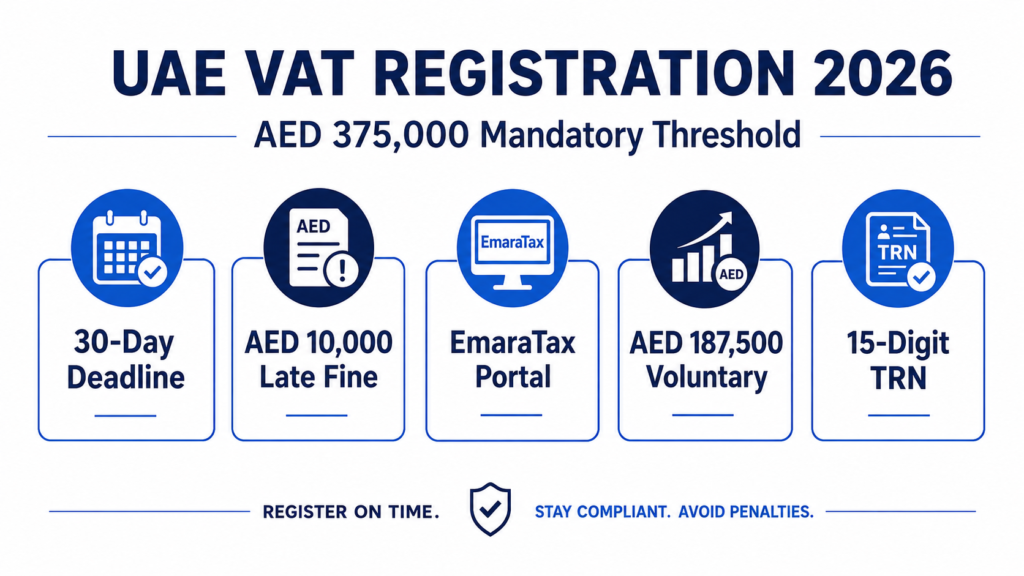
UAE VAT registration becomes mandatory the moment your taxable supplies exceed AED 375,000 over the previous 12 months, or when you expect to cross that figure within the next 30 days. From that point you have only 30 days to submit your application on the Federal Tax Authority’s EmaraTax portal, or you face a fixed late registration penalty of AED 10,000 under Cabinet Decision No. 40 of 2017. VAT itself is charged at the standard 5% rate set by Federal Decree-Law No. 8 of 2017. In this guide, Qaspro Global breaks down every threshold, document, and step so you register on time and receive your Tax Registration Number (TRN) without delay.
Last updated: 28 September 2026. This guide has been reviewed against the FTA’s 2026 administrative penalty reform (Cabinet Decision No. 129 of 2025, effective 14 April 2026) to confirm every figure below, including the AED 10,000 late registration penalty, is still current.
What Is VAT Registration in the UAE?
VAT registration is the process of formally enrolling your business with the Federal Tax Authority so it can charge, collect, and remit 5% Value Added Tax on taxable supplies. Once registered, the FTA issues a 15-digit Tax Registration Number (TRN) that must appear on every tax invoice. Registration is completed entirely online through the EmaraTax portal, using UAE Pass or Emirates ID credentials. There is no paper form and no in-person appointment.
Qaspro Global, a UAE-based tax and accounting consultancy, registers dozens of businesses each quarter and the single most common mistake is treating the AED 375,000 line as an annual calendar figure. It is not. It is a rolling 12-month test, and it can be triggered mid-year by one large contract.
What Are the VAT Registration Thresholds for 2026?
There are two thresholds in the UAE. The mandatory threshold of AED 375,000 forces you to register. The voluntary threshold of AED 187,500 lets you register early to reclaim input VAT on your costs. Both are measured on taxable supplies plus taxable imports, not on profit.
| Threshold | Amount (AED) | What It Means |
|---|---|---|
| Mandatory registration | 375,000 | You must register within 30 days of crossing it |
| Voluntary registration | 187,500 | You may register to recover input VAT on expenses |
| Below 187,500 | Under 187,500 | You cannot register for VAT |
The threshold counts your standard-rated supplies, zero-rated supplies, and reverse-charge imports. It does not count exempt supplies such as certain financial services or bare residential property rent. If most of your income is zero-rated (for example, exports), you can apply for an exception from registration and avoid filing returns entirely.
What Happens If You Register Late?
Late VAT registration carries a fixed AED 10,000 administrative penalty under the FTA’s penalty regime (Cabinet Decision No. 40 of 2017, as amended). The penalty applies from the day after the 30-day deadline passes, regardless of whether you made any sales in the meantime. On top of the fine, the FTA can assess the VAT you should have collected from your registration date, meaning you may owe 5% out of your own pocket on invoices where you never charged the customer.
If you have already missed the window, do not wait. Qaspro Global advises businesses to register immediately and, where errors have already occurred, to file a VAT voluntary disclosure before the FTA opens an audit, which reduces exposure to further penalties.
Does the 2026 Penalty Reform Change the Late Registration Fine?
No, the AED 10,000 late VAT registration penalty is unchanged. On 11 November 2025 the UAE Cabinet issued Cabinet Decision No. 129 of 2025, taking effect 14 April 2026, which replaces Cabinet Decision No. 108 of 2021 and overhauls how the FTA calculates late-payment and voluntary-disclosure penalties across VAT, excise, and corporate tax. The old model charged 2% of unpaid tax the day after the due date plus 4% a month later, a compounding structure that could reach 300% of the unpaid tax. From 14 April 2026 this is replaced by a flat 14% annual rate, calculated monthly (about 1.17% per month). Late VAT return filing keeps the same AED 1,000 fixed penalty, doubling to AED 2,000 on a repeat within 24 months. None of this changes the fixed AED 10,000 penalty for registering late in the first place, which still sits under Cabinet Decision No. 40 of 2017 as described above.
What it does mean for a newly registered business: once you hold a TRN, the cost of paying VAT late has dropped sharply from 14 April 2026 onward, so a late payment is no longer the runaway compounding risk it used to be, though it is still real money and still avoidable. For the complete penalty table across every UAE tax type, see our guide to UAE Tax Penalties 2026 under Cabinet Decision 129 of 2025.
How to Register for VAT in the UAE: Step by Step
The full EmaraTax registration takes most businesses 30 to 60 minutes to complete, and the FTA typically approves it within 5 to 20 business days. Follow these steps in order.
Step 1: Create an EmaraTax account
Go to the FTA EmaraTax portal and sign up using UAE Pass or your email. The authorised signatory should create the account, because their name is tied to the application.
Step 2: Add a Taxable Person profile
Inside the account, create a new Taxable Person and link your trade licence, ownership structure, and signatory details.
Step 3: Start the VAT registration application
Select VAT, then Register. Enter your business activities, turnover figures for the past 12 months, and your expected turnover.
Step 4: Upload supporting documents
Attach the trade licence, Emirates ID and passport copies, proof of turnover, and bank details (see the checklist below).
Step 5: Submit and receive your TRN
Review, submit, and wait for FTA approval. Once approved, your 15-digit TRN is issued and you must start charging 5% VAT from your effective registration date.
What Documents Do You Need to Register for VAT?
Missing documents are the number one cause of rejected or delayed applications. Prepare the following before you start:
- Valid trade licence (plus any branch licences)
- Certificate of incorporation or Memorandum of Association
- Emirates ID and passport copies of the owners and authorised signatory
- Power of attorney for the signatory if their name is not on the MOA
- Proof of turnover: audited financials, bank statements, or signed sales invoices for the last 12 months
- Bank account confirmation letter showing the company name and IBAN
- Company contact details and physical address
Mandatory vs Voluntary VAT Registration: Which Is Right for You?
If your taxable supplies are under AED 375,000 but above AED 187,500, voluntary registration can put money back in your pocket. Registering lets you reclaim the 5% input VAT you pay on rent, software, equipment, and supplies. The trade-off is quarterly return filing and the compliance work that comes with it.
| Factor | Mandatory (over AED 375,000) | Voluntary (AED 187,500 to 375,000) |
|---|---|---|
| Required by law | Yes | No, optional |
| Charge 5% VAT to customers | Yes | Yes |
| Reclaim input VAT | Yes | Yes |
| Best for | All businesses over the line | Startups with high VAT-bearing costs |
How Long Does VAT Registration Take?
The FTA usually approves a complete VAT registration application within 5 to 20 business days. Applications with missing documents, unclear turnover evidence, or mismatched signatory details take longer because the FTA sends the file back for clarification. Submitting a clean, complete application the first time is the fastest route to your TRN.
Can You Register a VAT Tax Group?
Yes. Two or more related companies under common control in the UAE can register as a single VAT tax group with one shared TRN. Supplies between group members are ignored for VAT, which improves cash flow and cuts filing to one consolidated return. This is different from a corporate tax group. If you are also planning your corporate tax structure, read our guide on the UAE corporate tax group election.
What About VAT Designated Zones? Do They Change Your Registration?
No. Companies in VAT Designated Zones must still register for VAT under the same AED 375,000 mandatory threshold as everyone else. A Designated Zone is a free zone specifically listed in Cabinet Decision No. 59 of 2017 (as amended) that is treated as being outside the UAE for VAT purposes, but only for the movement of goods. There are around 20+ Designated Zones across the seven emirates, including Jebel Ali Free Zone, Dubai Airport Free Zone (DAFZA), KIZAD (Khalifa Industrial Zone), Sharjah Airport International Free Zone (SAIF Zone), Hamriyah Free Zone, Ajman Free Zone, RAK Free Trade Zone, and Fujairah Free Zone. The full official list is on the FTA website.
Being in a Designated Zone changes how VAT applies to your transactions, not whether you register. The key rules under Article 51 of the Executive Regulations (Cabinet Decision No. 52 of 2017, as amended) are:
| Transaction | VAT Treatment |
|---|---|
| Goods moved between two Designated Zones (unaltered, under customs control) | Outside the scope of UAE VAT |
| Goods sold within a Designated Zone for resale or production (not consumed) | Outside the scope of UAE VAT |
| Goods brought from a Designated Zone into mainland UAE | Treated as an import, 5% VAT due |
| Goods consumed inside the Designated Zone | 5% VAT applies |
| All services supplied in a Designated Zone | Place of supply is inside the UAE, normal 5% VAT rules |
| Water and all forms of energy supplied in a Designated Zone | Treated as supplied inside the UAE, taxable |
Two traps catch Designated Zone companies every year. First, services are never “offshore”: consultancy, logistics services, rent of serviced offices, and management fees supplied in a Designated Zone follow normal UAE VAT rules, so a services business in Jebel Ali is treated exactly like a mainland one. Second, not every free zone is a Designated Zone: DMCC, Dubai Internet City, Dubai Media City, and most other free zones are not on the Cabinet list, so their supplies follow normal onshore VAT rules in full. If you trade goods through a Designated Zone, keeping customs documentation and proof of where the goods ended up is what protects your out-of-scope treatment in an FTA audit. Import-heavy structures should also review the reverse charge mechanism.
After Registration: What Are Your VAT Obligations?
Once registered, you must issue compliant tax invoices, file VAT returns (usually quarterly) through EmaraTax, and pay any VAT due by the deadline. Missing a return deadline triggers an AED 1,000 penalty that doubles to AED 2,000 on repeat within 24 months, as covered in our UAE VAT late filing guide. Import-heavy businesses should also understand the reverse charge mechanism and, if they have mixed income, how input tax apportionment works.
After VAT registration, filing errors can require correction. Use the Voluntary Disclosure UAE guide if an old return is wrong.
What Counts Toward the AED 375,000 Threshold?
The threshold is not just your sales revenue. It includes:
- Standard-rated supplies taxed at 5%
- Zero-rated supplies such as exports, international transport and the first supply of residential property
- Imports of goods and services
It does not include exempt supplies (for example residential rent after the first supply, bare land, local passenger transport and certain financial services), or supplies made outside the UAE with no connection to the UAE tax system.
Example: a business that imports goods worth AED 200,000 and makes taxable sales of AED 200,000 has a total of AED 400,000, which is above the mandatory threshold, even though its sales alone are not.
Who Does NOT Need to Register for VAT?
You are not required to register, and in fact cannot register, if:
- Your taxable supplies and taxable expenses are both below AED 187,500, or
- Your business makes only exempt supplies, such as a company that only rents out residential property.
If you make a mix of taxable and exempt supplies, you cannot recover all of the input VAT on shared overheads. The recoverable portion is worked out using the input tax apportionment formula.
Quick Decision Table: Do You Need to Register?
| Your Situation | Action Required |
|---|---|
| Taxable supplies above AED 375,000 | Must register within 30 days |
| Taxable supplies or expenses between AED 187,500 and AED 375,000 | May register voluntarily |
| Taxable supplies and expenses below AED 187,500 | Cannot register |
| Only exempt supplies (any amount) | Cannot register |
| Non-resident making taxable supplies in the UAE | Must register (no threshold) |
Detailed EmaraTax Walkthrough: What Each Screen Asks For
The five steps above are the overview. Inside the EmaraTax VAT registration form, you will work through these screens:
- Log in at eservices.tax.gov.ae with your email account or UAE Pass (UAE Pass is faster for UAE residents).
- Open the form: go to e-Services, then VAT Registration.
- Entity details: legal name, trade name, trade licence number, date of incorporation, legal form and registered address. Include every branch licence number if you have branches.
- Owners and authorised signatory: Emirates ID, passport details and contact information for each owner and for the person authorised to sign.
- Business activities: select your activities from the FTA list and state whether you import goods and whether you make exempt or zero-rated supplies. Be precise, because this shapes your VAT obligations.
- Financial information: the value of your taxable supplies for the past 12 months and expected supplies for the next 30 days. This decides whether the registration is mandatory or voluntary.
- Bank details: the company IBAN and bank name, used for any VAT refunds. The account must be in the company’s name, not a personal account.
- Documents: upload the documents listed in the section above. Tax groups also need details of the related parties and a board resolution appointing the representative member; branches need each branch licence.
- Review and submit: check every section first. Errors or inconsistencies make the FTA return the application for correction, which adds weeks.
- Receive your TRN: once approved, your Tax Registration Certificate with your TRN appears in your EmaraTax dashboard. If the FTA needs more information, it asks through the portal.
VAT and Corporate Tax: How They Connect
VAT and corporate tax are separate registrations and separate returns, but they affect each other:
- Revenue trail: the FTA can compare the revenue in your VAT returns with your corporate tax return. Differences between the two can trigger questions or an audit.
- Input VAT: VAT you recover through your VAT return should not also be claimed as a cost in your corporate tax return.
- Record keeping: VAT records are generally kept for 5 years and corporate tax records for 7 years. Keeping everything for the longer period avoids gaps.
- E-invoicing: the UAE’s phased e-invoicing rollout will link VAT invoices to the FTA’s systems, so VAT-registered businesses should prepare their accounting systems early.
For every filing date in one place, see our UAE tax deadlines 2026 guide.
Frequently Asked Questions
What is the VAT registration threshold in the UAE for 2026?
The mandatory VAT registration threshold is AED 375,000 in taxable supplies over any rolling 12-month period. The voluntary threshold is AED 187,500. Both are based on taxable turnover, not profit.
How much is the penalty for late VAT registration?
Late VAT registration carries a fixed AED 10,000 penalty under Cabinet Decision No. 40 of 2017. The FTA can also assess the VAT you should have collected from your effective registration date. This figure is unchanged by the 2026 penalty reform (Cabinet Decision No. 129 of 2025), which affects late-payment and voluntary-disclosure penalties, not the late registration fine.
How long do I have to register for VAT after crossing the threshold?
You have 30 days from the date your taxable supplies exceed AED 375,000, or from when you expect to exceed it within the next 30 days, to submit your EmaraTax application.
Can I register for VAT voluntarily below AED 375,000?
Yes. If your taxable supplies or taxable expenses exceed AED 187,500, you can register voluntarily to reclaim input VAT on your business costs.
How long does FTA VAT registration take?
A complete application is usually approved within 5 to 20 business days. Missing documents or unclear turnover evidence extend this timeline.
What is a TRN?
A Tax Registration Number is the 15-digit identifier the FTA issues on approval. It must appear on every tax invoice you issue and on your VAT returns.
Do free zone companies need to register for VAT?
Yes. Free zone companies follow the same AED 375,000 mandatory threshold. Being in a designated zone affects how VAT applies to certain goods, but it does not exempt you from registration.
What is a VAT Designated Zone in the UAE?
A Designated Zone is a fenced free zone with customs controls that is listed in Cabinet Decision No. 59 of 2017 and treated as outside the UAE for VAT on qualifying goods movements only. Services supplied in a Designated Zone always follow normal UAE VAT rules, and Designated Zone companies must still register once they cross AED 375,000.
What documents are required for VAT registration?
You need a valid trade licence, MOA or incorporation certificate, Emirates ID and passport copies of owners and the signatory, proof of turnover, and a bank confirmation letter with your IBAN.
Can I be exempt from VAT registration?
If all or nearly all of your supplies are zero-rated, you can apply for an exception from registration through EmaraTax and avoid filing VAT returns, while still not charging VAT.
Did the 2026 penalty reform change the VAT registration penalty?
No. Cabinet Decision No. 129 of 2025, effective 14 April 2026, replaces the old compounding late-payment penalty with a flat 14% annual rate and updates voluntary-disclosure penalties. The fixed AED 10,000 late registration penalty under Cabinet Decision No. 40 of 2017 is unchanged.
Do freelancers need to register for VAT in the UAE?
Yes, if their taxable supplies exceed AED 375,000. Freelancers are treated the same as companies for VAT, whether they hold a mainland freelance permit or a free zone permit.
Is VAT registration free in the UAE?
Yes. The FTA does not charge a government fee to register for VAT through EmaraTax.
Can I register for VAT online?
Yes. All VAT registration is done online through the EmaraTax portal at eservices.tax.gov.ae, using email login or UAE Pass. There is no paper or in-person process.
Do I need to register separately for VAT and Corporate Tax?
Yes. They are separate registrations on EmaraTax. A VAT TRN does not cover corporate tax, and a corporate tax registration does not cover VAT. See our corporate tax registration guide.
Can I deregister from VAT if my revenue drops?
It depends on how far it drops. If your taxable supplies and taxable expenses fall below AED 187,500, or you stop making taxable supplies altogether, deregistration is mandatory and you must apply within 20 business days. If your supplies fall below AED 375,000 but stay above AED 187,500, deregistering is your choice. Either way you file a final return and settle any tax due first. See our VAT deregistration guide.
Setting up in the UAE and also need residence visas, Emirates ID or document clearing? Our sister company Yalah Dubai handles visas and PRO services — see their new guide on checking your UAE visa status online in 2 minutes.
Need Expert Help?
Qaspro Global’s team of VAT consultants can assess your turnover, confirm whether you have crossed the AED 375,000 line, prepare a complete EmaraTax application, and secure your TRN without delays or penalties. Contact us today for a free consultation.
Restaurants and cafes have their own VAT questions, such as menu pricing and service charges, covered in our restaurant and cafeteria licence guide.
Related Reading
- Restaurant and Cafeteria Licence in Dubai 2026: DET Activity, Dubai Municipality Food Permit, and the VAT and Corporate Tax Rules F&B Owners Miss
- VAT Return Filing Service Dubai 2026: Real Fees and the 28-Day Rule
- UAE VAT Late Filing 2026: AED 1,000 Fine on Day One
- VAT Voluntary Disclosure UAE 2026: Fix Errors Before the FTA Does
- UAE VAT Reverse Charge 2026: The Box 3 Mistake Importers Make
- UAE Tax Penalties 2026: Full List Under Cabinet Decision 129 of 2025
- UAE VAT Input Tax Apportionment 2026: Most Businesses Overpay
- UAE Tax Deadlines 2026: Every Date Your Business Must Know
- How Much Does a Tax Consultant Cost in Dubai 2026? Real Fees, No Guesswork
- UAE E-Invoicing 2026: Miss This and Pay AED 5,000 Every Month

Founder & CEO, Qaspro Global — UAE tax expert with 16+ years of experience in VAT, corporate tax and FTA audit support.